
Casting Vision

© apops - Fotolia.comProducers and directors are in a position to cast vision for their film, giving cast and crew the information needed for impromptu interviews or questions from unannounced bloggers. It only takes two to six minutes, depending on the depth of information given, to create a united front for the film’s promotion.

I was involved in a production that had numerous layers to the story. Each cast member had certain plotlines they liked more than others, which showed up in their interview segments. By the end of the interviews, the host of the talk show was confused and no longer able to promote the movie because she didn’t understand what it was about.

Simplicity in promotion is critical for sending messages through word of mouth. Any attempt at explaining all of the plotlines dilutes the message and weakens the film’s box office. It’s important that there is one simple vision cast that the production team can share.

The producer and director can prepare their vision casting talk using the following outline:

1. KEY ISSUE: All films address some form of a problem, burning issue or needed societal change. The beginning of the vision casting talk should include an attention-getting device and a clear statement of the key issue.

2. BACKSTORY: Listeners need to hear what brought about the key issue and the common answers of the day that were unsuccessful. This will not only allow the audience to understand the stakes involved, but it also sets up the film’s solution as something plausible and worth pursuing.

3. FILM’S SOLUTION: Present a tangible idea as a solution for the common problem using references to real resources. Use example scenes from the story to support the statements. This will help the listener understand the practical steps needed for success.

4. PAY-OFF: Make a clear and concise statement that gives a specific answer to the key issue. To make a greater impact, keep the comment simple and memorable.

5. CLOSE: Follow up with the prominent benefit that results from the change and encourage everyone to get the word out to reach fans, friends and family with the benefits.

By casting a specific vision for the film, the producer and director are able to focus the promotional and social media messages to drive the film’s box office. The repetition of the message throughout the project’s duration will ensure that the cast and crew embrace it and share it.
© 2013 by CJ Powers

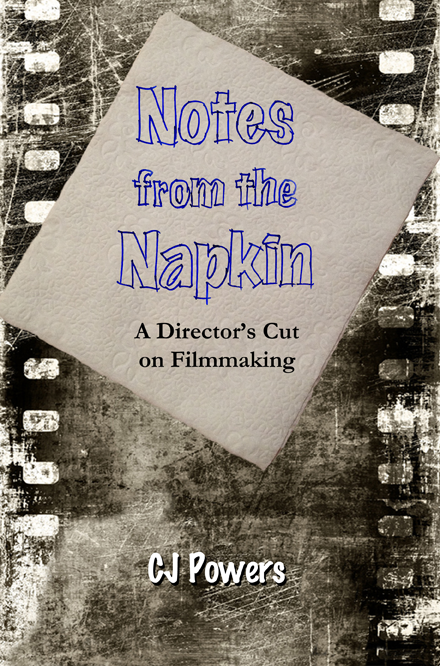
Notes from the Napkin

Notes from the Napkin by CJ PowersMy latest book, Notes from the Napkin: A Director’s Cut on Filmmaking is now available at Amazon.com and at my estore.

The book features lots of industry tips and tricks that I’ve picked up from conversations with filmmakers Ron Howard, Christopher Nolan, and Ken Burns to name a few. My conversations weren’t much longer than 2-5 minutes, but I gleaned valuable information that changed the way I wrote, directed and produced.

I’ve also added in great tips that I’ve learned from independent filmmakers. The helpful information was never taught in my college film or television classes. Nor have I come across many of the tips in industry books. It’s as if there is an entire set of knowledge only available to those who have been on set with the pros, which I’m making available to independent filmmakers through this book.

The book is broken into three sections: Notes from a Screenwriter, Notes from a Director, and Notes from a Producer. However, there are plenty of notes for actors salted throughout all sections of the book.

I’ve also added in some tips that I’ve learned from the school of hard knocks when working on projects released to ABC, CBS, PBS, WGN, and ABC Family. A few of my tips have come from international workshops that I’ve conducted in Europe and Asia Pacific. And, from my experience successfully releasing films in eight countries.

If you’re looking for tips that actually work, I believe this book is for you. My easy to read, informal style will help you unpack complex issues, adding new technics to your filmmaking tool belt.

Whether you’re interested in reading the book or not, I’d appreciate you passing on the information to other filmmakers who might want to learn a few golden nuggets.

Narratives Change Behavior

© Marek - Fotolia.comDaniel J. Siegel wrote a fascinating book titled, The Developing Mind. In his book, he points out a direct correlation between narrative and long-term memory. The process starts in the hippocampus and prefrontal parts of the brain, which captures autobiographical memory. Only a small portion of the memory will transfer to long-term memory.

The transference of the memory to permanent memory is based on a form of narrative, through cortical consolidation. This narrative is developed in small children in the second year of their life through interactions with their parents. The process of interacting that includes the sharing of their day with each other creates the transfer link to permanent memory.

The more a person interacts through the sharing of the story of their day, the more likely they will be able to narrate to themselves. When parents show an interest in their child’s day and allows the child to share his or her events, the process helps the child create free thought. The result is an ability for the child’s imaginings and the content of their memories to become an active part in their subconscious and conscious thoughts.

Filmmakers and preachers, to help their congregation or audience alter their behavior, can use this same narrative process. Shareable stories determine patterns of behavior or narrative enactments, which influences our subconscious thoughts – Leading to an altered state of mind.

This process can easily be seen in people working through issues or difficult decisions while in a dream state, watching guided imagery (like films), and journaling. This is possible because the process accesses more information from our minds and experiences than can be reviewed during purposeful introspection.

Preachers have shared for centuries that one of the best ways to break a reoccurring sin in our lives is to “confess our sins one to another.” This act is a form of narrative that can directly impact our decision making process and cause us to neutralize the impact or hold the temptation has in our lives – Setting us free and empowering us to make other choices.

The narrative process that can drop life-changing information into our long-term memory, which we use in decision-making, requires co-construction or interaction of some kind. It is a form of interpersonal communication that includes a person sharing and another person listening. A person of faith who believes God hears his or her prayers fits the process and helps the person develop more powerful decision-making abilities.

What I find fascinating is how narrative films can also alter coherent functioning through co-construction. Since the regular narrative process is based on social experiences and relationships, a movie can draw a person into the narrative through the use of strong visuals and emotional music to the point where the person is the listener in the conversation. The verbal and non-verbal reactions that the audience exhibits when bonded with the main character or protagonist, can create the false experience that the audience is also involved in the sharing, albeit vicariously – Not that our memories can distinguish the difference.

Film can thereby link and unify disparate memories to generate new behaviors, as if it originated within the core of a person’s thought process. This will directly impact future decisions to reflect the overlaying ideas determined by the media. In other words, the narrative process used in film can reorganize our thought patterns to create new mental models that strongly weigh in on our decision process.

To disarm negative inputs after watching a liberal movie, the person would have to journal or socially discuss the movie with another person. This conscious and purposeful approach would create a new narrative that will overwrite the first or at least put the first into memory as a negative element rather than a false positive element – Thereby empowering conservative decisions.

Both preachers and filmmakers have the ability to impact peoples’ behavior through narrative. The congregation and audience who receives the messages without consideration will store it in their memory as a good element for future decisions, but the person who consciously reviews the narrative in a social setting will be able to decide if it is remembered as a good or bad element. This empowers people to increase their memory with wisdom rather than foolishness.

It is no wonder that great spiritual movements have come from preachers using narrative. Nor is it a surprise that society has changed based on trends in the motion picture industry. Narrative is a powerful tool for changing behavior.

© 2013 by CJ Powers