
It’s Not an AI Problem. It’s a Clarity Problem


Why AI without human clarity multiplies confusion—and how to fix it using the 3Cs and the 11–7–4 framework

Introduction: The Mistake Most Organizations Are Making

They thought one open house would save the school.

A private grade school with strong values, committed teachers, and a meaningful impact in their community was quietly struggling. Enrollment was declining. Donations were slowing. Vendor partnerships were fading.

So they did what most organizations do.

They planned:

  • One big open house
  • A few social media posts
  • An email announcement

And they hoped it would turn things around. It didn’t.

The Real Problem: It Wasn’t Visibility—It Was Connection

At first glance, this looked like a marketing issue.

The principal said, “People just need to know we exist.”

But that wasn’t true.

People had already seen the school.

What they hadn’t done… was connect.

You can’t build connection without clarity.
And without connection, nothing grows.

Why Most Organizations Fail to Build Connection

The core issue wasn’t effort. It was clarity.

Most organizations try to scale their message before they simplify it.

They communicate:

  • At too high a level
  • With too much complexity
  • Without a clear focal point

Clarity isn’t missing because the message lacks intelligence.

It’s missing because it hasn’t been simplified.

Then they try to compensate by increasing activity:

  • Posting more content
  • Sending more emails
  • Hosting more events
  • Using AI to produce more, faster

But when the message isn’t clear:

They’re not building connection.
They’re scaling confusion.

And AI doesn’t fix that. It accelerates it.

Step One: Clarity Creates Connection (The 3Cs Framework)

Before anything else can work, clarity must come first.

This is where the 3Cs Framework becomes essential:

1. Communication → Clarify

What is the ONE thing your audience needs to understand?

Not everything.

Too much information creates noise.

Clarity comes from focus.

2. Connection → Relate

Why should someone care?

Not in theory.

In their life.

Connection happens when people see themselves in your message.

3. Collaboration → Align

Is your message consistent everywhere it appears?

Or does it change depending on the platform?

Consistency builds trust. And trust opens the door for deeper engagement and collaboration.

Step Two: Scaling Connection with the 11–7–4 Framework

Once clarity exists, connection becomes possible.

Now—and only now—can you scale it.

This is where the 11–7–4 framework comes into play.

But not as a shortcut.

As a multiplier.

11–7–4 doesn’t create connection. It scales it.

What Is the 11–7–4 Framework?

The framework is built on three components:

11 Touchpoints → Repeated Opportunities to Connect

People need to encounter your message multiple times before it becomes familiar.

This isn’t just about visibility.

It’s about recognition and memory.

7 Hours → Depth of Connection

Trust is built over time.

Through stories, insights, and meaningful experiences, your audience begins to understand—and believe—you.

4 Locations → Reinforced Credibility

When people see you across multiple platforms, your message gains legitimacy.

They begin to think:

“This must be real.”

Real Results: What Happened When the School Applied This

The school didn’t suddenly go viral.

Something more important happened.

People began saying:

“I feel like I’ve been seeing you everywhere.”

And even more importantly:

“This feels right.”

As a result:

  • Enrollment conversations improved
  • Donors referenced specific stories
  • Vendors began reaching out again

Nothing changed about who they were.

They simply became:

  • Clear enough to connect
  • Consistent enough to be trusted

Where AI Fits Into This Strategy

AI is a powerful tool—but only when used in the right sequence.

Not first.

After clarity.

How to Use AI the Right Way

1. Clarify Your Message

Prompt:

“Help me simplify this message into one clear idea my audience will understand instantly.”

2. Expand Connection

Prompt:

“Turn this idea into a step-by-step content series that helps someone feel understood.”

3. Reinforce Across Platforms

Prompt:

“Adapt this message for multiple platforms while keeping it consistent.”

AI isn’t creating your message.

It’s scaling how well you connect.

The Bigger Lesson

Many people believe:

“If what I offer is good enough, people will come.”

That’s no longer how it works.

Today:

  • Clarity creates connection
  • Connection builds trust
  • Trust drives action

And AI accelerates all of it—for better or worse.

Practical Takeaways

If you’re trying to grow a business, nonprofit, or initiative, ask yourself:

  • Is my message clear enough to understand immediately?
  • Is it relatable enough to create connection?
  • Is it consistent enough to build trust over time?

Final Thought

You don’t need more content.

You need:

  • Clearer communication
  • Deeper connection
  • Aligned collaboration

That’s what makes you…

Irreplaceably Human.

Copyright © 2026 by CJ Powers
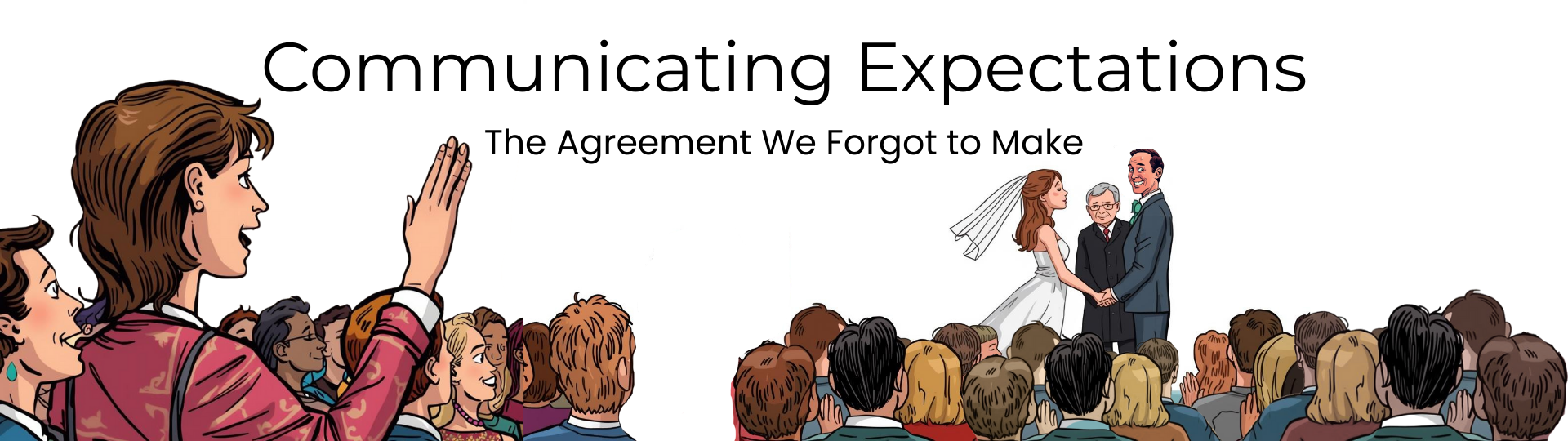
Communicating Expectations: The Agreement We Forgot to Make

It took time and distance for me to understand what I was really witnessing.

When I first noticed Mike walking toward me, I sensed something was off. His smile looked practiced, almost manufactured, as if confidence were being worn rather than felt. There was a tension in his eyes that didn’t match his enthusiasm. I remember thinking, whatever he was about to ask would carry consequences.

I was a co-leader of a Divorce Care recovery group at the time. Mike attended after a marriage that had gone rapidly south, largely due to unspoken expectations. He was doing the work—or at least appearing to.

“CJ, I’m getting married,” he said.

I paused. “To Sarah?” I asked. “From the group?”

He nodded. “We’ve been helping each other through the program. We talk every night. We eat dinner together. We’re in love.”

I reminded him that they had known each other for only seven weeks and that we encouraged people not to start new relationships for twelve months so they could fully recover. He listened—but didn’t slow down.

“We’ve been recovering together,” he said. “It’s working for us.”

Then he leaned in and asked if I would stand up for them at the wedding.

I was surprised. I cared about Mike and wanted the best for him. At the same time, I sensed he was trying to outrun his grief rather than heal from it.

I agreed—but with one condition. I told him that if, in six months, he realized the marriage was a mistake, he would come back to me and allow me to help him work toward reconciliation instead of divorce. He agreed without hesitation. He even said it was why I would make the perfect best man.

Six months later, Mike approached me again. He told me he was getting divorced.

I suggested we talk through reconciliation. He declined. He had already filed. He explained that if he divorced quickly, the marriage could be annulled—no child support, no alimony. The court date was set. He simply wanted me to know.

Then he walked away, adjusting his path toward a woman who had caught his eye. I turned and walked in the opposite direction.

At the time, I wasn’t angry. What stayed with me was something quieter—clarity.

Mike hadn’t forgotten our agreement. He had simply stopped honoring it once it no longer served him.

That realization lingered. And over time, I began to notice a pattern.

The Silent Contracts We Live By

As I reflected on that experience, I began seeing the same dynamic everywhere—at home, at work, in leadership, and in partnerships.

There are few things more exhausting than trying to live up to expectations you never agreed to. It isn’t just frustrating, it’s unfair. And it becomes even more painful when those expectations were never spoken, yet somehow we’re judged for failing to meet them.

This happens when we live under silent contracts.

One person operates from a mental checklist:

  • “I thought you’d handle that.”
  • “I assumed you knew the deadline mattered.”
  • “I expected more initiative.”
  • “I thought you cared.”

The other person operates from a different script:

  • “No one told me.”
  • “That was never discussed.”
  • “I would have done it differently if I’d known.”
  • “I didn’t realize that was the priority.”

Both people may be sincere. Both may be committed. But without shared expectations, commitment alone isn’t enough. Resentment begins quietly, long before anyone names it.

Efficiency and Effectiveness: Competing Desires

As my curiosity deepened, I noticed that many expectations are formed by one of two desires: efficiency or effectiveness.

Efficiency values speed, output, and momentum. Effectiveness values quality, care, and impact. Both matter. Both are necessary. Yet they pull in opposite directions.

When efficiency dominates, things move quickly. Boxes get checked. Progress looks good on paper. But nuance fades. Communication shortens. People begin to feel like tools rather than partners.

When effectiveness dominates, care increases. Empathy deepens. Quality improves. But time slips away. Deadlines drift. Momentum slows. Frustration builds—especially for those responsible for results.

Neither approach is wrong.

The problem arises when one person expects efficiency while another is pursuing effectiveness—and no one talks about it.

Without conversation, disappointment is almost inevitable.

Agreement Changes Everything

What became increasingly clear to me was this: balance doesn’t happen by accident. It has to be negotiated.

Healthy relationships, personal or professional, depend on three shared understandings:

  1. What is expected
  2. What a win looks like
  3. What failure looks like

Without these, people can be fully committed and still completely misaligned.

In business, this shows up as missed deadlines, rework, and frustration that seems to come out of nowhere. In personal relationships, it shows up as emotional distance, recurring arguments, and the phrase, “You should just know.”

No one should have to decode expectations like a puzzle. Clear expectations aren’t controlling. They’re kind.

Expectations as Agreements, Not Demands

A year after Mike’s second divorce, he invited me to speak with his leadership team during a major business expansion. He believed the communication challenges he experienced personally might apply professionally.

In the room, as expectations were openly discussed and negotiated, the atmosphere shifted. Tension gave way to understanding. People realized that no one’s expectations were born from bad intentions—only from different pressures and priorities.

But when Mike stepped back in, his expectations stopped sounding like agreements and started sounding like conclusions. He wasn’t looking for alignment. He wanted endorsement.

That moment clarified something else for me: expectations stop working the moment they stop being shared. When expectations become demands, collaboration collapses.

Over time, I learned that Mike’s business didn’t survive the expansion. Decisions were made that no one felt ownership of. Trust eroded. The company failed. I also learned he divorced again, blaming circumstances and other people.

The pattern was hard to ignore.

The Simple Truth

Unspoken expectations don’t just damage relationships. They drain trust. They erode collaboration. They quietly undermine everything they touch.

People don’t usually leave marriages, teams, or companies because expectations were too clear. They leave because expectations were never agreed to—or worse, rewritten after the fact.

What I’ve learned, and continue to explore, is this: Clear expectations don’t limit people. They liberate them. They replace guessing with confidence, resentment with alignment, and frustration with forward movement.

The question I now ask myself, personally and professionally, is simple: Where am I expecting something that I’ve never actually agreed upon with the other person?

A conversation doesn’t guarantee agreement. But without one, we almost guarantee disappointment—Because it isn’t fair in business or in life to expect someone to live up to standards they never agreed to.

Copyright © 2026 by CJ Powers

When Social Glue Outweighs Truth

We live in a time when news travels at the speed of a click. A story breaks, opinions explode, and before the dust settles, millions of people have already picked a side. It would be encouraging if those positions were built on verified facts, but often they’re not. Instead, they’re shaped by something more powerful than truth itself: the social glue of belonging.

A Story That Stopped Me Cold

Recently, I read a breaking news report that angered me. The media shared details immediately—without taking time to verify the facts—because ratings and clicks mattered more than accuracy. The half-baked story took off, fueling activists who staked clear positions on the issue before anyone truly knew what had happened.

This morning, I bumped into someone who brought up the story. Since I had access to the actual facts from industry insiders, I began to explain what had really transpired. BLAM! Before I could finish, the person yelled at me. I tried to clarify, but I wasn’t allowed.

Why? Because their opinion wasn’t anchored in truth—it was cemented by their social circle. Their friends had already taken a stand. To question the narrative meant risking social rejection, and belonging outweighed accuracy.

The ripple effects were staggering. Activists were boycotting, social media arguments flared, and tempers ran hot—all based on false information. An industry insider confided that they had no idea how to slow the emotional rampage or get people back on the same page. Instead, they were forced into triage mode, just hoping to capture a shred of reality.

It got worse. One of the three companies involved had to build an entirely new publicity campaign that treated the falsehood as if it were true—because that’s where the public conversation had already landed. It sounds absurd, but there’s wisdom hidden there: sometimes the only way to lead people back to reality is to start where they are and slowly walk them across the bridge you build into truth.

Why Truth Often Loses

That experience hammered home a difficult reality: truth doesn’t always carry as much weight as community. People may claim they value facts, but when those facts threaten the acceptance of their social group, most will hold tighter to the group than to reality.

This is confirmation bias on steroids. We don’t just look for information that validates our perspective—we look for information that validates our tribe. And once we’ve socially reinforced a belief, even airtight evidence can feel like a threat.

Familiarity Feels Like Truth

Another reason false stories gain traction is repetition. The more often something is said—especially by trusted friends or favorite voices—the more “true” it feels. Familiarity breeds credibility, even if the information is wrong. That’s why fact-checks and corrections rarely travel as far or as fast as the initial story. Once a narrative is familiar and socially reinforced, it feels like common sense.

Why Facts Alone Don’t Change Minds

We’ve all tried it—dropping statistics or news articles into a heated debate, only to be dismissed or attacked. The problem isn’t always the strength of the evidence; it’s the lack of trust between the messenger and the audience. Facts are abstract. Relationships are personal. And when truth threatens to fracture relationships, it often loses.

This is why shouting louder doesn’t work. Correcting someone in front of their peers can backfire, because it doesn’t just challenge their opinion—it threatens their standing in the group.

The Path Back to Truth

So, what do we do when social glue outweighs truth? We start by recognizing that people are relational beings first and rational beings second. If we want truth to stick, it has to travel through trust.

Here are a few practical approaches:

  1. Lead With Respect. People listen when they feel respected, even in disagreement.
  2. Build Trust Before Sharing Facts. A trusted voice can carry hard truths where a stranger’s voice can’t.
  3. Find Shared Values. Frame truth in ways that connect with what the other person already values—safety, freedom, fairness, or community.
  4. Plant Seeds, Don’t Throw Stones. Change rarely happens in the heat of debate. It happens later, when a planted idea starts to grow.
  5. Start Where People Are. As frustrating as it sounds, sometimes the only way forward is to meet people inside their existing narrative and carefully build a bridge toward reality.

People Believe What Helps Them Belong

The story I experienced reminded me that truth, on its own, isn’t always enough. Social belonging can be stronger than facts, louder than reason, and more persuasive than evidence. People don’t just believe what they think is true—they believe what helps them belong.

If we want to see truth prevail, we can’t only correct lies. We must cultivate relationships, build trust, and patiently guide people across the bridge from where they are to what’s real. Because in the end, truth matters—but only if we can carry it together.

Copyright © 2025 by CJ Powers