The 13th is a Blessing

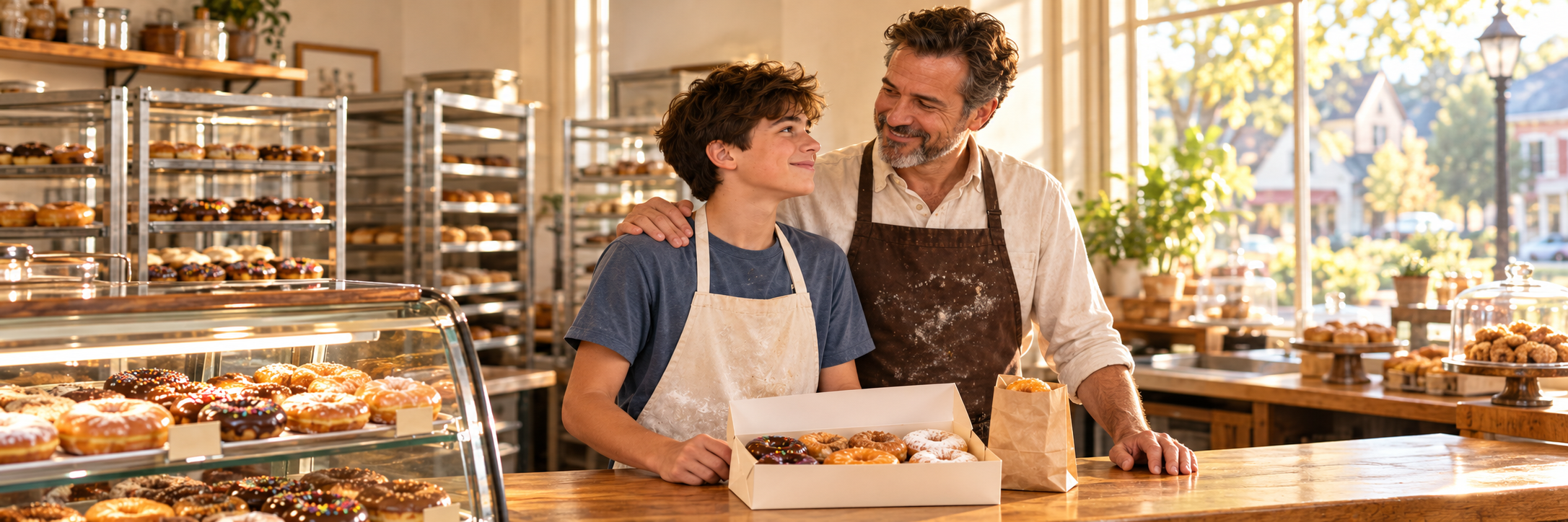
Ethan and Dad behind the counter at Miller’s Bakery with a box of doughnuts and a small bag.

Our little suburban village was waking up before the crack of dawn. Miller’s Bakery had been handed down two generations, and today, I was being prepped for the next handoff.

My first batch of doughnuts came out of the fryer at 5:47 a.m.

“Perfect timing,” said Dad, lifting the golden rings onto a cooling rack. “You’re 14, which means you’re officially my apprentice.”

“Which means I officially get paid?” I exclaimed as clearly and slowly as possible.

Dad looked at me like I was trying way too hard.

“Which means you officially get to learn why people pay us.”

“Sounds like a no.”

Dad grinned and handed me a box. “A dozen glazed doughnuts.”

I counted them out and confirmed 12.

“Thirteen,” Dad corrected as he handed me a 13th doughnut in a separate little bag.

“You said a dozen, that’s 12.”

“Around here, that means 13.”

“Okay, a baker’s dozen. I get it.”

“But do you know why?”

In that moment I knew Dad was about to educate me, no matter what my answer. “Dad, I’m still a bit tired. It’s not even six in the morning.”

“Excellent. Then your brain should be fresh.”

Dad leaned against the counter.

“In medieval England, bakers could get into serious trouble for selling underweight bread. There were laws about how much a loaf was supposed to weigh. So, to protect themselves, some bakers started giving customers 13 loaves instead of 12.”

“Medieval times, like when people carried candles around at night. You do know we click an app to turn on our LED colored lighting sequence, right?”

“Okay… wait, what?” Dad’s voice quivered with confusion.

“Nothing, I get it. History repeats itself.”

Dad chuckled. “One day, somebody’s going to ask you why it’s called a baker’s dozen. What are you going to tell them?”

“That they get 13 for the price of 12.”

“And when they ask why?”

“Because we’re… terrible at math?”

The bell above the front door jingled.

“Morning, Frank!” Dad called.

An older gentleman in an old high school letterman jacket stepped inside.

“Morning, fellas. Got any of those cinnamon twists?”

“Fresh out of the fryer. How’s Margaret doing?”

“Better. Doctor says another couple weeks, and she’ll be walking without that brace.”

“Tell her we’re thinking about her.”

Dad slipped two extra cinnamon twists into Frank’s bag.

“One for you and one for Margaret.”

Frank smiled. “Keep doing that, I’m gonna have to start bringing you gifts.”

“Just bring yourself back next week.”

After Frank left, Dad continued his lecture.

“There’s another baker’s dozen story. Centuries ago, bakers often supplied street vendors with 13 loaves for the price of 12. The vendor could sell the extra loaf and make a little profit.”

“Just what I needed. Two history lessons before breakfast. Look, Dad. Times have changed. People just want good doughnuts at a decent price.”

“You’re right.”

Startled, I had to be sure what I heard. “I am?”

“Absolutely. But that’s only part of the business.”

A young woman hurried through the door, phone pressed against her ear.

“Can I get a large coffee and two blueberry muffins? I’m running late.”

“Of course,” Dad said. “Ethan, would you take care of her?” I moved quickly, filling the cup and bagging the muffins.

“Seven eighty-five,” I said.

She tapped her phone against the reader, grabbed the cup and bag, and rushed out.

“See, Dad. Fast. Accurate. Easy. That’s what people want.”

“Some of the time.”

“Well, Dad, for those times, we could buy an AI robot to work the counter. They’ll cost less than hiring a part-time person for a year. They could take orders, answer questions, remember everything, and never call in sick.”

Dad wiped down the counter. “Sounds impressive.”

“Yeah. And we already have an online business. People can order without even talking to us. We could automate practically everything.”

“You’re probably right.”

“So why don’t we?”

Dad looked out the picture window at our quaint village. “Because there are hundreds of places where people can buy a doughnut. Grocery stores. Gas stations. Coffee shops. Delivery apps. Some of them are cheaper than we are.”

“Exactly, efficiency counts.”

“Son, there is a time for it. But when everybody can sell the same thing, people need a reason to choose you. To choose here. To choose Miller’s Bakery.”

“Our doughnuts taste better.”

“Maybe, today. But what happens when someone improves their recipe?”

“We improve ours.”

“And then they improve theirs.”

“Then we improve ours again.”

Dad smiled. “A game that never ends.”

The bell jingled again.
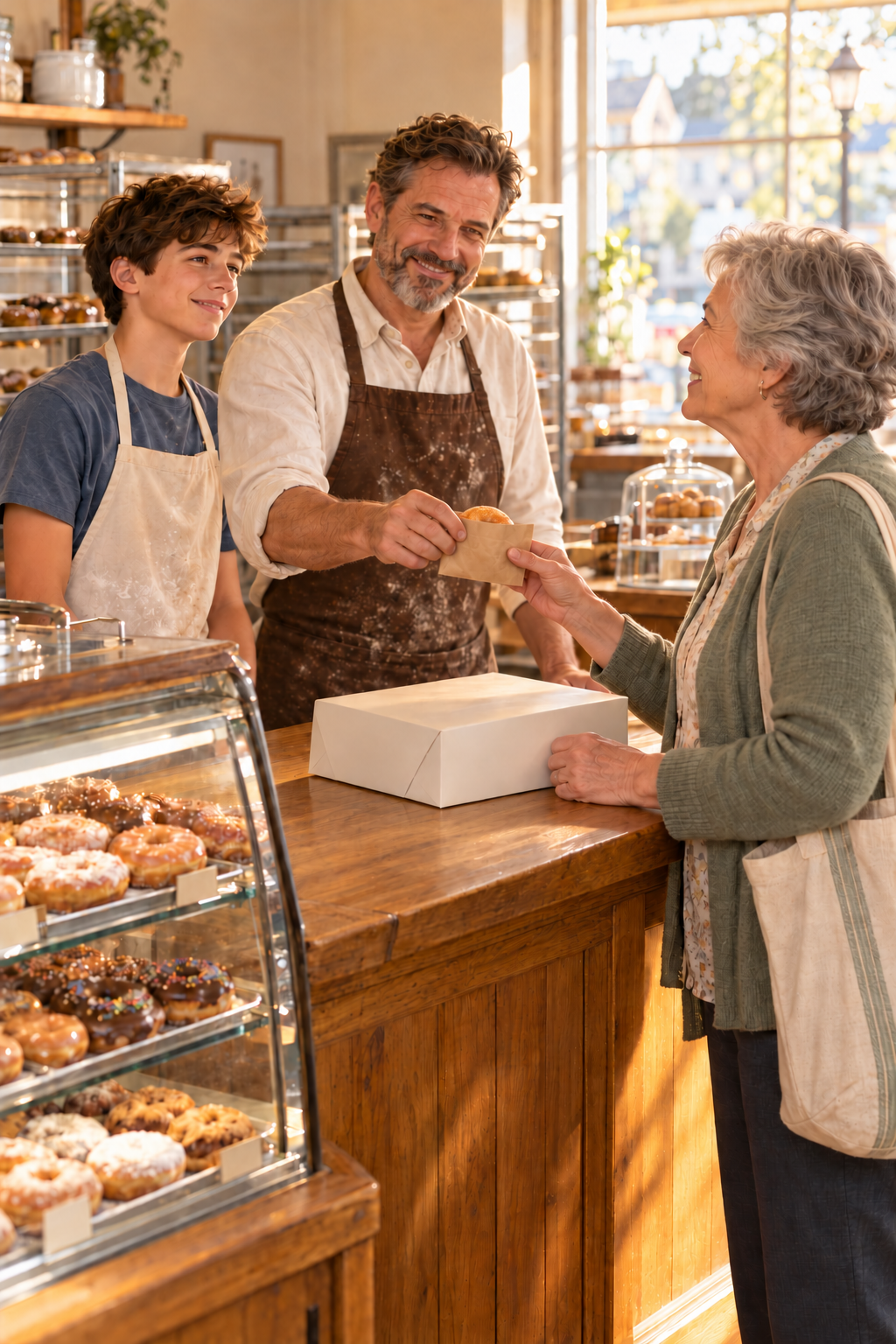
Dad gives Mrs. Peterson an extra doughnut in a small bag as Ethan watches.

Mrs. Peterson came in carrying a canvas shopping bag. “Good morning, gentlemen.”

“Morning, Helen,” Dad said. “The usual?”

“You remembered?”

“Six plain cake doughnuts and six chocolate frosted. Unless your grandchildren have changed their minds.”

“They haven’t changed their minds about anything except cleaning their rooms.”

Dad laughed and nodded for me to fill the box, as he slipped into the back room.

Mrs. Peterson glanced at me and asked, “Your first official day?”

“Yes, ma’am.”

“Your father must be proud.”

“He’ll be prouder when I learn how to work the cash register without getting a history lesson.”

She laughed.

Dad came back into the front room with a small bag and slipped a 13th doughnut into it. “One for the driver.”

Mrs. Peterson smiled. “That’s why I come here.”

Dad winked at me as she left the bakery.

“Okay, but seriously, Dad. We could let a robot handle the counter—or even the baking—and spend our time making more doughnuts.”

Dad looked like the wheels in his head were cranking, as he pulled out a rag and wiped down the counters. “Son, let me ask you something. What’s the point of making more doughnuts?”

“To sell more.”

“And the point of selling more?”

“Make more money.”

“And the point of making more money?”

I closed my eyes for a moment and wondered if we were going to continue Dad’s version of the 7 whys. Then I answered, “To have a better life.”

Dad nodded.

“Now we’re getting somewhere.”

He set the rag aside.

“Technology can make things faster. It can make things cheaper. It can even make things easier. And there’s nothing wrong with any of that. But if we keep removing people from everything we do, eventually we remove the very thing that makes life worth living.”

I wondered if people were really what made life worth living.

Dad continued, “Connections. Friendships. Knowing somebody cares whether you show up tomorrow.”

Dad gestured toward the areas of the bakery where each customer had stood while ordering.

“Frank comes because somebody remembers Margaret. Mrs. Peterson comes because we remember her grandchildren.”

“But a robot could remember all that.”

“It could remember the data,” Dad said. “But remembering information isn’t the same as showing empathy and caring about a person.”

“That’s true.”

“Son, convenience is wonderful. But if we trade away every human connection for convenience, we might end up making life lonelier instead of better.”

“That’s a pretty dark thought for a bakery.”

Dad smiled. “Then let’s brighten it up.” He opened a fresh box and began placing doughnuts inside.

I grabbed a box and did the same.

“Remember those medieval bakers, son?”

“How could I forget?”

“They gave 13 because they were afraid of being punished for selling too little. And those street vendors? The extra loaf helped them earn a living.”

“Neither are important today.”

“You’re right, we could give everyone 12 today. But when someone drives across town, fights traffic, finds a parking space, and walks through our door instead of ordering from somebody else, they’ve given us something valuable.”

“Money.”

“Their time. They’ve given us their time. They chose to spend it with us.”

“So we give them a baker’s dozen?”

“We give them a little thank-you for being the person who went out of their way.”

“So the 13th doughnut isn’t really about getting more, but giving more.”

Dad smiled. “Now you’re beginning to understand.”

The bell above the door jingled.
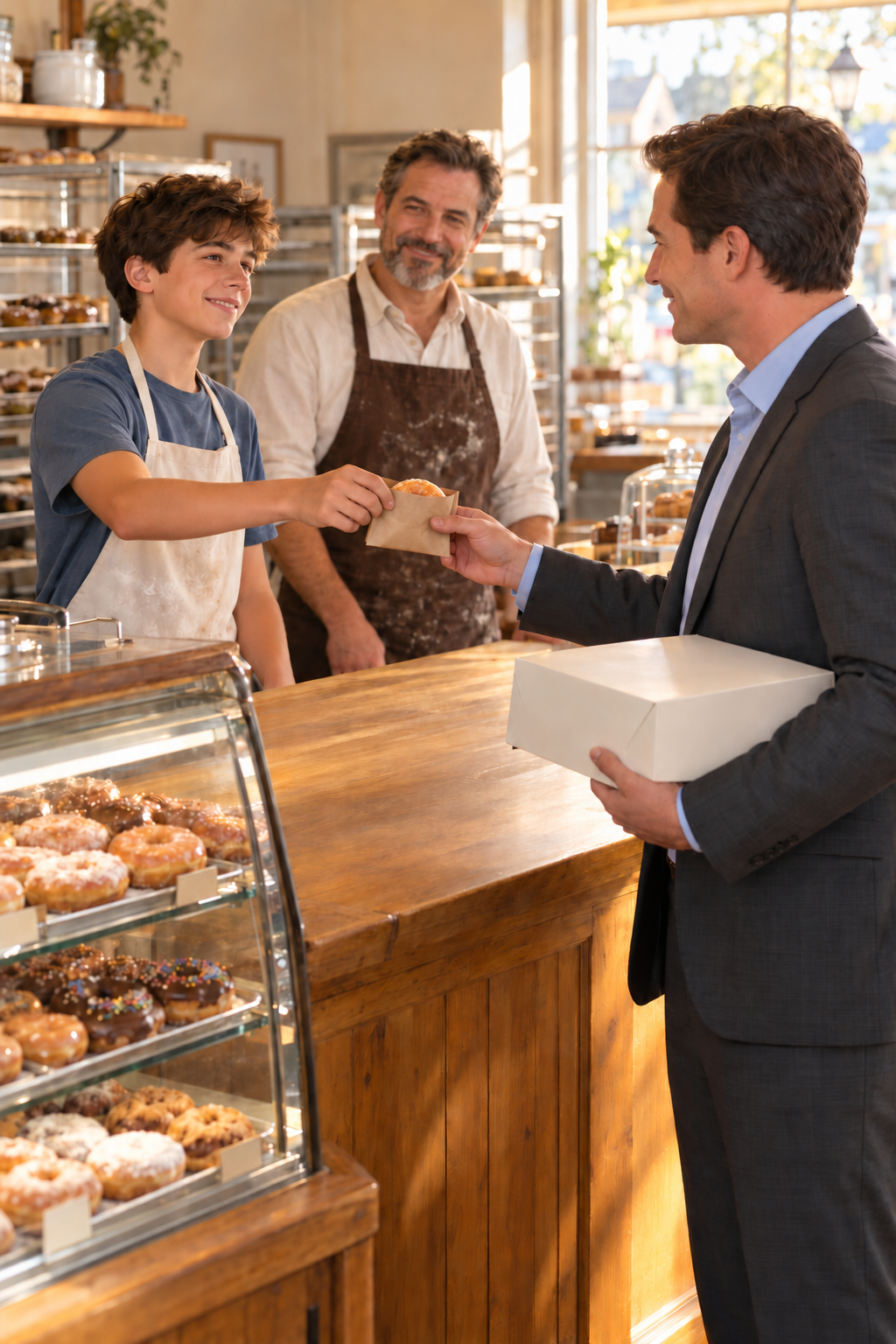
Ethan hands the businessman an extra doughnut in a small bag while Dad looks on.

A man in a business suit stepped inside, looking distracted. “Morning. Can I get a dozen assorted? Whatever’s fresh.”

“Absolutely.” I grabbed the mixed box that I had just finished packing. Then I placed a 13th doughnut into the little bag and placed both items on the counter. “That’s a dozen mixed doughnuts to go, and one special doughnut for the guy who went out of his way to pick them up.”

The man laughed. “Well, that’s the best deal I’ve had all week.”

He paid, thanked me, and headed for the door. But just before leaving, he turned around.

“You know, I usually order from one of those delivery apps. First time I’ve been in here.”

“Thanks for sharing. We’re glad you came.”

The man smiled and closed the door behind him.

I turned to Dad and said, “Okay. I get it.”

“Get what?”

“A robot could have sold him 12 doughnuts.”

“And?”

I smiled. “But I got to give him the 13th.”

Dad put a hand on my shoulder.

“Welcome to the family business.”

© 2026 CJ Powers
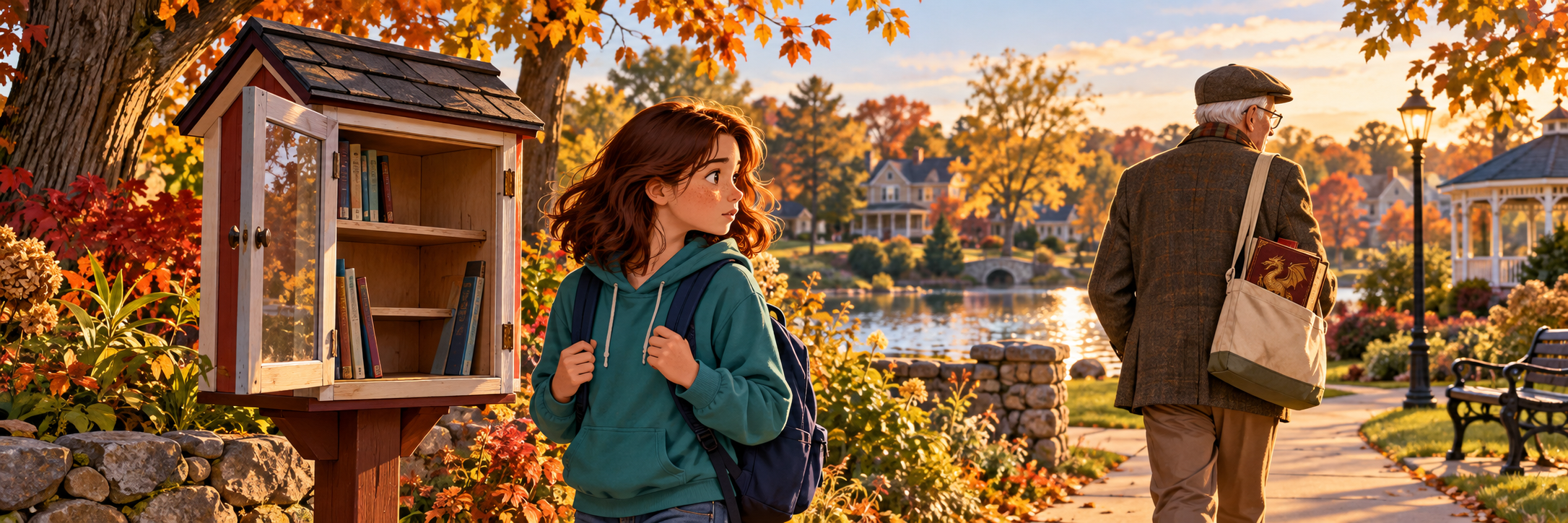
The Dragon Book

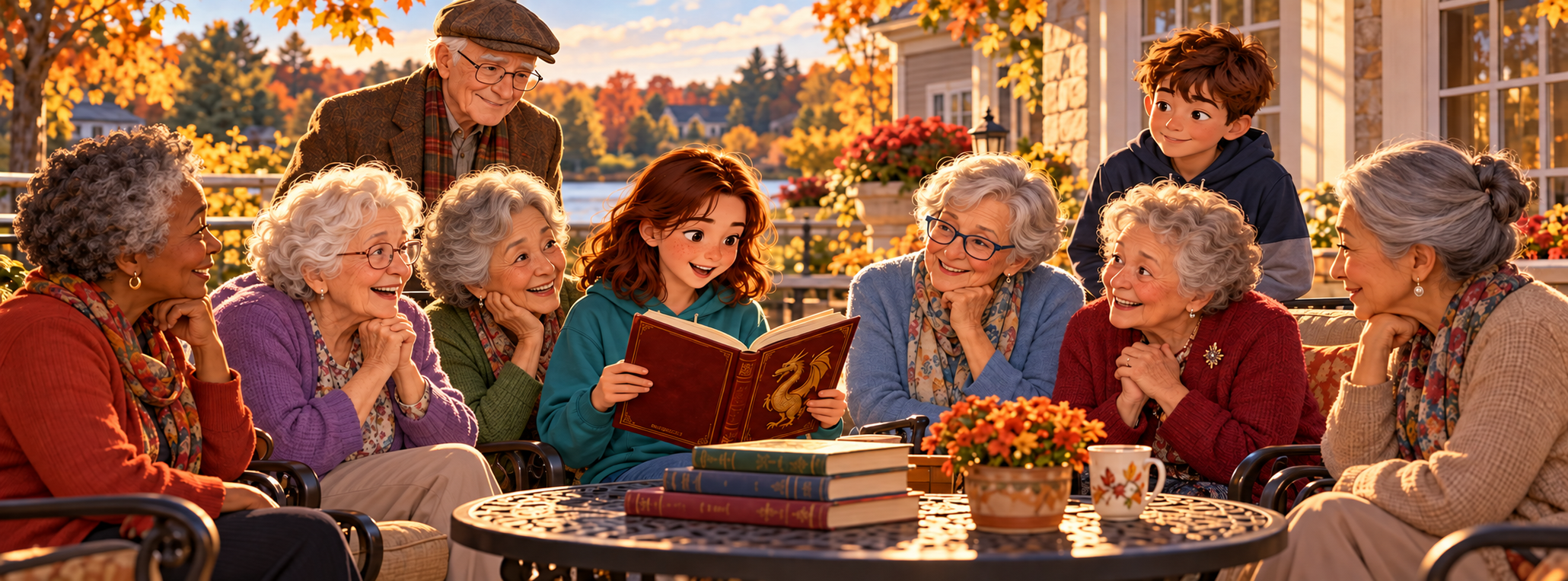
Caitlyn loves dragon stories, and today she can barely wait for the last bell to ring. The moment it does, she hurries out of her sixth-grade classroom, waves to a few friends, and heads for the little lending library in her neighborhood.

Last night, she spotted a flying dragon on the cover of one of its books. She wanted to take it then, but she hadn’t brought a book to exchange. Today, she’s ready.

She reaches into the middle compartment of her backpack to make sure her book is still there. It is. She smiles—and stops.

Mr. Bellows is standing at the little library.

Caitlyn darts behind a row of bushes and crouches. She lifts her head just high enough to see him open the glass door and pull out one book. Then another.

Please don’t take my dragon book.

By the time he closes the door, six books are in his bag. He hasn’t put a single one back.

Where are the books he’s supposed to trade?

Mr. Bellows heads down the sidewalk. Caitlyn rises from behind the bushes—and nearly screams when Jeremy lands beside her.

“Why are you spying on Mr. Bellows?” he asks.

“He just took six books.”

“As long as he swapped them, who cares?”

“He didn’t. His bag was empty when he got here.”

“Then let’s ask him about it.”

Jeremy starts to stand. Caitlyn grabs his sleeve and pulls him down.

“I don’t want to make a thief angry,” she whispers.

“A thief? Cait, he’s our neighbor. I’m going to ask him a question.”

“You’ll make a scene.”

“What scene?”

Caitlyn glances down the sidewalk. “Let’s wait until he turns the corner. Maybe he left a note explaining why he borrowed them.”

Jeremy settles back on his heels. “Okay. That’s worth checking.”

They watch Mr. Bellows turn the corner, then hurry to the little library. Caitlyn opens the glass door and searches every shelf.

No note.

“He took my dragon book,” she says, her voice catching. “And he left nothing for the six books he took.”

Jeremy peers inside. “That’s almost half the library.”

“We need to tell Emma’s mom. She takes care of it.”

“First, let’s find out what’s going on.”

“It’s obvious what’s going on.”

“Then asking him won’t change anything.”

Jeremy starts toward the corner. Caitlyn stares after him for a moment, tightens the straps of her backpack, and runs to catch up.


They spot Mr. Bellows crossing the park. He continues across the street and walks around the back of the retirement community.

Caitlyn motions for Jeremy to keep quiet. Together, they circle the building and slip behind a cluster of evergreens.

Beyond the trees, six older women are gathered around a patio table. Mr. Bellows lays his books on it. Each woman adds a book of her own.

“Okay, ladies,” he says. “You have twelve books to choose from today. I’ll return whichever six are left to the neighborhood library.”

Jeremy looks at Caitlyn.

“What?” she whispers. “How was I supposed to know?”

“He’s giving them more choices. They can pick from twelve books instead of six.”

“Yeah, I can count.” Caitlyn watches the women turn the books over, reading the covers. “But somebody could be standing at the library right now, hoping to find that dragon story.”

Jeremy leans against a tree. “There’s more than one way to share a story.”

Caitlyn looks at him. Then at the women. Then at the dragon book on the table.

“Oh,” she says.

She steps out from behind the evergreens.

“Mr. Bellows?”

He turns. “Caitlyn! Hello.”

She swallows. “Before everyone picks a book, would you like me to read the first chapter of that one?”

She points to the dragon on the cover.

The women pull their chairs closer. Mr. Bellows hands Caitlyn the book, and she opens it.

“Dark clouds swirled above the stone castle. Along its walls, torches burned in black iron sconces. The Watchers hurried to their posts, searching the sky for the dragon hidden somewhere in the clouds…”

By the end of the first chapter, no one wants her to stop. Caitlyn reads a second. As the sun sinks below the treeline, the women thank her and begin choosing their books.

Caitlyn makes her way around the table, hugging each woman. She gives the dragon book back to Mr. Bellows.

“You made everyone’s day,” he tells her.

Caitlyn glances toward the women. “I’m glad you bring the library to them.”

“Well, I’d better return these six before supper.” He gathers the remaining books into a stack.

“I can do that. I live next door to the little library.”

Mr. Bellows hands them to her and heads inside. Jeremy joins Caitlyn as the women carry their new books into the building.

“You’re a pretty good storyteller,” he says. “No wonder your imagination got so dramatic.”

Caitlyn jabs him lightly in the ribs.

“Ow! Be nice, and I’ll carry those books for you.”

She drops the stack into his arms, then takes the dragon book from the top.

“I’ll carry this one.”

Together, they cross the street and cut through the park, bringing all six books back to the little library.

Copyright © 2026 by CJ Powers

The Last Stakeout

The first time Jim followed his son, he told himself it was instinct.

Detective Jim Callahan had spent twenty-two years reading body language, spotting lies, and noticing tiny changes in routine that other people missed. So when sixteen-year-old David suddenly became secretive, protective of his phone, and vague about where he was going, Jim’s internal alarms started ringing.

That afternoon, Jim stood across the street beneath the shadow of an old brick awning, pretending to study the reflection in a storefront window.

David emerged from a catering business carrying two large silver warming trays with both hands.

Jim narrowed his eyes. “That’s odd,” he muttered.

David looked around nervously before loading the trays into the back of his friend’s pickup truck.

Jim slipped deeper into the shadows. “Catering trays? For what?” His curiosity sharpened.

A few hours later, Jim found himself hiding beside a newspaper machine near the downtown shopping district. He felt ridiculous, but not ridiculous enough to stop.

David exited an upscale bakery carrying a large white box edged in gold ribbon.

Cake box.

Expensive cake box.

Jim’s mind raced through possibilities faster than he cared to admit. A party? A girl? A lie?

Something worse?

Before he could follow, a voice growled behind him.

“You planning to arrest your own kid, Jimmy?”

Jim spun around.

His father, Frank Callahan, stood with his arms crossed, disappointment etched across his weathered face.

Jim exhaled hard. “Dad, don’t sneak up on me.”

Frank smirked. “Funny hearing that from a man hiding behind a newspaper machine spying on his son.”

Jim straightened. “David’s been acting strange.”

“He’s a teenager,” Frank replied. “That’s the job description.”

Jim glanced toward the bakery window. “Something’s going on.”

Frank studied him quietly.

“What’s really going on,” he said, “is that you’ve spent so many years looking for trouble that you forgot not everything suspicious is bad.”

Jim scoffed. “You don’t understand.”

“Oh, I understand perfectly.” Frank stepped closer. “You want to get to the crux of the matter before anyone else knows there’s a matter at all.”

Jim crossed his arms.

Frank shook his head slowly.

“Jimmy… sometimes people need enough space to do what they think is right…and important, without judgment hanging over their shoulder.”

Jim laughed bitterly. “Seriously? You’re lecturing me about judgment?” he asked. “It took me years to break free from your critiques. Years. So don’t stand there acting enlightened.”

Frank looked wounded, but for only a moment before nodding.

The words landed harder than Jim expected.

“You’re right,” Frank admitted quietly. “I did learn the hard way.”

He looked in the direction David had gone.

“And I’m hoping you can learn from a single hint instead of twenty years of regret.”

Jim said nothing.

Frank sighed.

“Well,” he muttered, stepping away, “I guess some lessons still need experience.”

Then Frank disappeared down the sidewalk.

Jim watched him leave, stubbornness hardening in his chest.

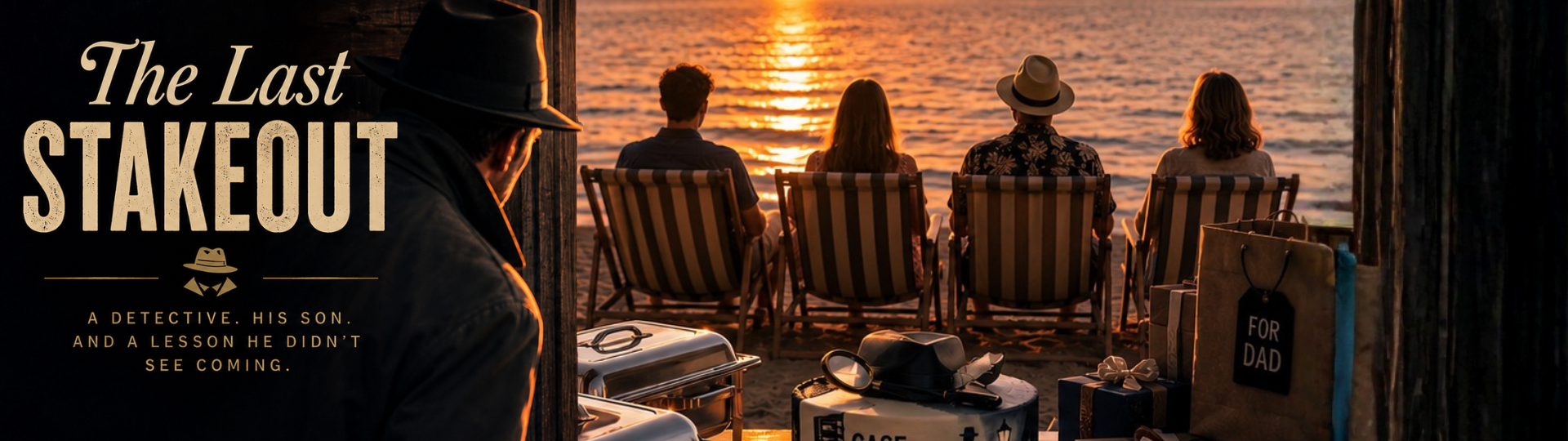
By sunset, Jim was crouched behind a weathered shed near the rear of a small lakeside hotel.

The sky blazed orange and crimson across the water. Waves rolled softly against the shore while music drifted faintly from somewhere near the beach patio.

Jim spotted David again.

The teenager walked casually toward a row of reclining beach chairs, carrying a tropical drink topped with a tiny paper umbrella.

Jim narrowed his eyes.

“Oh, this is it,” he whispered.

David sat down facing the lake.

Jim noticed several people in chairs lined up beside his. All facing the lake.

Jim’s pulse quickened.

He moved swiftly around the side path, staying low, heart pounding with certainty, about to catch David red-handed.

He burst around the chairs dramatically.

“I’ve caught—”

“Happy Father’s Day!”

Jim froze.

David stood grinning beside his sister.

Frank sat laughing in one of the beach chairs.

Jim’s wife held her hands over her mouth, trying not to laugh at the stunned expression on his face.

Behind them sat the silver catering trays.

The gold-edged cake box rested on a table nearby. The cake itself was decorated like an old detective noir novel, complete with a chocolate magnifying glass, a fondant fedora, and the words:

CASE CLOSED, DAD.

A pile of wrapped gifts sat beside it, with ‘Dad’, ‘Son’, and ‘Jim’ written across the tags.

Jim blinked several times.

“You… all this was…”

“For you,” David said.

Jim looked at his father.

Frank raised his tropical drink slightly. “Told you to chill, Jimmy.”

Everyone laughed.

Jim rubbed the back of his neck, embarrassed beyond words.

Then he looked at David.

His son wasn’t hiding something terrible. He was trying to do something meaningful.

Jim finally smiled.

“Dad,” he said softly to Frank, “you were right.”

Frank leaned back in his chair. “That’s my favorite sentence.”

Jim chuckled and shook his head.

“Sometimes,” Jim admitted, “we need to give people a chance to do what they think is right and important.”

The sun dipped lower over the lake as his family gathered around him, and for the first time all day, Detective Jim Callahan stopped searching for what was wrong and simply enjoyed what was right.

Copyright © 2026 by CJ Powers