
It’s Not an AI Problem. It’s a Clarity Problem


Why AI without human clarity multiplies confusion—and how to fix it using the 3Cs and the 11–7–4 framework

Introduction: The Mistake Most Organizations Are Making

They thought one open house would save the school.

A private grade school with strong values, committed teachers, and a meaningful impact in their community was quietly struggling. Enrollment was declining. Donations were slowing. Vendor partnerships were fading.

So they did what most organizations do.

They planned:

  • One big open house
  • A few social media posts
  • An email announcement

And they hoped it would turn things around. It didn’t.

The Real Problem: It Wasn’t Visibility—It Was Connection

At first glance, this looked like a marketing issue.

The principal said, “People just need to know we exist.”

But that wasn’t true.

People had already seen the school.

What they hadn’t done… was connect.

You can’t build connection without clarity.
And without connection, nothing grows.

Why Most Organizations Fail to Build Connection

The core issue wasn’t effort. It was clarity.

Most organizations try to scale their message before they simplify it.

They communicate:

  • At too high a level
  • With too much complexity
  • Without a clear focal point

Clarity isn’t missing because the message lacks intelligence.

It’s missing because it hasn’t been simplified.

Then they try to compensate by increasing activity:

  • Posting more content
  • Sending more emails
  • Hosting more events
  • Using AI to produce more, faster

But when the message isn’t clear:

They’re not building connection.
They’re scaling confusion.

And AI doesn’t fix that. It accelerates it.

Step One: Clarity Creates Connection (The 3Cs Framework)

Before anything else can work, clarity must come first.

This is where the 3Cs Framework becomes essential:

1. Communication → Clarify

What is the ONE thing your audience needs to understand?

Not everything.

Too much information creates noise.

Clarity comes from focus.

2. Connection → Relate

Why should someone care?

Not in theory.

In their life.

Connection happens when people see themselves in your message.

3. Collaboration → Align

Is your message consistent everywhere it appears?

Or does it change depending on the platform?

Consistency builds trust. And trust opens the door for deeper engagement and collaboration.

Step Two: Scaling Connection with the 11–7–4 Framework

Once clarity exists, connection becomes possible.

Now—and only now—can you scale it.

This is where the 11–7–4 framework comes into play.

But not as a shortcut.

As a multiplier.

11–7–4 doesn’t create connection. It scales it.

What Is the 11–7–4 Framework?

The framework is built on three components:

11 Touchpoints → Repeated Opportunities to Connect

People need to encounter your message multiple times before it becomes familiar.

This isn’t just about visibility.

It’s about recognition and memory.

7 Hours → Depth of Connection

Trust is built over time.

Through stories, insights, and meaningful experiences, your audience begins to understand—and believe—you.

4 Locations → Reinforced Credibility

When people see you across multiple platforms, your message gains legitimacy.

They begin to think:

“This must be real.”

Real Results: What Happened When the School Applied This

The school didn’t suddenly go viral.

Something more important happened.

People began saying:

“I feel like I’ve been seeing you everywhere.”

And even more importantly:

“This feels right.”

As a result:

  • Enrollment conversations improved
  • Donors referenced specific stories
  • Vendors began reaching out again

Nothing changed about who they were.

They simply became:

  • Clear enough to connect
  • Consistent enough to be trusted

Where AI Fits Into This Strategy

AI is a powerful tool—but only when used in the right sequence.

Not first.

After clarity.

How to Use AI the Right Way

1. Clarify Your Message

Prompt:

“Help me simplify this message into one clear idea my audience will understand instantly.”

2. Expand Connection

Prompt:

“Turn this idea into a step-by-step content series that helps someone feel understood.”

3. Reinforce Across Platforms

Prompt:

“Adapt this message for multiple platforms while keeping it consistent.”

AI isn’t creating your message.

It’s scaling how well you connect.

The Bigger Lesson

Many people believe:

“If what I offer is good enough, people will come.”

That’s no longer how it works.

Today:

  • Clarity creates connection
  • Connection builds trust
  • Trust drives action

And AI accelerates all of it—for better or worse.

Practical Takeaways

If you’re trying to grow a business, nonprofit, or initiative, ask yourself:

  • Is my message clear enough to understand immediately?
  • Is it relatable enough to create connection?
  • Is it consistent enough to build trust over time?

Final Thought

You don’t need more content.

You need:

  • Clearer communication
  • Deeper connection
  • Aligned collaboration

That’s what makes you…

Irreplaceably Human.

Copyright © 2026 by CJ Powers
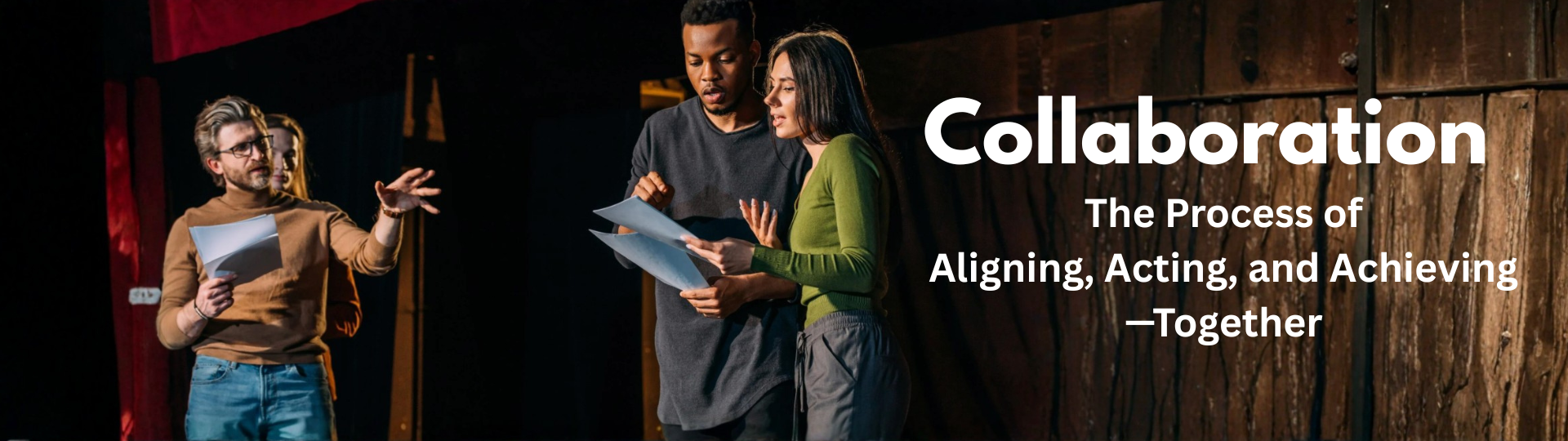
Collaboration: The Process of Aligning, Acting, and Achieving—Together

A theatre director collaborates with actors on stage during rehearsal, aligning vision, encouraging shared action, and building toward a successful production.

Collaboration is often spoken about as a goal, but rarely understood as a process—much less an enjoyable one.

Many teams assume collaboration happens when people agree, attend meetings, or divide up tasks. But agreement alone doesn’t move things forward, and activity without direction only creates motion, not progress.

True collaboration, the kind that produces meaningful results, requires something more intentional.

Director to Director: Learning Collaboration the Hard Way

Years ago, I took another directing class. I already had several TV shows and films under my belt. Still, I wanted to learn a few techniques from a director who had won numerous awards for directing shows on the legitimate stage. Her work was brilliant, and I knew some of her techniques would transfer.

Before our first class, knowing my background, she suggested that there was nothing she could teach me that I didn’t already know. I assured her that I’d be happy if I learned one technique that could improve my skill set. She agreed to teach me under the condition that she could ask me questions about film and television so she could learn from me as well. 

After the first month of classes, she suggested I learn to collaborate better with my actors and crew. While she enjoyed watching the outcome of my directing, she suggested I could have more fun and dive a bit deeper into the script through a balanced view of collaboration.

Her suggested form of collaboration follows a simple, but demanding pattern. Progress happens when people align, act, and achieve—in that order.

ALIGN: Collaboration Begins With Shared Direction

Sharing elements of direction was hard at first. As a director, the vision started with me, and most of the time, my direction was the only direction provided. However, my instructor suggested that, while I have a complete understanding of the entire show, the actors know their characters’ subtleties better. 

The costume designer, while she quickly picked up my vision, was the one who sculpted the final wardrobe. The same concept applies to the property master, the set designer, and all other department heads. Each one had to pass direction on to their teams, but first had to capture my approval.

When I realized that the department heads could all share some form of direction, I was able to work smarter, not harder. Their direction just needed to align with mine.

Alignment is the most overlooked and most critical step in collaboration.

To align means ensuring everyone is oriented toward the same outcome before action begins. It’s not about unanimous agreement or identical thinking. It’s about shared understanding.

I gave it a try. At first, each person had interpreted my vision a bit differently. Some were focused on the heart of the character transformation. Others prioritized the show’s visual quality. A few were motivated by what made them look good, even if their ideas didn’t fit the show.

Without alignment, a predictable pattern emerges: activity fragments, energy scatters, and frustration grows quietly.

Alignment requires slowing down long enough to ask:

  • What are we actually trying to achieve?
  • Why does this matter?
  • What does success look like together?

Once we named these answers out loud, something shifted. The tension in the room eased, not because conflict disappeared, but because clarity arrived.

Alignment doesn’t eliminate differences. It gives them a common direction. At that point, everyone felt heard and understood. When I had to turn down some ideas due to focus or vision, everyone aligned their ideas because we had become a cohesive team, and no one wanted to break the show.

ACT: Collaboration Comes Alive Through Ownership

Action is where collaboration becomes real—or reveals itself as theoretical.

Once alignment is established, movement must follow. But collaborative action isn’t about assigning tasks and hoping for the best. It’s about shared ownership and visible contribution.

Once the production team aligned on the outcome, we stopped debating ideas and started committing to actions. Roles became clearer. Deadlines became meaningful. Accountability became mutual instead of managerial.

Action requires trust. It asks people to step forward, not wait to be told. It also requires restraint—knowing when to act independently and when to coordinate.

Collaboration stalls when people wait for permission. It accelerates when people take responsibility within shared clarity.

The careful blending of these ideas creates a better show than any single person’s vision. In this case, mine.

ACHIEVE: Collaboration Is Measured by Results, Not Effort

Achievement is the natural byproduct of aligned action—but it’s often misunderstood.

Many teams celebrate effort. Fewer take the time to evaluate outcomes.

Achievement doesn’t mean perfection. It means progress that can be named, measured, and learned from. It gives collaboration credibility.

When our team finally delivered the initiative, it wasn’t flawless—but it was real. And because we reflected together afterward, the achievement became more than a result; it became a shared reference point for future collaboration.

The live audiences made it clear that something special had emerged from our production. Not because I was a great director, but because I learned how to collaborate and draw the best out of each person on my team.

Achievement reinforces trust. It proves that working together was worth the investment. It also feels good. Everyone in the cast and crew told me they would work with me again, anytime I needed them. Our joint achievement came from the trust we had instilled in each other.

Collaboration Requires Intention

Collaboration is not a personality trait or a meeting format. It’s a discipline.

When collaboration fails, it’s rarely because people didn’t care enough. More often, it’s because they skipped a step—acting before aligning, or celebrating effort without achieving clarity.

Strong collaboration asks us to slow down early, step up fully, and reflect honestly.

Take a moment to consider the spaces where you collaborate—at work, in leadership, or within your community.

  • Are you aligned on what truly matters?
  • Are you acting with shared ownership?
  • Are you achieving outcomes you can learn from together?

Progress doesn’t happen by accident. It happens when we choose to align, act, and achieve—intentionally, patiently, and together.

Copyright © 2026 by CJ Powers

A Gig of Conversations: Lessons from Bob Schmidgall

Bob Schmidgall was one of the most incredible speakers I’ve ever heard. I admired his ability to connect with people and studied him often. One of his greatest strengths was speaking in a way that reached blue-collar, white-collar, and gold-collar workers—all at once. Each listener walked away believing Bob was speaking directly to them.

If you haven’t heard those terms, they’re general categories of labor:

  • Blue Collar: Manual laborers and skilled tradespeople.
  • White Collar: Office and professional workers.
  • Gold Collar: Highly skilled and valued specialists, often in cutting-edge fields like AI.

When Bob made a key point, he often shared it three times. But he never sounded repetitive. Instead, each sentence was crafted for a different group. He wasn’t restating; he was expounding—layering meaning so each person heard it in a way they could relate to.

The result? Everyone left the room feeling as though his talk was written just for them. He was relatable, informative, humorous, and full of great stories. Out of the hundreds of speakers I’ve listened to, Bob remains in my top five.

At some point, I realized something important: no amount of study would turn me into Bob. But that wasn’t the point. Bob had his gift. What I needed to see was that all of us actually speak far more than he ever did. Over a lifetime, we will likely have the equivalent of a gigabyte of conversations—not just spoken words, but emails, texts, social DMs, and even old-fashioned snail mail.

Each exchange adds another “file” to our personal archive. Some are blurry images best deleted, but others are crisp, high-resolution moments worth revisiting.

And that leads to the real question: if you’re going to spend that much time talking, typing, and connecting—why not upgrade your conversations so they actually build trust, opportunity, and collaboration?

Here are five simple Conversation Upgrades I’ve found that can transform ordinary chatter into meaningful dialogue.

Upgrade 1: Curiosity Beats Cleverness

Instead of prepping stories to tell, prepare questions to ask. Dale Carnegie put it best: “You can make more friends in two months by becoming interested in other people than in two years by trying to get other people interested in you” (How to Win Friends and Influence People).

A practical way to stay curious? Think about their Family, Work, Recreation, and Dreams (the F-W-R-D framework). Ask about their kids’ hobbies, the wildest thing that happened at work this month, the new restaurant they tried, or the goal that lights them up. When you anticipate their story, you can’t help but lean in—and that anticipation is contagious.

Upgrade 2: Turn on Charisma Mode

Charisma isn’t some magic dust—it’s built from presence, warmth, and confidence. Olivia Fox Cabane (The Charisma Myth) shows how teachable this is.

  • Presence: Give someone the sense that there’s nowhere else you’d rather be.
  • Warmth: Try the “flooding smile”—pause, take them in, then let a genuine smile slowly spread. It feels personal, not pasted on.
  • Confidence: Strong posture and a few thoughtful pauses tell the room you’re comfortable in your own skin.

When those three align, people don’t just hear your words—they feel your attention.

Upgrade 3: Add a Twist of Surprise

Boring conversations fade. Playful ones stick. Instead of standard answers, toss in a curveball:

  • Instead of “I’m from Chicago,” say: “I’m from Chicago, where pizza is deep enough to need a lifeguard.”
  • Instead of “I’m a consultant,” say: “I’m a consultant who’s learned more from coffee spills in boardrooms than from MBA textbooks.”

It’s not about impressing—it’s about giving others something fun to react to, like setting up the first line of an improv scene.

Upgrade 4: Ask for Feelings, Not Just Facts

Charles Duhigg’s Supercommunicators highlights a Harvard study of speed dating conversations: the people who landed second dates asked emotion-driven questions, not fact-gathering ones.

Swap:

  • “Where are you from?” → “What do you love most about your hometown?”
  • “What do you do?” → “What makes your work exciting—or exhausting?”
  • “What did you do this weekend?” → “What was the highlight of your weekend?”

By aiming for Dreams, Elevated moments, and Passions (D-E-P), you’ll unlock stories that reveal what matters most. That’s the difference between polite small talk and real connection.

Upgrade 5: Let People Know They Landed

Everyone wants to feel heard. Psychiatrist Mark Goulston (Just Listen) says even small acknowledgments—nodding, “mm-hmms,” or paraphrasing—make a huge impact.

When someone shares, don’t just reply with “Wow, that’s crazy.” Echo a detail that mattered: “That’s hilarious—after all that effort, the IKEA shelf was upside down the whole time.”

It signals: I didn’t just hear you. I understood you. That’s the glue of collaboration.

Why These Upgrades Matter

Each “conversation upgrade” builds on the 3Cs framework that I’ve developed:

  • Communication: Clearer, warmer, and more engaging.
  • Connection: Deeper emotional resonance—because you’re asking what really matters.
  • Collaboration: When people feel seen and valued, they bring their best ideas to the table.

Conversations aren’t background noise—they’re the raw material of relationships. And when you upgrade them, you upgrade your influence, your opportunities, and your impact.

It’s Time to Upgrade

You’ve got a gig of conversations ahead. Most people will let theirs auto-save in the background. But you? You can choose to upgrade yours—turning them into meaningful files worth archiving.

Start small: one curious question, one genuine smile, one playful twist. Then watch how fast your communication, connection, and collaboration grow.

Copyright 2025 by CJ Powers