
The founder who feels behind isn’t failing. They may simply be running a life and business nobody deliberately designed.

Ask a founder how things are going, and you’ll often hear two seemingly contradictory answers: the business is doing well, but they feel behind.
They may feel behind on work, on the latest AI tools, on their responsibilities at home—or on all three at once. From the outside, they appear successful. Inside, their days feel increasingly fragmented.
Jim Brenner and I encounter this problem from different directions.
Jim advises founders and business owners at significant turning points—after a sale, an investment, a major deal, or a prolonged period of overload. His work helps them redesign how they live and lead.
My work focuses on helping people use AI to simplify repeatable tasks while protecting the judgment, creativity, relationships, and responsibilities that still need a human being.
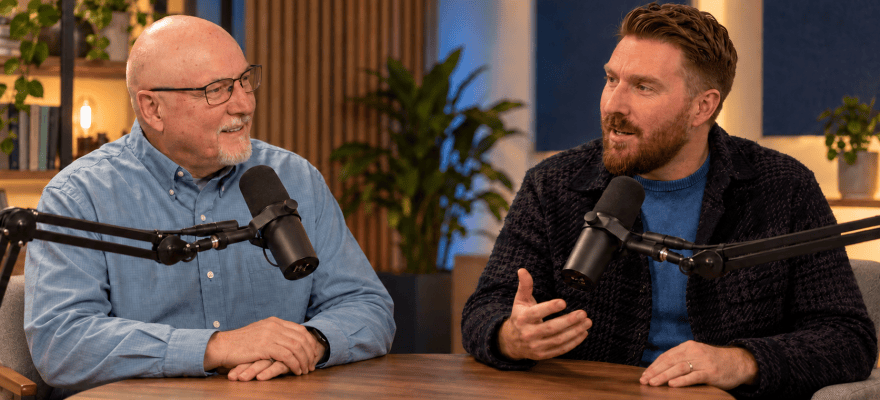
I invited Jim to discuss the pressure successful founders experience, why the usual solutions often fail, and how people can deliberately design a better way to work. His approach intersects with mine, so I asked him the key questions—and added my perspective after each answer.
I see Jim’s approach as step one and mine as step two in the same solution: design the life and work you want, then use AI thoughtfully to help protect it.
What changed the way you think about pressure?
CJ: Jim, what changed the way you think about how people cope with pressure and change?
Jim: Honestly, I used to think pressure was a discipline problem. When things became difficult, you worked harder.
That’s what I did for years while building a business—head in a laptop, working far too many late nights after everyone else had gone to sleep.
It worked professionally, but I was often home without really being there. Nothing in my week was designed to change that.
Eventually, I decided what would no longer be allowed to move: time to think and create, my health, time with my children, and my closest relationships. Then I designed my work around those priorities instead of trying to fit them into whatever time remained.
I now see the same pattern in some of the best founders I work with. The ones who have adopted a more deliberate approach aren’t necessarily the people who work the hardest. They’re lighter, calmer, and happier—and that difference is by design.
They still face problems, stress, and the ordinary messiness of life. But they’ve established non-negotiable boundaries around their work, health, family, and the things that make them feel alive.
I wish I had done it much earlier.
CJ’s perspective
My career has taken me through government, technology, communications, healthcare, nonprofit work, and several other fields. In some environments, stress is intentionally manufactured to drive performance. In others, it grows out of inefficient systems that were never updated.
Most often, however, stress compounds because the original source of pressure is never properly removed. New expectations, tools, and responsibilities are simply placed on top of it.
I experienced that firsthand while working in the technology sector. On one particularly difficult day, I faced a real deadline, a client who had manufactured a crisis to test me, and a prospective client who wanted a customized presentation before taking it to the company’s board that evening.
I became so overwhelmed that I lay down on the floor to ground myself and determine my next steps.
Then I met the deadline. I explained to the client why an immediate response to the manufactured crisis would be the wrong choice. And instead of giving the same presentation twice, I asked to speak directly to the prospective client’s board.
The immediate problems were resolved. But the experience taught me that enduring pressure isn’t the same as designing a system that reduces it.
What does this problem look like on an ordinary Tuesday afternoon?
CJ: What does this problem look and feel like for the person living it—not as a textbook definition, but on an ordinary Tuesday afternoon?
Jim: It’s three o’clock on a Tuesday afternoon.
You’ve been in back-to-back calls since eight. Most of those calls could have been emails or handled by a team that understands what good work looks like.
You answer messages while someone is speaking to you and tell yourself you’ll be present later. But later never arrives.
By nine, you’re home but still at your desk. Your back aches, you feel slightly numb, and a hundred things are waiting for your input. You realize it has been a month since you did anything meaningful with your children. Time with your spouse has shrunk to watching television together on the sofa.
You already know you’ll wake up at three in the morning with a flood of thoughts that won’t turn off.
Nothing is obviously wrong, and that’s what makes the problem difficult to name. From the outside, it looks like success: the business, status, house, car, and possessions.
From the inside, it feels fragmented. You’re running on fumes with a quiet suspicion that you should be doing better than this.
CJ’s perspective
The day after my experience on the office floor, I felt both victorious and foolish. I hadn’t failed, but my mind immediately began searching for a way to ensure that I would never feel so overwhelmed again.
The ideal solution didn’t exist. Circumstantial crises, unexpected attacks, and other people’s poor decisions are part of life. We cannot predict every difficult situation.
What we can do is prepare ourselves to think on our feet and focus on the best available solution instead of becoming consumed by the storm.
The goal isn’t to eliminate uncertainty. It’s to build enough capacity into our lives and work that uncertainty doesn’t immediately overwhelm us.
What do people assume is wrong—and what do they try first?
CJ: What does everyone assume is going wrong, what do they try first, and why doesn’t it work?
Jim: People often assume it’s a mindset or discipline problem, so they try the obvious fixes: earlier mornings, another productivity app, a better to-do list, more delegation, and now AI.
Those fixes rarely last because each one is added to a setup nobody intentionally designed.
Delegation without a destination simply creates space that gets refilled with more work. The founder isn’t short of effort or tools. The real problem is that they never decided what the week was for.
As a result, everything urgent fills the available space—including the time they just worked so hard to recover.
CJ’s perspective
AI can fall into exactly this trap.
Businesses see a new technology and immediately ask where they can install it. But adding AI to a poorly designed process can make it faster without improving it. In some cases, it simply helps the confusion spread more efficiently.
Before we automate anything, we need to understand the pressure we’re trying to relieve and what we intend to do with the capacity we create.
We also need to separate problem-solving from assigning blame. When leaders focus first on who was at fault, everyone’s attention becomes divided between protecting themselves and finding a solution.
A better starting point is to treat the problem as a new design challenge: What happened? What pressure did it reveal? What could we change so that the same pressure does not return every week?
What does it cost if nothing changes?
CJ: If nothing changes for another year, what does it cost—in the business, at home, and in how founders feel about themselves?
Jim: In the business, decisions are made while tired and in reaction to the latest problem. Everything continues to route through the founder.
At home, they’re physically present but mentally somewhere else. Eventually, the people they love stop expecting more from them.
The way they see themselves also begins to change because the business becomes the structure they live inside.
Then the company sells—or finally learns to operate without them—and suddenly there’s space with no shape to it. They’re no longer reacting to everything, so they finally have time to live, but many don’t know how.
They drift.
That can eventually appear as money problems, health scares, strained relationships, and a family that feels the distance. I watched that happen to my own father, and it didn’t go well.
CJ’s perspective
There’s another cost: the gradual loss of confidence in our own judgment.
When we don’t have a healthy way to learn from mistakes, we begin treating every mistake as evidence that something is wrong with us. We build a protective façade that hides our authenticity and suppresses the very qualities that make our work valuable.
During one long technology project, the stakes felt enormous. When I made a mistake, people lost their jobs. When I succeeded, the company expanded and hired more people.
The more I obsessed over avoiding mistakes, the worse I performed. When I returned my attention to doing the work in my unique way, the results improved.
The lesson wasn’t to ignore consequences. It was to stop allowing fear of imperfection to replace my judgment.
Is this really a time-management problem?
CJ: Finish this sentence: “This isn’t a ___ problem; it’s a ___ problem.” Then tell me why.
Jim: This isn’t a sacrifice problem. It’s a design problem.
Founders are taught that long hours, missed moments, and constant pressure are simply the price of success. I don’t believe they are. They’re what an undesigned role produces.
Stress may get our attention, but the answer isn’t merely to cope with it more effectively. The answer is to build a structure that stops the same pressure from arriving every week.
That creates room for family, health, and the thinking that made the founder good at the work in the first place.
CJ’s perspective
I would add that this isn’t merely a business problem. It’s part of the human condition.
Mistakes help us learn. Fear helps us survive. Stress captures our attention because something may need to change.
The problem begins when we treat stress as a permanent operating system instead of a signal.
Stress should prompt us to examine our processes, eliminate unnecessary friction, and identify repeatable work that can be simplified or automated. Used thoughtfully, AI can help manage those recurring demands and increase both our capabilities and our capacity.
But technology should support the life and work we have deliberately designed. It should not decide what that life and work become.
What does a better approach look like?
CJ: What does the better approach look like in practice? What should someone do first—and what should they stop doing?
Jim: Start by writing down the week you actually want. Then compare it with the week you currently have.
Protect two things before anything else is scheduled:
- Time with family and friends that will not move.
- Time to think and create.
Then design the business around those commitments instead of squeezing them into whatever time remains.
Stop adding tools or delegating work until you know what the recovered time is for.
One founder I work with did exactly that. He now has protected creative time and non-negotiable time with his wife and family. He’s more present at home and more focused and strategic at work.
He feels happier, lighter, and more alive.
CJ’s perspective
Once you know what you’re protecting, you can begin redesigning the work that threatens it.
Many businesses still rely on processes that once worked but can no longer keep pace with today’s expectations. For decades, companies focused primarily on innovating products for their customers. Now they must also innovate how work happens internally.
I approach that process by building a minimum viable solution. Instead of attempting to transform the entire business at once, I use AI to create the smallest useful version of a better process.
We test it on real work, observe where it fails, improve it, and only then decide whether it deserves a permanent place in the organization.
The objective is not to hand everything to AI. It is to let technology handle the repeatable tasks so people can remain responsible for the judgment, relationships, and creative decisions that require them.
Can you summarize your approach in a simple model?
CJ: What simple model do you use to explain this?
Jim: My process has four steps:
- Notice where the week actually goes.
- Decide what the week should be for.
- Design the structure around those priorities.
- Protect that structure—especially family time and thinking time.
Your model and mine may be describing the same process from different directions.
CJ’s perspective
My process is also built around four steps:
- Relieve: Identify the pressure point and describe what meaningful relief would look like.
- Define: Choose the smallest useful solution you can test.
- Build: Apply it to real work and record the adjustments it needs.
- Adopt: Keep it, improve it, or stop using it.
Jim begins by determining what the person wants their life and week to protect. I begin by identifying the operational pressure that prevents them from protecting it.
The approaches meet in the middle: design the destination first, then build only the systems and tools that help you reach it.
What can someone do in the next 20 minutes?
CJ: What is one thing a reader could do in the next 20 minutes that would change something this week?
Jim: Open next week’s calendar.
Before anything else, block one stretch of time with your family that you will not move. Then block one stretch of time for thinking.
Look at everything else on the calendar and ask yourself which commitments you would choose deliberately.
It takes about 20 minutes, and it can change the week.
CJ’s perspective
Once you make room for your priorities, use some of that thinking time to examine your work.
Choose one task you perform repeatedly. Describe what you do, why you do it, and what a successful result looks like. Then ask an AI tool to help you identify which parts could be simplified, prepared, or automated.
Do not begin by asking AI to take over the entire task. Begin with the smallest repeatable portion that consumes time without requiring your judgment.
There is little value in saving time unless you know what deserves that time more.
Who is this approach for—and what should they do next?
CJ: Who is this for, who is it not for, and what should someone do next?
Jim: It’s for founders and owners at a turning point: after a sale, investment, major deal, or extended period of overload. It is especially relevant to parents running a company.
It isn’t for someone seeking a quick hack or someone unwilling to change how they work. It’s for people whose lives and businesses are doing well, but who know “doing well” is not the same as living and leading well.
I work one-to-one and with small groups, so I cannot personally help everyone. My three-minute System Score diagnostic can show you where to begin. It identifies where your current setup is aligned and where the pressure is concentrated.
Take Jim Brenner’s System Score
CJ’s perspective
Jim’s system is a strong foundation for building an AI ecosystem. It helps ensure that AI is integrated into a deliberately designed business—instead of forcing the business to reshape its workflow around the technology.
AI is lowering the barriers to developing ideas, improving operations, and building valuable businesses. But those capabilities mean little if we surrender our family time, thinking time, judgment, or relationships to obtain them.
First, protect the people who matter. Second, protect the time required to think, create, and lead. Then build an AI-supported ecosystem that serves those priorities.
After you take Jim’s free assessment, I invite you to explore Irreplaceably Human, my new AI community for founders and other thoughtful professionals who want technology to support—not replace—their judgment, creativity, and relationships.
Design the destination before choosing the tools
Jim and I approach the problem from different angles, but we agree on the order.
Decide what your work and life are for. Protect the time and relationships that should not be negotiable. Identify the recurring pressure that threatens them. Then use processes, delegation, and AI to deliberately remove that pressure.
A new tool cannot design your week for you. But once you have designed the week, the right tools can help you protect it.
Take the next step with Jim’s free assessment:

