Dreams Happen with Good Story Structure

In my travels to Spokane, WA this past weekend, I had the opportunity to co-author and co-illustrate (although my role was minimal) a cool children’s book titled “Emily’s Dream.” The most amazing thing was working with an author/illustrator who understood story, something few professionals seem to grasp.

The 16-page children’s book will not be sold in any bookstore, because my co-author is only in second grade and just wanted to create a book for her mom and dad. I counted it a privilege to participate in creating the book for such an important audience and I even got to staple it together.

Emily's DreamIt all started after breakfast when Gracie shared a story that she wanted to make into a book. She then paused to ask if I too had ideas for the story. Since I was amazed at how structurally sound her story was, I merely asked her a couple questions to determine if she knew how to tell stories or was just lucky.

Her answers suggested that she had told many stories in the past and intuitively understood how to use an inciting incident, a turning point or plot twist, the dark night of the soul when all seems lost, and how to resolve her story in a positive uplifting manner.

She also understood the importance of the main character being proactive and not passive. And, she understood how to set up the emotional throughline of the story with obstacles the protagonist had to overcome.

Yes, I’m talking about a seven year-old. Here is the unedited story with a few of the pictures:

Emily’s Dream by Gracie

Emily dreamed about being a horse trainer.

One day she learned about a training class for new trainers. The cost was more than she could afford so she decided to earn the $400 she needed to learn how to be trained.
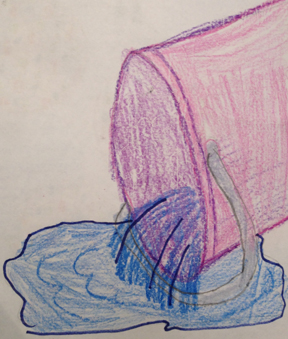
Emily's DreamShe set up a car wash and had a lot of people drive up, but her little daughter Mariah knocked over the bucket of soap water. Emily then tried to bake several cakes for a contest. The winner would receive $500. Unfortunately, Mariah poured all of the flour onto herself and the floor. She looked like a ghost.

Emily was sad because she was no longer able to raise $400 in time to be trained.

Emily's DreamEmily decided to make the best of the situation and took a picture of Mariah looking like a ghost. She shared the picture with friends on Facebook, who shared it with their friends.

The next day Emily got a phone call and learned that someone entered her ghost picture in a Halloween costume competition and won $400. Emily was thrilled and paid the fee to be trained.

Emily's DreamThe next day Emily learned how to train horses and had fun doing it. That night Emily listened to Mariah’s dream about racing horses. Emily told Mariah to hold onto her dream because it just might happen.

The final book stirred her parents’ hearts. She loved watching her parents’ genuine response to her incredible story. Her mom later explained how many times Gracie wrote books each month and I surmised that this little princess would be published before she graduated from high school.

But for now, she’ll have to continue learning more words and how to use them to spark the reader’s interests – Although her vocabulary is already bigger than I expected. I’ll look forward to promoting her first published book in the not too distant future.

Gracie, hold onto your dream of making books because it just might happen!

“Working Title” #10 – Have You Talked with His People?

© ktsdesign - Fotolia.comHollywood is filled with people who know people, just as in Chicago everyone knows a guy who knows a guy. If you want something done in Chicago, you need the right guy to introduce you to the guy that can get things done. In Hollywood, you need to be in touch with the people who are in touch with the person that can get things done.

Unfortunately, some times a person who can get you to the next right person wants more than you are willing to give up. Other times, they just want to add in their expertise to make the project better, which means you have to sift and sort through everything you hear before making a decision that might take your property in the wrong direction, or save it.

The difficult thing is trying to maneuver through the ideas while maintaining what makes your story great. Years ago I was a part of an incredible motion picture titled Legend of the Lightstone. The script was the most fantastic story I had read in years and I was thrilled to be brought on to direct it.

But, about the time I was working with Lucas Films Ltd, on the special effect storyboards, the producer and writer were in Hollywood to get a distribution presale. Every executive that had the power to suggest certain changes did so with a promise that it would make the story more marketable or bankable. The writer got excited and pumped out the changes, only to find that it wasn’t quite what the executive was looking for.

In the meantime, the writer went to additional meetings and met with the top executives in the business, who all added to the story. By the time the trip was done, I reread the story and hated it.

The thing that made the story unique was replaced by something familiar – More marketable. Its uniqueness was gone and it no longer had the luster that could make it great. The cast was no longer interested in being a part of the story, the distributors were no longer interested because there was nothing unique about it, and I was no longer willing to direct it.

With “Working Title” I’ve met with several top people in the industry and they each had something to share about the story. I’ve taken about 10% of the suggestions to heart and have walked away from the rest. In some cases, it didn’t change the connections, but in others it cut off our possibilities. Each incident was handled in its own way.

One Hollywood heavyweight read the script and was excited about the story. She was amazed that the story was so unique and fresh, yet captivating. She too had a few suggestions for the story, but told me to only consider it, if it helps the story. She was emphatic about me not changing the story unless her idea would work, because the story was already so well crafted.

David Coleman and I spoke on the phone yesterday. He is a co-producer at The Nerd Machine, a company he and Zachary Levi (Chuck, Thor: The Dark World, Tangled) started. Dave and I talked about co-producing “Working Title” and the strengths of the story. He too had a few concerns about possible changes, but not due to the story itself, but rather due to the actors we were interested in having star in the picture.

The conversation reminded me that some films are based on star power and others are based on story. The ideal film being one with a great story and great actors attached, which seldom happens. Only Sandra Bullock could play Ryan Stone in Gravity, only Robert Downey Jr. could play Iron Man, and only Michael J. Fox could play Marty McFly in Back to the Future.

No one is able to separate the great combinations. When one name comes up, so does the other. If I were to say Rocky, you couldn’t help but think Sylvester Stallone. The same holds true for Tom Hanks as Forest Gump, Dustin Hoffman as Tootsie, and Johnny Depp as Captain Jack Sparrow.

The key is finding the right balance between enough star power to draw an audience to the box office and enough story power to stir word of mouth for the film’s staying power in theaters.

I gave Dave the names of four stars I was interested in having play our lead character. It turns out he is best friends with two of the four, which can do wonders for our film. However, the actors need to decide if they can live with the story as it was intended, suggest minor changes to improve the development of their characters, or suggest significant changes if they are interested in being a part of something different.

My next decision would be to determine how important the star is compared to the story and decide to what degree I’m willing to be flexible, if at all. The core elements of the story can’t be compromised without changing the story to something different. I can always find a different story for an actor, but right now I’m focused on finding an actor that wants to be a part of this unique story.

We’ll see how the collaboration process works when adding in the actors. It took the writing team hundreds of days of intense collaborating to finalize the story that has been received well by many. Now we have to tweak it for the actors, but not change the core of it. After all, we don’t want another Legend of the Lightstone.

Copyright © 2013 by CJ Powers

“Working Title” #9 – Searching for Stars

We’re still on pace for an Aug. – Nov. production schedule for “Working Title.” To make sure key actors are available, we’ve started conversations with several. I’ve found it to be an interesting experience, as many significant actors are more available and at much lower rates than in the past.

With the top studios making far less pictures (11 in 2013) and the rest coming from independent producers (440 in 2013), we have a much greater selection of name talent than ever before. We also have a greater chance of developing new unique stories, unlike the studios that focus on sequels.

Some of the name actors find it difficult to determine which film project they should sign onto. The companies with the better stories are virtually unknown, while the known commodities in the production world have quickly thrown together scripts that are sure to fail without a great performance from its star. The paradox is that actors need great stories to up their performance level.

I spoke on the phone with a name talent’s agent this week and found myself laughing at his attempt to control the conversation and the negotiation. His technique would probably work if I represented a major studio, but he had no clue how to talk to an independent filmmaker.

I’ve produced seven films outside of the Hollywood system and can tell you that playing negotiation hardball with an independent is silly, because we’ll just select a different actor and open up another dialog. Independents don’t “need” the star, just a great actor. In fact, more actors have been “found” based on their performances in independent pictures than studio films throughout history.

Negotiating with an independent is all about building a relationship and understanding their style. Those two factors can create an impressive working relationship that leads to award winning films in the festival circuit. And, the connection will show up on screen, which will increase box office revenue that the star is more likely to share in – A rare experience for studio films.

This is not to say that a certain level of credentials have to be in place in order to make things work for all involved, but it must come from both party’s looking for a win/win scenario compared to the agent who demands to be in control for the sake of his win over everyone else’s loss.

The good news is that “Working Title” continues to move forward even though we’ve changed out some of our choice actors. However, the great news is that we’ve found new talent that is actually better than our first choices. The experience has also helped us to expand our search to those who have great box office draw overseas.

With China representing 50% of the market by the time our film releases, we are happy to have started searching for Chinese talent as well. It’s our hope that an international cast with well-known actors will not only help our box office appeal, but also expand our fan base. And, since fans in 144 countries already read this blog, it fits the direction we’ve been headed for some time.

Copyright © 2013 by CJ Powers