
Creating A One Sheet for Development

One SheetOne of the most common tools used by a producer looking for investors and a creative team to produce his story as a movie is a “One Sheet.” This is not to be confused with the poster, which is also called a one sheet. This tool not only helps in pitch sessions, but it also works as a great leave-behind.

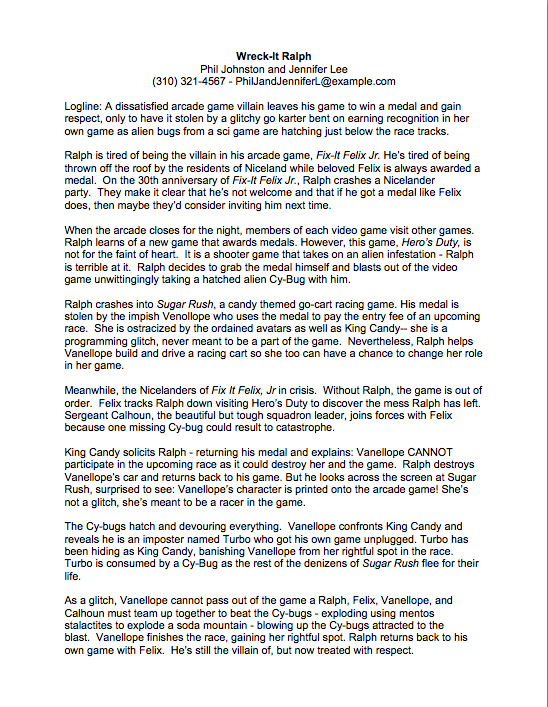
Example One Sheet – The King’s Speech

One sheets include:

1. The Title: The movie’s title is centered at the top of the page and is in bold type. It uses the same type  (Times Roman or Arial 12 pts.) as the entire sheet.

2. Contact Info: Directly under the title is the producer’s name. Directly under his or her name is the phone number and email address. Both lines are centered.

3. Logline: The logline is one sentence that represents the essence of the story. The Hunger Games logline might have been something like: When a young woman’s sister is chosen randomly to be placed in the Hunger Games, a televised fight to the death, she volunteers to go in her stead.

The logline reveals:

  1. The main character.
  2. His or her flaw.
  3. The obstacle he or she has to overcome.
  4. What’s at stake.

If possible, the logline should also reveal the irony of the story.

4. Story Synopsis: The synopsis is broken into four paragraphs representing content from Act 1, Act 2A, Act 2B, and Act 3. The content is broken down into the following paragraphs of information:

Paragraph One: This represents the background of the story and all of the key set ups. Anything put into this paragraph must be paid off by the fourth paragraph. Since the One Sheet is limited to one page, it’s important that the focus stay on the action plotline only.

The first paragraph should answer the following questions:

    • What is the world like?
    • Who is the main character?
    • What does he or she want and why?
    • What is his or her obstacle?

Paragraph Two: The second paragraph needs to address the following:

    • The steps the main character takes to achieve his or her goal.
    • The complications that make his or her goal difficult to obtain.
    • A focus on his or her objective and whether or not he or she is getting closer or farther from obtaining it.

Paragraph Three: The third paragraph needs to raise the stakes and put the main character at a point of no return. The idea is to make sure the main character can’t turn back and is forced to move forward because of the bigger stakes he or she faces.

Paragraph Four: The fourth paragraph is all about the pay-offs. Anything that is set up in earlier paragraphs must be paid off at the end. The paragraph also includes the climax and any lesson the theme of the story might bring out in the main character.

Some suggest the ending should never be given, but that is only true in movies without answers, thrillers and horror films. All other types of movies require the reader to comprehend the importance of the ending.

Copyright © 2013 by CJ Powers



Review: Audrey Bunny

Audrey BunnyAudrey Bunny is an important book for those younger years to help a child realize that they were made perfectly, including all their little imperfections. The story by best-selling author Angie Smith, is about a stuffed animal who fears that her imperfections make her unworthy of a little girl’s love. By the end of the story, the bunny learns her true value and that everyone is special and wonderfully made by God.

The illustrations are frame worthy and the story easy to follow for older children. The younger ones might need mom or dad to clarify parts of the story, as the author used subtext to stir the emotional story, which is welcome by adults, but more difficult for younger kids to understand.

Smith is the lead singer of Dove Award winning group Selah. She has authored numerous books including: I will Carry You, What Women Fear, and Mended. She also has a blog and is a popular speaker.

The book is now available in stores and online.

Product Details
ISBN: 9781433680458
Trim Size: 10.00 x 8.00 x 0.10 in
Page Count: 32
Weight: 1.03lb
Binding: Hardcover w/Dust Jacket
Status: Active
Publication Date: October 2013

An Investor’s Dream

Tax Free Money

The film industry is about to lose the federal tax program known as section 181 on January 1, 2014. This fiscal law allowed investors of motion pictures to expense out 100% of their investment in one year, compared to the normal amortization of investments over five years.

Not only did section 181 give the investor the ability to deduct the full investment in one year, but it also allowed the investor to use it two years prior to obtaining it or up to 44 years after obtaining it. In other words, if the investor needed to offset high incomes from 2011, they could file a corrected tax return utilizing the write off benefit from this year. Or, the investor could hold it until a higher than normal income year hit their books.

The good news is that filmmakers can grandfather in section 181 into their film project for use in the future. The grandfather clause allows the filmmaker to set things in place before January 1st and can be used at anytime within the next 44 years.

To qualify for grandfathering in section 181, the filmmaker must file the following by 12/31/13:

1. A completed screenplay.
2. A full budget top sheet.
3. Footage from one day of filming a scene.
4. Investor documentation.

The screenplay needs to be titled and copyrighted. It can be any length, but must qualify as a feature film. I believe 47 minutes is the current length for a film to be considered a feature by the MPAA. While the title can’t change, the screenplay can be 100% rewritten when the rest of the film is to be shot.

The full budget top sheet can also have changes made to it, but keeping the gross total the same will help the validity of the grandfather clause. There is a $20MM cap on the gross project cost and the details of section 181 would need to be reviewed for what portions of the budget qualify. There are specific rules about above the line and below the line items, as well as a certain level of spend being done in a “depressed” area.

One day of principal photography needs to include a segment from the screenplay and its dialog placed onto a DVD. The amount of footage shot or the number of hours it takes to capture it is not of importance. The footage doesn’t even have to make the final edit or include the final actors. Nor does it require a full crew. But, it does need to be clear that it’s principal photography.

The investment document that needs to be in place is the subscription agreement. However, it is safer to also have an operating agreement, the investor questionnaire, and the manager questionnaire. This deliverable also assumes that all the future investors will be accredited, so a private placement memorandum would not be needed.

If the filmmaker has all these items in place, he can sign investors on any year after 2013 and give them the full grandfathered in benefit, allowing investors to deduct 100% of their investment immediately or when it’s ideal for them, rather than amortizing it over five years.

And yes, if a filmmaker was creative enough and had a high degree of business acumen, he could set up several LLCs with these grandfather clauses for future films over the next 44 years. And, he could also sell some of those companies to other filmmakers who want to give the full benefit to their investors, as the company will retain the grandfathered in section 181.

The only issue is that the title of the film, the grand total of the budget, and the LLC paperwork must stay the same. And, with the new law that allows motion picture offerings to now be promoted on websites, it will make those smart filmmakers ideal candidates for investors who need a full tax write off.

One man shared last week that he owed $5.2MM in taxes and invested $6MM in a section 181 film. Because he was just barely above the 39% tax bracket, the dollar for dollar write off dropped his taxes down to $1.4MM. Because the numbers didn’t mathematically work for me, I asked a few more questions and learned he also used the film company’s tax credit to drop his number all the more.

In other words, by investing $6MM in the film, he saved $3.8MM in taxes, which meant he only had a third of his investment at risk. And, he shared that the film made $37MM in profit, so he was looking for another section 181 film to invest in to help offset his new tax issues.

Now is the time for investor savvy filmmakers to prep a few companies with the section 181 for their investors before it disappears in January. And, for those who already qualify, but their accountants don’t understand the tax relief program, they should fire their accountant and hire one that knows how to use section 181 to their favor.

Copyright 2013 by CJ Powers