

Check It Out – OPEN CASTING CALL

ChecK It OutA new web series will release in 2015 called “Check It Out.” The weekly show will feature movies, books, music and television shows that are worth looking into. While Check It Out is a review show, it will focus on finding the great entertainment that’s worth investing time in watching, listening, and reading. Its Facebook Page is at http://www.facebook.com/CheckItOutReviews

The show features two anchor co-hosts and several field reporters. It’s the producers’ hope to expand the series to include reporters from all across the globe, especially since entertainment continues to expand internationally.

Today the show announced its first OPEN CASTING CALL for individuals that live in or near New York, Los Angeles, Chicago, Orlando, Dallas, Nashville, Atlanta, London, Dublin, and Sydney. Headshots, resumes/credits, and links to sample video clips of talent presenting a review can be emailed to: auditions@checkitout.reviews

The show is a magazine review format with a strong, professional male host (40s or 50s) and a strong, motherly female host (late 30s to mid 50s). The male anchor will focus on action and adventure with a touch of tenderhearted moments. The female anchor will focus on the moral and educational with a touch of excitement. The format will include jovial conflict and lighthearted banter between co-anchors.

The field reporters can be any age, but must command a great screen presence. The ability to come across playful and share a deep passion for the arts is critical to the show’s success. Individuals auditioning should consider what makes them stand apart from others. Talent that looks and acts just like everyone else will not get the part. Talent that presents his or herself as an extremely unique person will not get the part.

There is a difficult balance between being interesting in a unique way and coming across as having tried too hard. The talent must stand out, but without becoming a gimmick or cliché.

Casting selections will be made through December and into January. Contracts and all phases of the auditioning process confidential.

When released, the show will be broadcast over an Internet channel, but the central location for publicity and archives will be at http://CheckItOut.Reviews and include bios of the talent, behind the scenes footage, fan pages and local stories.

Entertainment Value in Preshow and Post Show elements

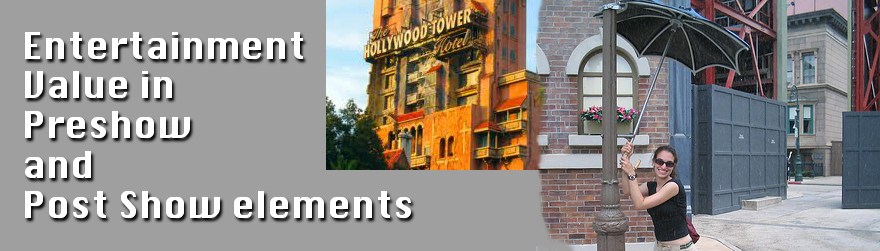
Tower of TerrorDisney is at the top in the entertainment world, always thinking about how to entertain their audiences. Disney’s Hollywood Studios has the same mindset and continually places small elements of entertainment just about anywhere someone could possibly get bored.

In the Tower of Terror, just after exiting the library, there are fuse boxes on the sidewall with handles. While most people will just pass by, thinking they are for atmosphere, a few brave souls will pull the handle and get an entertaining, or should I say shocking surprise.

Disney's Singing in the Rain UmbrellaOn a behind the scenes street some might notice that a streetlamp on the corner has an umbrella attached, just like Gene Kelly’s moment in Singing in the Rain. If a brave soul decides to stand on the black pad and pull the umbrella handle, a smile is sure to form on their face.

Those who are less bold, but still courageous, can climb on the Honey I Shrunk the Kids playground. And, if by chance the person sticks their arm inside of the dog’s nose, they are sure to be surprised by the dog’s reaction.

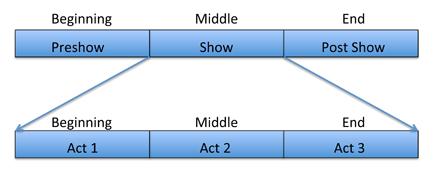
Entertainers want to delight audiences before, during and after their show. Disney always felt that the wait needed to prepare a person for the fun they were about to experience. It needed to warm them up to the world they were about to enter. He used preshow to set the tone and mood that would heighten the show itself.

Memorabilia quickly became part of Disney’s post show experience, as he wanted kids of all ages to find reminders of the wonderful experiences they had during the show. With the object comes the memory of a message worth holding onto that was promoted within the show.

Few independent filmmakers think through what activities might be a part of the preshow and post show entertainment value, but those who do, find greater success in the marketplace. Those who focus solely on the film’s message, create a weaker atmosphere that tends to allow the message to dissipate before the audience returns home.

Show ChartBy considering the preshow as the beginning of the story process and the post show as the end, a storyteller can encompass a broader story than his initial three act structure will allow. This gives him the ability to warm the audience up to his story and to help them remember it long after they’ve seen it.

All entertainment is about using story to make a point, while entertaining the soul. Anything short of this story structure reduces the entertainment takeaway value for the audience. Disney figured it out and always takes time for the details related to story.

Copyright © 2014 by CJ Powers

Unexpected — The Beginning, Middle and End

When little time exists during an interview or when I receive quick questions after a speaking engagement, the number one question everyone asks is, “What’s the single most important thing I need to understand about story structure?”

My answer is straightforward, “Your story needs to have a beginning, middle and end.”

At that point the person stops listening because they think they know how to make it happen. They are sorely disappointed that I haven’t given them a secret Easter egg of success. But I have and they’ve missed it.

All great stories are about movement, change and growth. The movement is reflected in the pacing and universal questions raised within the story. The change is based on circumstances and how it affects the character. And, the growth is the development of the character. The only way to demonstrate these issues and effects is through a three-act structure that has a beginning, middle and end.

The beginning is all about the character’s typical life in contrast to his dreams – Defined as the thesis world. The middle is about the character overcoming obstacles or battles, as circumstances keep the character from his dreams – Defined as the anti-thesis world. The end is all about how the character succeeds at overcoming his obstacles and ends up with his dream, but not as expected – Defined as the new thesis world.

BeginningBEGINNING: HELP THE AUDIENCE TO CARE
If there is no beginning, the audience can’t care about the character or relate to him. They can’t understand his dreams in contrast to his daily mundane life. Nor can they care to watch the rest of the film because they weren’t able to connect with him or be emotionally charged enough to care. But with a beginning properly in place, the audience will cheer him on to achieving his dreams.

MiddleMIDDLE: DEMONSTRATE WHAT SUCCESS LOOKS LIKE TO THE AUDIENCE
If the middle is missing, the audience won’t be excited about the character’s achievement. It’s only when we watch someone continue to preserver through the toughest of situations that we applaud their accomplishment, having overcome numerous obstacles. Also, without a middle, the audience can’t see past the normal or mundane. There is no need for hope or achievement, just status quo, which doesn’t make for a very good story.

EndEND: GIVE THE AUDIENCE HOPE
If the story has no end, then the audience feels ripped off. For it’s in the ending that we find hope of success and a new way of living. It contrasts the mundane or excessively difficult world we sometimes face and it provides a new hope for our own lives. We no longer see life from the point of us not being good enough or being squelched by the world. Instead we see a new hope that causes us to realize that we can make a permanent impact in our own life.

So, the most important part of story structure is having a beginning, middle and end.

And, not the kind that a person says is the beginning, middle and end, but a real one.

I recently talked with a filmmaker who stated that his short had a beginning middle and end. After watching it, I was not able to see all three elements. In other words, his film drove me to not care, see no practical demonstration of success, and take no hope into my own life. He had fooled himself into thinking there was a story structure in place when it didn’t exist.

All stories must have a beginning, middle and end, or it isn’t a story.

What do you feel are the most important elements of story structure?

COPYRIGHT © 2014 BY CJ POWERS