Show Don’t Tell – Unless You’re Christian – What!?!

I was working at Lucent Technologies during the beginning of my heart wrenching divorce. The battle to save my marriage was so intense that I dropped from one of the top ten employees, out of the hundreds holding my same title, down to the bottom of the barrel. I was laid off. Yes, I lost my job and marriage within weeks of each other.

A few weeks before I was escorted out of the office, one of my associates asked me if I was a Christian. It took me by surprise, since I hadn’t shared anything about my beliefs with him. I asked what caused his curiosity.

He told me that he watched my divorce meltdown and how I reacted to it, which was very different than what he had witnessed with others. He shared how I kept my tongue and made my decisions based on love, rather than the pain I was immersed in. He assumed that for me to be able to live in that manner required a supernatural force and he needed it confirmed.

Simply put, he had witnessed what I had shown, not said.

In writing and filmmaking we are taught: Show don’t tell. In Sunday school we are taught to tell. Jesus, however, pointed out the importance of action over words when he said, “My little children, let us not love in word, neither in tongue; but in deed and in truth.”

While he wasn’t telling us to not say anything, he was pointing out the importance of action behind our words. That same sentiment is a great rule in storytelling.

Ashley JuddI watched the movie The Identical this week and found that the film had two messages: The one that the writer forced into the story; and, the one that rose out of the story or the action plotline.

Because the movie showed certain decisions and actions, a theme rose from within it that was perfectly summed up in Ashley Judd’s (Louise Wade) dialog: “It’s a man’s job to learn to stand in his truth.”

The writer, however, artificially presented a different theme in Judd’s dialog: “If He is in your dreams, nothing can stand against them.” This is the same theme showing up on the Blu-Ray and DVD packaging due out on January 13, 2015, but it doesn’t reflect the true voice of the story. Clearly the shown theme was more powerful than the stated theme.

Showing is always more powerful than telling, yet in the Christian marketplace film investors continue to require filmmakers to tell certain things in their films rather than just show or demonstrate them. The odd thing is that it weakens the story, which should be of great importance to the sending of a message.

I also find it peculiar that in all of Jesus’s teachings done through story, he always showed the action to reveal the key point and he never told the point outright. So, why is it that when I watch a Christian or faith-based film that the point is always told to me in the most obvious fashion?

The most powerful films made over the past few years in America were either stories of redemption or patriotism. Both of which can only be shown, not told. Oh, and I’m not including those films that said they were redemptive stories, but really weren’t. I’m talking only about the films that were actually redemptive stories.

Like my associate at Lucent pointed out to me, the power in the message comes from the display, action or demonstration of the truth, not from the telling of it. This fact is something I hope Christian filmmakers grasp in 2015. After all, the story structure Jesus used in his parables was show don’t tell.

Copyright © 2014 by CJ Powers

Check It Out – OPEN CASTING CALL

ChecK It OutA new web series will release in 2015 called “Check It Out.” The weekly show will feature movies, books, music and television shows that are worth looking into. While Check It Out is a review show, it will focus on finding the great entertainment that’s worth investing time in watching, listening, and reading. Its Facebook Page is at http://www.facebook.com/CheckItOutReviews

The show features two anchor co-hosts and several field reporters. It’s the producers’ hope to expand the series to include reporters from all across the globe, especially since entertainment continues to expand internationally.

Today the show announced its first OPEN CASTING CALL for individuals that live in or near New York, Los Angeles, Chicago, Orlando, Dallas, Nashville, Atlanta, London, Dublin, and Sydney. Headshots, resumes/credits, and links to sample video clips of talent presenting a review can be emailed to: auditions@checkitout.reviews

The show is a magazine review format with a strong, professional male host (40s or 50s) and a strong, motherly female host (late 30s to mid 50s). The male anchor will focus on action and adventure with a touch of tenderhearted moments. The female anchor will focus on the moral and educational with a touch of excitement. The format will include jovial conflict and lighthearted banter between co-anchors.

The field reporters can be any age, but must command a great screen presence. The ability to come across playful and share a deep passion for the arts is critical to the show’s success. Individuals auditioning should consider what makes them stand apart from others. Talent that looks and acts just like everyone else will not get the part. Talent that presents his or herself as an extremely unique person will not get the part.

There is a difficult balance between being interesting in a unique way and coming across as having tried too hard. The talent must stand out, but without becoming a gimmick or cliché.

Casting selections will be made through December and into January. Contracts and all phases of the auditioning process confidential.

When released, the show will be broadcast over an Internet channel, but the central location for publicity and archives will be at http://CheckItOut.Reviews and include bios of the talent, behind the scenes footage, fan pages and local stories.

Entertainment Value in Preshow and Post Show elements

Tower of TerrorDisney is at the top in the entertainment world, always thinking about how to entertain their audiences. Disney’s Hollywood Studios has the same mindset and continually places small elements of entertainment just about anywhere someone could possibly get bored.

In the Tower of Terror, just after exiting the library, there are fuse boxes on the sidewall with handles. While most people will just pass by, thinking they are for atmosphere, a few brave souls will pull the handle and get an entertaining, or should I say shocking surprise.

Disney's Singing in the Rain UmbrellaOn a behind the scenes street some might notice that a streetlamp on the corner has an umbrella attached, just like Gene Kelly’s moment in Singing in the Rain. If a brave soul decides to stand on the black pad and pull the umbrella handle, a smile is sure to form on their face.

Those who are less bold, but still courageous, can climb on the Honey I Shrunk the Kids playground. And, if by chance the person sticks their arm inside of the dog’s nose, they are sure to be surprised by the dog’s reaction.

Entertainers want to delight audiences before, during and after their show. Disney always felt that the wait needed to prepare a person for the fun they were about to experience. It needed to warm them up to the world they were about to enter. He used preshow to set the tone and mood that would heighten the show itself.

Memorabilia quickly became part of Disney’s post show experience, as he wanted kids of all ages to find reminders of the wonderful experiences they had during the show. With the object comes the memory of a message worth holding onto that was promoted within the show.

Few independent filmmakers think through what activities might be a part of the preshow and post show entertainment value, but those who do, find greater success in the marketplace. Those who focus solely on the film’s message, create a weaker atmosphere that tends to allow the message to dissipate before the audience returns home.

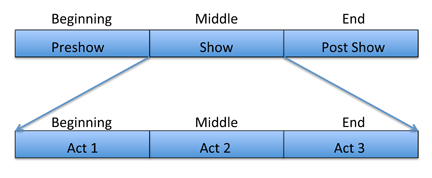
Show ChartBy considering the preshow as the beginning of the story process and the post show as the end, a storyteller can encompass a broader story than his initial three act structure will allow. This gives him the ability to warm the audience up to his story and to help them remember it long after they’ve seen it.

All entertainment is about using story to make a point, while entertaining the soul. Anything short of this story structure reduces the entertainment takeaway value for the audience. Disney figured it out and always takes time for the details related to story.

Copyright © 2014 by CJ Powers