

Few states tell us how to raise our kids. Illinois is now one of those states that says, “any minor under the age of 14 years whose parent or other person responsible for the minor’s welfare leaves the minor without supervision for an unreasonable period of time without regard for the mental or physical health, safety, or welfare of that minor” is being negligent.
The new law suggests that I would’ve needed a babysitter when I was 13 years old—a teenager. The funny thing, I was a babysitter for the little kids around the block at age 12. I was responsible, being raised by a police officer and teacher, and I knew how to keep the kids entertained. I even handled a faulty gas line fire both calmly and efficiently, making the parents thankful they hired me.
A few high school and college kids I knew were far less responsible and couldn’t manage an emergency if it happened. They allowed the kids under their supervision to wreak havoc, creating a huge mess for the parents to clean up after their return.
And what about the fact that our 13-year-olds are allowed to watch a single occurrence of natural frontal nudity and hear two F-words in a PG-13 movie, but they can’t stay home alone for a subjective unpublished time frame?
The law does allow you to leave your child for a “reasonable” amount of time, but if a neighbor makes a call suggesting negligence, the state can take the child into custody without a warrant. Once a court date is provided, the judge has 15 non-exhaustive factors to consider in determining the guilt of the parent. Unfortunately the courts do not provide a list of criteria to help the parent determine if his or her 13-year-old can be left alone for a short time.
I’m a firm believer that most parents know if their 13-year-old can be left alone and for how long. I’m also confident that the government has no idea if a young teen is capable of being left alone, regardless of the period of time in question. This perspective suggests that the new law was put in place as a tool to punish a very small percentage of people who are negligent when it comes to raising their kids.
The problem with a law aimed at so few, rather than being a law for the majority, is that it opens the door for someone wanting to abuse or hurt a healthy family. It only takes one phone call to engage the system and pull a kid from their home until the issue can be resolved in court.
Worse yet is the list of 15 non-exhaustive factors a judge can use in making his or her determination. This list is not available to the general public (at least not at the time I wrote this blog), which means parents don’t know the criteria that their parenting skills are being judged on.
And, what happens if the political landscape changes and a new list warns the judge about children living in what might be considered an overzealous “religious” home? Can the government eventually define healthy parenting as those who “protect” children “from” religion until they become adults? That’s the way it is in some countries.
Whenever laws are put in place to punish the few instead of protecting the many, we find more restrictions placed on our lives, which takes away another piece of our freedom. Historically, specific and objective laws were designed for the majority of the people and the few oddball cases were determined by the judge based on the intent revealed by the majority of the laws.
Abuse becomes too prevalent when laws become highly subjective and parents are being measured by a list that is not available for their review. Our society has become so focused on protecting the few that we’ve lost sight of how we protect the majority.
I hope we protect all children who face abuse, but we do it without jeopardizing the freedom of the majority of our children. There has to be a better way. Shouldn’t lawmakers look for it?
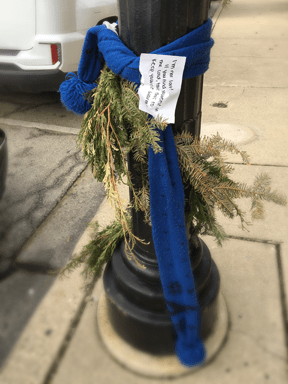 I walked downtown this morning to make a bank deposit, return a book to the library, and send a Christmas package to a dear friend. The walk was lovely with old lampposts decorated in garland and red ribbons. But something was a bit different on the next lamppost I approached.
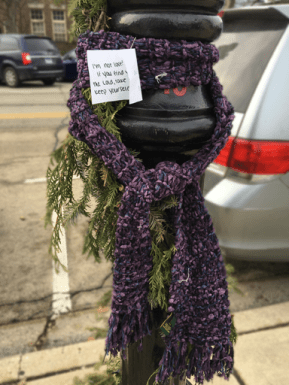 Then I spotted another scarf, and another. Glancing across the street I noticed others scattered among various lampposts. The Christmas cheer was plentiful and I wondered how long it would be until those in need received comfort and warmth. I turned back to my path and continued toward the library.
 The cold drove me down the street faster than normal with the hopes of stepping into the next shop for warmth. Handing out promotional rack cards to every business in town was difficult due to the whipping wind. While I loved the freshness of the Chicago breeze during other seasons, winter typically saw the wind chill drop below zero, which was once again the case.
