 Placing the razor to my face, which was lathered with shaving cream, became difficult when the lights flickered. I had skipped shaving yesterday, so it was important to finish. After a few strokes, the lights went out and I faced the dilemma of going to work with a partially shaved face or hunting for a flashlight in the dark.
I banged my hand into the door as I reached for the doorknob. The handle was not where I had imagined. Once found, I opened the door to a window-lit bedroom and spotted my cell phone laying on the desk. After swiping up for the flashlight, I moved into the bathroom and positioned the light on the right side of my face. There was enough bounce light coming off of the glass shower door to illuminate my left side. Within a few minutes I was clean shaven and curious.
There was a rythmic thumping noise coming from outside my unit near the hallway. Faint voices bantered back and forth, so I figured they spoke on the topic of the day—the electrical outage. Choosing to take a very short shower, I jumped in and lathered up in record time, but I hesitated to rinse when I heard a plea for help. I stood motionless trying to hear the words being uttered.
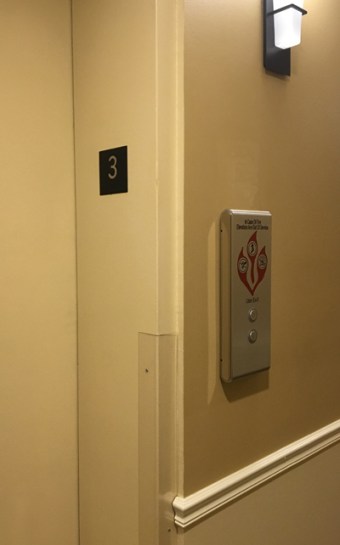
My shower backs up to the elevator and I realized someone was trapped inside. I scrambled to dry off and get dressed with the understanding that taking time to help the woman would make me late for work. I chuckled as my mind flashed back to the end of work yesterday. In that moment I thought about providence.
Circumstances caused me to work an additional hour past my normal quitting time. One of the owners told me to come in later the next day to avoid overtime. So here I was staring providence in the face with an hour given me in advance to help calm the woman and her anxious dog. I was amazed and immediately focused on making sure the woman was okay.
She and her dog had been trapped in the pitch black box suspended around the third floor for 10-15 minutes. The woman’s voice trembled with fear as she responded to someone a floor lower shouting about the phone in the elevator. The backup battery had failed and the phone line was dead.
I looked for the elevator key, but there was not a breakable glass case that held the key. “I’m going down to the first floor to get the elevator key,” I said.
“Thank you,” she responded with a tone of relief in her voice. Her confidence level was boosted.
I moved swiftly down the hallway lit by a couple fading emergency lights and was thankful that the staircase was still lit. On the first floor I bumped into the building manager who providentially arrived seconds earlier for a planned meeting. “The fire department is on the way,” she said.
“I’d rather the woman trapped in the elevator not have to wait any longer,” I said. “Let’s grab the elevator key and I’ll head upstairs and speed her escape.”
The building manager moved quickly to the glass case and noticed it was cracked open. The key was gone. “I’m not surprised,” she said. “The new laws only allow police and firemen to open an elevator door in emergencies.”
“Today would be a good day for an exception, is there another key somewhere else?” I asked.
She took me into the elevator room where the equipment is stored. As we entered, she threw the light switch to the “on” position and nothing happened. Then she laughed.
“Don’t worry about it,” I said. “You did it out of habit.”
She nodded and scanned the room for a backup key, but couldn’t find one. Then the thought hit her. “There’s probably one in the Knox-Box,” she said. We headed toward the one hanging in the foyer. After struggling to get into it, she remembered the one at the backdoor.
I watched her struggle with it. “Don’t worry about it, the firemen are here,” I said when I noticed the reflection of red lights flashing on a pane of glass.
The building manager walked out to the Fire Chief car, but no one was there. I circled back to the front door and went outside to see if he was doing a quick inspection of the surroundings.
“There’s a woman trapped in the elevator on the third floor,” I said.
“Is the electricity out?” he asked.
“Yes.”
The Chief got on his radio and instructed his team of the situation. He entered the foyer and met with the building manager. They went to the Knox-Box at the front door and found no elevator key. She took him next to the one at the back door, which was also void of an elevator key.
“I have a universal key in my car,” he said. “I’ll get it.”
“Shouldn’t one of the smaller keys open the elevator box next to the elevator? Won’t there be an elevator key there?” asked the building manager.
“Yes, but it’ll be faster to grab my keys.”
Soon a fireman dressed in full gear carrying an axe entered the foyer with keys in hand.
“Oh, don’t bring that axe in here,” said the building manager. “We don’t want anything destroyed. There is a key.”
The fireman held up a metal loop of a dozen different elevator keys. “I’ve got the key right here. Where is the woman?”
“I think she’s stuck between the third and fourth floor,” said the building manager.
“She’s on the third floor,” I clarified. I’ve already talked to her and she’s expecting me to come back up with the key. I can take you there.”
The fireman signaled for me to lead the way. I was being followed by two male firefighters, a female firefighter, and the building manager. When we got to the elevator door the fireman started working his loop of keys, but couldn’t find one that seemed to engage the mechanism needed to open the door.
“Shouldn’t we get the key from the Knox-Box to open the elevator lock box and get the key we know works with this elevator?” asked the building manager.
“I have every known elevator key right here,” the fireman said as he lifted the loop of keys.
“Okay,” said the building manager with a huff.
The fireman worked a key, then another and another. Then he pulled the loop back and the keys slipped, forcing him to start the search over.
I thought about providence and wondered if it was about to show itself once again. Just then the lights in the hallway came on. The building power had been restored.
“Should I turn the elevator back on?” said the voice over the fireman’s radio.
“Yes, turn it on,” he responded.
The sound of power surging was heard. “The lights came on,” shouted the woman trapped in the elevator.”
I leaned toward the door and said, “Push the door open button.” The door opened and her shaking dog charged into the hallway. The woman followed with a broad smile on her face. Everyone was relieved.
Realizing her predicament the woman asked, “Is the elevator working now?”
“Yes,” answered the fireman.
“Well I need to take the dog downstairs then,” said the woman. She stepped back in the elevator, but her dog fought to stay out.
“It’s good to get back on the horse after a fall,” I said. “The dog will need to rebuild his confidence.”
The woman looked at me and nodded. Then she gave the dog a big yank and his little feet slid across the carpet and entered the elevator. She pushed the first floor button and the door closed. She was back on schedule to letting her dog outside.
I stood in awe of the team of people who gathered to help the woman. After watching everyone head toward the staircase, I turned toward the opposite staircase and passed by many congregating in the stairwell with questions and stories to share.
One man who followed me asked, “What happened?”
“Providence was able to save the woman before any of us could,” I said.
I opened the stairwell door and we were met by a lady with lots on her mind. “I just got off the phone with the power company,” said the lady. “They said there was an accident and they lost power to 155,000 buildings in the area. They also said the power will be on in about two hours.”
I smiled and quietly stepped away from the group. I glanced back and saw the man who had followed me step away from the group. He seemed to be in a daze. As I entered the garage I heard him mutter, “He knew something happened. I want that ability.”
Copyright © 2018 by CJ Powers

 There is a clear distinction that I’ve noticed between average and above average films. Most audiences pick up on the vibe, but can’t put their finger on the “why” behind the flat performance of an average film. Add to this the convoluted approach to look-alike pictures and it’s easy to understand the drop off in theater attendance.
 Independent filmmakers are known to dive into projects without fully developing their story. Some come up with a cool scene idea and toss together a film to facilitate what’s in their mind’s eye for that 2-3 minute segment. The words that flow from their lips two years later is something like, “It didn’t quite turn out the way I pictured.”