

7 Strategies for Producing a Quantity of Ideas

© James Thew - Fotolia.comDuring my senior year in college I had a professor tell us that we didn’t need to read the 880 page text book if we didn’t want to. It was a great relief to me, except the way he shared the comment caused me to question why he might say what he did. I dove into the book and consumed it within a few weeks.

I was all the more amazed to learn that 100% of the students in the class did the same thing. It drove me to ask the head of the communications department about how often books are actually read. He stated that there was only one book in one particular class that had 100% readership every semester.

There were two grades in the class, one for participation in discussions and another for a semester end report on the topic of our choice. The class was the most amazing one I had taken throughout all my years of study and I attribute it to one comment the professor shared just before he told us we didn’t have to read the book.

“This semester, I only have one goal for this class. I’m going to teach you how to think.”

My mind has been racing ever since.

This past weekend I shared with a friend that the proof copies of my latest book arrived. She could tell by the tone of my voice that I was happy with the accomplishment. In fact, there was a certain level of excitement, not wanting to wait a couple more weeks for the book’s official release.

That positive energy caused me to share how far along I was on my next book, which generated an interesting response, “Don’t you ever stop and rest?

The amount of writing I do on a regular basis could fill about six books a year. Between emails, business documents, blog posts, e-zines, screenplays, and books, I seem to have no lull in the ability to think up things to write about. I attribute this to God’s gifting in my life and what my professor taught us about thinking.

According to my professor… Thinking up new ideas is simply about coming up with something original by incorporating random elements into the creative process to deconstruct existing patterns in order to reorganize them in new ways. Simple…right?

Here are the 7 strategies that can be used to accomplish this above definition:

1. Continuous Thinking

People think every work needs to be of high quality, but over time those who produce a volume of work end up with the greatest of works. Thinking often is the key to productivity, invention, innovation and achievement.

Michael Jordan is known for his incredible shots and held the record as the highest scorer in basketball history, and, the record for the most misses. Bach wrote a cantata every week and Mozart generated 600+ musical scores. Thomas Edison created 1, 093 patents by assigning himself the duty of inventing something minor every 10 days and something major every six months. Einstein published 248 papers including one on relativity.

2. Combinatory Play

Taking time to randomly put various combinations of ideas together will develop some of great value. This process must be done in a playful form as it involves the conscious and subconscious thinking process.

The Scientific Genius, published in 1988, suggested that geniuses are considered genius only because they take more time creating unique or novel combinations of existing ideas than the normal person. This act of randomly combining or recombining images, ideas, thoughts, and so forth, into new combinations both consciously and subconsciously generates even more new ideas than most people take time to think through.

Einstein’s equation of E=mc2 was developed by just looking at energy, mass and speed of light in a new way. He didn’t invent the concepts, but instead just established a new perspective that changed our world. And, for Einstein it was all about having fun. He called his process “combinatory play”.

3. Change the Juxtaposition

Shifting the juxtaposition of an idea through time, space, category or other non-related venues or circumstances, will create something all together new.

Samuel Morse, who invented Morse code, was trying to figure out how to produce a signal strong enough that it would survive across the country. One day he watched horses being exchanged at a relay station and juxtaposed the idea of using relay stations with his cables. This led to the invention of relay boxes or repeaters to boost the signal numerous times to get it across the country. Morse would not have succeeded, had Leonardo da Vinci not first made the juxtaposition of water ripples with the sound of a bell ringing, thereby realizing that sound traveled in waves.

4. Combine the Incompatible

Everyone knows that you can’t combine incompatible things without some form of ramification, yet the new combination typically drives change and new ideas. While most people will say it wouldn’t make sense to combine the incompatible, geniuses do it to force a new breed of thinking when looking at a problem.

Niels Bohr tried hard to combine the idea that light is a particle and a wave. This thought pattern allowed him a new perspective that led to the principle of complementarity, a fundamental principle of quantum mechanics.

5. Transfer the Metaphor

Finding some form of resemblance between one area of life and another was considered by Aristotle to be a sign of genius. By finding those relationships from unlike sources, allows us to think in new ways and develop ideas never considered.

It only took Thomas Edison one day to invent the phonograph after he saw the resemblance between a toy funnel and the motion of a paper man and sound waves. Alexandra Graham Bell invented the telephone after comparing the inner workings of the ear with the membrane used to move steel.

6. Find it in Failure

The number of inventions that were accidentally created when someone was working on another invention is staggeringly high. Rather than conducting a review of a failed attempt on what was intended or expected, the question that can advance the creative process and innovation is “What have we done?”

Thomas Edison was struggling with how to create the filament for light bulbs and to calm his nerves he played with some putty stretching and twisting it – Leading to the idea of twisting the carbon like rope. B.F. Skinner invented more things than what he set out to do because he would shift to whatever he found interest in rather than operating according to his preconceived plan.

7. Collaboration of Elements

Collaborative outcomes seem to always be greater than the sum of the individually presented elements. This is accomplished by a team of people allowing all ideas to grow, without shooting down any of them. During this process no one has to tell anyone that their part of the idea won’t work or isn’t any good, as everyone will see what portions of the ideas build on the whole and raise the level of excellence with little effort.

The greatest lesson about thinking doesn’t come from what we are supposed to think about, but rather some of the ways to think. For instance, if you were told to count the number of O’s in the below diagram…


O   O   X   O   O   O

O   X   O   O   O   O

O   O   O   O   X   O

O   O   O   X   O   O

O   O   O   X   O   O

O   O   O   O   O   O

Would you count up all the O’s?

Or, would you count up the X’s and subtract it from six rows times six columns? By counting the O’s, you see things the way the system taught you to see it. By counting the X’s, you’re finding an alternative process that saves you time and gives you a unique perspective in life.

Like all creativity, there is no right or wrong answer, just a new or old perspective. By thinking according to the old perspective, we will come up with the same ideas that hundreds of others will have, but by thinking in a new way we can create and develop new ideas that have never been considered before.


Attention Getting Devices Embedded in Scenes

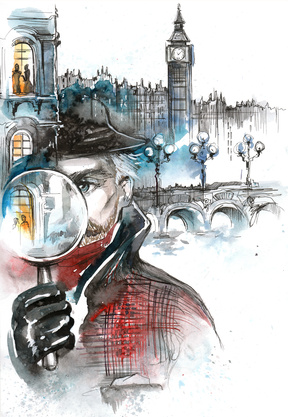
SherlockSpeakers start off their talks with some form of attention getting device. Newspapers use a headline to draw the person to a newsstand in hopes of them picking up a paper. Book authors try to capture the reader with a snappy cover, title and great first paragraph. Movie posters use imagery and star power to attract the passerby. Even movies open with some opening imagery or teaser to pull the audience into the story in the first 2-5 minutes of the film.

Attention Getting Devices are more important today than any other time during our history of communication. With attention spans dropping from 20-30 minutes in the 1960s, to 8-12 minutes in the 80s, to 90 seconds to 2 minutes in the 2000s, it is more important than ever to not only grab the attention of the audience, but to keep it.

Mega box office features use large scale, fast action, and cool visual imagery as attention getting devices. Dramas use a point of fascination within the story coupled with raising a question within the audiences’ mind about how the story will paly out or resolve.

I was chatting with screenwriter Guy Cote last night about how attention getting devices are no longer restricted to just open a film, but are now needed in a more subtle, but still effective form within each scene in a movie. It’s Guy’s view that there has to be something special in every scene that entertains the audience and I agree.

I looked back at the courtroom drama we co-wrote, Tried & True, and realized we did that very thing. Every scene has some form of entertainment in it, which forces the story into a more cinematic mode, compared to the film being limited to a direct to DVD release or television.

The BBC’s Sherlock MOWs are fascinating, as every scene has some entertaining nugget or reveal in it. I’ve watched all 7 episodes and can hardly wait for the 3 that will be released this year. Each 90-minute episode could be successful in theaters and keep the audiences’ attention, but the BBC decided to release it on television – In my opinion, raising the standards of television.

The average number of stars on a 10-point system that critics have assessed the Sherlock shows is a 9.2 over the 7 episodes. This is amazing when you think about maintaining such a high quality of story within 10 stories over 3 years. Its no wonder the series is a huge success internationally – Everyone loves a high quality entertaining story.

Here are some of the attention getting devices that are salted throughout every scene in Sherlock:

Universal Question
A question in the form of a mystery is revealed at the beginning of every episode. This drives the audience to watch the film until they get the question answered. In most episodes the question is associated with a murder that must be solved within a certain time constraint to drive the audiences’ need to know the answer with a sense of urgency. In some scenes additional questions get raised or it’s revealed that the universal question has more parts to it.

Relationship Reveals
The unique relationship between Watson and Sherlock is like an onion that has one layer peeled a way with each story. The characters are both clearly experts in their fields, which generates mutual respect and a sense of friendly unspoken competitiveness. This drives the audience to know more about how and why they get along so well, even when the relationship appears dysfunctional or miraculous – Both very entertaining prospects worth exploring.

Hyper Focus
Sherlock’s level of genius brings boredom into his life all too quickly. He needs extremely difficult puzzles to solve or his insanity rises. This demand on his soul for stimulation drives him to observe the tiniest of details and drives a fascination in the audiences’ mind as they watch genius at work. Everyone loves watching extreme experts do their thing like Michael Jordan playing basketball, Luciano Pavarotti singing lyric opera, and Sherlock solving unsolvable cases.

The above attention getting devices are salted generously throughout each scene. These entertainment moments are embedded organically in each scene making it’s existence mandatory for the progression of the story. In fact, I can’t recall seeing any scene that didn’t have to be in the film. Nor was there any scene that didn’t have something specific for the audience to enjoy or chew on.

The series also used a good deal of humor to help the audience rest just long enough to be refreshed and then reengaged into the mystery. By allowing the audience to get their emotional wind back, they were ready to receive more information and attempt solving the case as junior detectives. Each viewer was bound to walk away from an episode longing to be more like Sherlock, or at least feeling driven to be the best in their field.

Copyright © 2013 by CJ Powers
Illustration © okalinichenko – Fotolia.com

Filmmaking Resources

© Ilyes Laszlo - Fotolia.comI’m often asked for book recommendations and other resources that cover various techniques someone desires to learn. My answer is typically non-specific, as I’ve learned most of my information from pros in the industry. However, I do take time to read books and magazines written by friends and other industry leaders who are known for specific information.

For instance, I’ve had a couple opportunities to work with Dr. Linda Segar who has great insights concerning character development, hero based story structure, and translating a book to the screen. Each of her books has a handful of nuggets that have stayed with me over the years. She also consults for those who like to pick the brains of brilliant people. I believe her biggest selling book is Making A Good Script Great.

Several books from my library on story and screenwriting that have become dog-eared from certain chapters being reread include:

The Coffee Break Screenwriter by Pilar Alesandra
The Story Solution by Eric Edson
Screenwriting 434 by Lew Hunter
Story by Robert McKee

There are a lot of other great books published by Lone Eagle, Focal Press, Michael Wiese Productions and Penguin Books, to name just a few.

For those working with smaller crews, I recommend Craig D. Forrest’s book: Commando Tactics for Digital Filmmakers.

My latest reads and rereads include:

Professional Storyboarding by Sergio Paez & Anson Jew (Note: Excellent book!!!)
On Directing Film by David Mamet
The Film Director Prepares by Myrl A. Schreibman
Directing Film Techniques and Aesthetics by Michael Rabiger

I mix up my reading between books on business, story, creativity, screenwriting, directing, filmmaking, biographies and fiction. I made a commitment to read a minimum of 12 books a year since I joined the entertainment industry. However, that number changed once I learned that a person can become an expert in a few short years by reading every book and article they can find on a given subject. I now read the equivalent of two books a month on average, taking into consideration interview transcripts and trade articles covering industry pros.

Of course, there is one new book coming out in July that is a must read…

Notes from the Napkin: A Director’s Cut on Filmmaking by CJ Powers

Okay, so a little self-promotion isn’t too bad, right?

My new book includes some of the most read articles from CJ’s Corner and other chapters based on questions new and independent filmmakers have asked me or that I’ve asked of the Hollywood pros. Since a lot of my most used knowledge came from 2-5 minutes spent with people like Ron Howard, Christopher Nolan, Wally Pfister and Ken Burns, I thought passing on my notes from the “napkins” I’ve collected over the years would be of help to the reader.

There are film techniques still done the same way as it’s been done since the early 1900’s and other techniques that are developed every year. To stay on top of this information there are numerous trade publications and websites available for gleaning this information. The lists below are just a smattering of what is available.

Screenwriting
Hollywoodlitsales.com
Donedealpro.com
Scriptpipeline.com
Writerstore.com
Script-o-rama.com
Scriptologist.com
Inktip.com
Wordplayer.com
Moviebytes.com

Filmmaking
Filmmaking.com
Filmmakers.com
Filmfestivals.com
Wihtoutabox.com
Insidefilm.com
Zap2it.com
Projectgreenlight.com

Filmmaking Terminology
Filmland.com/glossary/Dictionary.html

Film Buffs
Imdb.com
Moviejuice.com
Aint-it-cool-news.com
Rottentomatoes.com
Filmthreat.com
Filmsite.org

Screenwriting and Filmmaking Magazines
Creative Screenwriting
Screenwriter
Script Magazine
Imsdb
Fade In
Hollywood Scriptwriter
Moviemaker
Screentalk
Film Journal
Filmmaker Magazine

Industry Publications
Hollywood Reporter
Variety
Daily Variety
Back Stage
Premiere
The Independent: Film & Video Monthly
Written By (Writers Guild of America, West)
DGA Quarterly