
Workplace Wisdom from an Entertainer

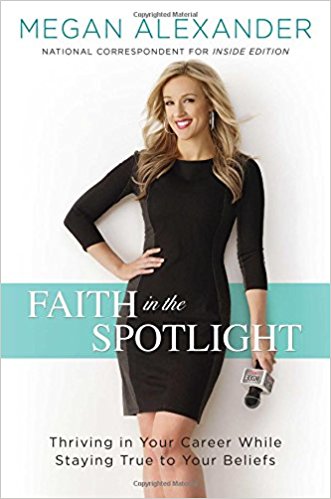
BookI met CBS’ national correspondent for Inside Edition, Megan Alexander, last week. She was a speaker at a film and television conference I attended and had a signing for her latest book Faith in the Spotlight. Between the pages are applicable suggestions designed for the person that wants to honor their faith, while thriving in the professional workplace.

Her husband Brian is a man committed to their relationship and family, a standard that she can count on in her weekly travels. Brian engaged me in a short chat and I soon realized the sacrifice their family quietly suffers in order to help and encourage professional woman (and men) to influence their marketplace with wisdom, advice and good ole fashioned morals.

Megan lives with her family in the Nashville area and commutes to New York and other locations for 3-4 days each week. It takes a toll on her and her family, but they know it is the right thing to do at this time. But being the right thing doesn’t stop a professional woman in the entertainment world from facing unhealthy and relentless demands that Megan must counter to maintain her faith.

“You gain strength, courage and confidence by every experience in which you really stop to look fear in the face.” Eleanor Roosevelt

A clear example from a couple years ago was Megan’s “after the Oscar” segment that challenged her beliefs. When she came into the studio that morning, the wardrobe person pointed to the dress she was supposed to wear. It was a knock-off dress made for less than $100 designed to look like the $5,000 dress Angelina Jolie wore on the red carpet.

The dress was provocative including a slit that went so far up the leg there wasn’t much left for the imagination. In that moment Megan was faced with a career decision that might compromise her faith. She took a few minutes to think about how to solve the problem and reached for a black conservative dress, suggesting someone else would be better suited to show off the white dress.

Not only did the contrasting dress allow her to maintain her beliefs on what’s proper attire to wear, but it demonstrated to the audience a valuable lesson on how great professional women can look without compromising their beliefs. Another lesson came from the moment that was helpful to everyone in the room.

Most compromising situations can be precluded if we think through several scenarios we might face every day.

Megan learned that talking about a less expensive version of a red carpet dress is an annual segment after the Oscars®. She now knows to chat with wardrobe in advance of the show to predetermine the types of dresses she will wear. She also learned that the wardrobe person is only doing their job based on the directives given from the segment producer.

In her climb up the career ladder, Megan has attended several churches that catered to stay-at-home moms with morning Bible studies. Her needs for fellowship and spiritual encouragement were not facilitated by the churches because she didn’t fit the stereotypical model of a Christian woman.

The person impacting millions of people every week had no one ministering to her.

It didn’t take long for Megan to start her own Bible study. She still gets together every week with a group of women in New York for encouragement and camaraderie in maintaining their faith in the entertainment industry. And yes, you would know every woman in the group if I shared their names.

Every one of us needs to have accountability to maintain our beliefs. Megan’s new book Faith in the Spotlight gives golden nuggets of wisdom that are practical and easy to apply. Her words come from the heart and are laced with years of experience navigating a fickle industry where you can be “the toast of the town one day and yesterday’s news the next.”

Take it from a woman who has to battle fierce competition where “someone is always looking to take your job or steal your spotlight.” Megan knows what it takes to stay relevant and her book empowers the reader to do the same. This book is for anyone who wants to thrive in their career, while maintaining their beliefs.

Copyright © 2018 by CJ Powers

 

The Shape of Best Picture

Academy AwardsThe Shape of Water took home the Best Picture Oscar® and was the perfect choice in reflecting the media’s interpretation of who we as a country have become. The picture presented the LGBTQ community in a positive light and as the new norm of society, even though it makes up less than 2% of the population. The story also focused those with a liberal we/they political mindset to a new enemy and quickly divided the audience.


The antagonist, or the uber bad guy in The Shape of Water, was a white, Christian man who required his wife to submit and loved shooting guns. The proxy antagonist was a white, male business owner who, after being propositioned by a homosexual, refused to serve the man going forward. Both men were put into the light of being extremely evil.

Three Billboards Outside Ebbing, Missouri was snubbed, in the name of politics, even though it was a better choice. That’s not to give my stamp of approval for it, as I’d prefer a couple films that weren’t nominated due to its lack of politics.

In Three Billboards, the protagonist treated everyone the same and demonstrated unity. No dispensation was required of any people group, as everyone in the film was equal. The protagonist and antagonist had a profound respect for each other. While neither backed off of their heated position, they treated each other with a commendable amount of dignity. They shared laughs and tears, and made sure each one’s opinion was clear and respected, regardless of the conflict between them.

Some say the large increase in Academy members included people that haven’t mastered their craft, but are politically far left, making a difference in the award outcome. While minorities were limited in the past and the pendulum swinging wide will help balance the industry, many members are now voting based on politics for the sake of balance, rather than on art.

I watched all nine movies nominated for Best Picture and disagree with the outcome. While The Shape of Water was brilliantly made, the story was working overtime with its heavy-handed political agenda—destroying the very art it was creating. Three Billboards respected the audience and provided a unique look at political issues that are worth considering by both sides.

Last week I was at a conference with numerous filmmakers and television producers. I had a chance to talk with many of them and watched seven film premieres. Most of the pictures took the we/they approach of an overt, in-your-face presentation. But one film, which brought me to tears, demonstrated a respect for the audience and stirred everyone in the room with what I’ll call “the right way” to present inclusion. I’ll share more about that film in a future post.

This year’s Best Picture is a perfect selection if the award is to represent the political climate in our nation. Many filmmakers have jumped on the bandwagon of overt content to further the phenomenon of dividing our culture with the we/they mentality—a sad commentary.

Art, when done without an overt and disrespectful agenda, helps the nation look at important issues, while uniting both sides in the name of healthy progress.

Unfortunately, The Shape of Water did not respect the audience and elevated the LGBTQ community as the new norm, which in of itself might help the pendulum swing to a healthier place, unless the lack of respect neutralizes the effort. Three Billboards shared the same valuable message without alienating or disrespecting its audience.

I’m a firm believer that films should artistically stir change through exploration, not politics. And, the award for Best Picture should be given to the best crafted film, not to the one with an in-your-face political agenda. So, call me old fashioned, because the trend is not likely to change until filmmakers that believe in the intrinsic value of storytelling get funded.

Copyright © 2018 by CJ Powers

If you’d like to help fund me one cup at a time…

Buy Me a Coffee at ko-fi.com

Selecting The Best Story Angle

The Angle of StoryI have a friend that found an incredible story that’s worthy of being developed into a screenplay. When he first told me about the true events, he talked about it from the perspective of the children. After chatting on the phone with the family, he shared the story again, but this time from the mindset of the mother. When he introduced me to one of the children, I heard the story from the father’s viewpoint. It was clear that the real life elements, or story beats, were significant enough to impact everyone in the family, giving us several choices in how to develop the motion picture.

After analyzing the information presented, I broke the elements down by each potential story angle to determine which one was best for the film. The categories I used included emotional beats, high stakes at risk, and entertainment value for the audience. The weighting of each category helped determine from what angle the story would be told.

EMOTIONAL BEATS

Film is an emotional medium that requires a story with passionate and poignant twists and turns. While beginning filmmakers think the story must first drive home a valuable message, it’s the emotional throughline that earns the right for the filmmaker to speak a message into the audience’s lives through the B-plotline. Those who try to craft the message within the action plotline soon find their story meanders or falls flat. The action plotline must take the audience on an emotional roller coster ride to properly make use of the medium. The film should therefore be from the perspective that drives the main character through a series of actions that heighten the emotional appeal and the story’s consequences.

Some of the films with clear emotional beats include: Les Misérables, Star Trek 2009, The Blind Side, The Darkest Hour, Schindler’s List, and The Wizard of Oz. These stories were well developed and crafted for the screen. The films were visual and hit every story beat that takes an audience on a journey of exploration. The stories argued both sides of a specific message in a way that enticed the audience to side with the filmmaker’s beliefs.

HIGH STAKES AT RISK

The character with the most to lose typically finds themselves in circumstances that amps up the volume of the emotional beats. This is critical to drive the story to its climatic conclusion. While stories typically have comic relief or temporary lulls in the action, so the audience can catch their breath, the story must be driven by choices that turn into physical and visual action. A “talking-head” plotline, where the main character spews forth nothing more than teachable moments, does not move the story forward or raise the stakes. The throughline must overcome the rule of diminishing returns, which is only possible by raising the stakes.

The rule of diminishing returns relates to the weakening of the audience’s buzz. The college student who gets his first car is excited to drive a secondhand clunker because its his. When after graduation he gets a normal car, he finds it difficult to get excited if he has to drive a clunker again. After a wonderful promotion and driving his upscale company car, the newly married driver struggles to find the excitement in driving the minivan on weekends. With every increased excitement, comes the rule of diminishing returns that makes it harder to generate the same buzz experienced in past events.

P.T. Barnum was a showman who used the rule of diminishing returns to his advantage. Everything he did had to increase its shock value to draw in an audience during the depressed era. Curiosity drove the people to purchase tickets over and over again as Barnum kept increasing the amazing acts within his show. Film is the same way. The audience must be taken on a journey that continues to amaze. The good news is that a director can use techniques to reset the audience’s expectations before every emotional increase so his story doesn’t get out of control.

ENTERTAINMENT VALUE

At today’s high ticket prices and costly cable packages, audience’s demand their monies worth. They want to be taken on a journey that they’ve never been on before or introduced to a character that they can learn about for the first time. To accomplish this goal all stereotypes must be dropped by the filmmaker. He also must find ways of allowing his unique character to directly impact the plot based on his or her choices. The audience must find the story fun in order to watch it a second time, or stirring enough for those who like to have a good cry. A great story with fantastic production values are always at the top of the box office list or award categories—due largely to the embedded entertainment value.

The Oscar nominated film, The Shape of Water, takes the audience on a alien-like journey in time during the Cold War. The audience is also introduced to a compassionate, mute woman. Her unique circumstances and personal drive grabs the audience’s attention, whether they agree or disagree with her life choices. While the film is a far left propaganda piece, it’s entertainment value drives curiosity among conservatives who may revisit their political views after watching the filmmakers perspective.

Developing a cinematic story with great emotional beats, high stakes at risk, and emotional value, earns the filmmaker the right to speak into the audience’s life. The result is consideration by the audience of the filmmaker’s argument, but only when the picture is properly developed using the above proven elements.

Below you’ll find a button to buy me a cup of coffee. Any money raised through this process will go toward the purchase of podcast equipment for a weekly show that explores the creativity and messages in the latest motion picture releases. So please help by clicking…

Buy Me a Coffee at ko-fi.com

Copyright 2018 by CJ Powers