Developing a 4D Character

It’s easy to develop a single sided character, by saying he’s a maverick or any other stereotypical label like thief, Boy Scout, or law student. Using a well know label allows you to dive directly into your plot, requiring less screen time to develop the main character. However, using stereotypes hinders you from making a character driven film.

Writing an intresting character.Developing a paradox within the character gives you leverage to expand the single story into multiple sequels or a series. Adding in the opposite characteristic under certain circumstances develops the paradox and a far more interesting character.

Pierce in M.A.S.H. was such a character. He hated war, but could never leave a wounded person behind. Every time he was due to leave another chopper filled with the wounded was inbound, forcing him to override his hate of war with his compassion for the wounded. His conscience wouldn’t allow him to walk away from a wounded person no matter how passionately he wanted to leave the war zone.

Adding a third dimension to a character, based on an internal secret that the audience doesn’t know, develops a greater emotional range and a far more realistic character. Many actors develop this angle within their own character to create realism, so it would only be natural for the screenwriter to supply it. The story angle could be absurd or devastating, but needs to be something the main character would never share. An example might be the main character having been raped by his drunk, abusive mother who never remembered the incident once she sobered.

The fourth dimension requires a reality factor that is birthed from within the main character’s surroundings. This is the opposite of the standard process of creating supporting characters that slowly reveal certain truths about the main character as the show progresses. While all the standard books will tell you the reveals must come from the other characters, which is why they are called “supporting” characters, the 4D process requires the main character to adjust his thoughts and actions based on who he interacts with.

This new 4D process was developed to reflect the real life scenarios of how people ebb and flow in conversation with the people or person they are currently communicating with through dialog. Some of these elements naturally happen, as a screenwriter writes conflict into the dialog. When planned out, the main character can be even more interesting and complex.

For this to work properly, the main character has to adjust his comments and actions based on those around him, or their absence. The best way to explore this dimension is in the form of a demonstration to the below questions. Whatever it is that he does, how does it make him act or respond:

        1. When he is alone?
        2. When he is with another person?
        3. When he is in a group?

Once you have this fourth element in place and you’re able to demonstrate it under one of the above circumstances numerous times throughout the film, you can then break the habit of him doing the action to instantly reveal that he has changed or grown.

This tool works best in showing how the character eventually grows to overcome his circumstances or the antagonist. The more subtle the demonstrated change, the more realistic the character and the story. These simple steps make it simple to create a compelling complex 4D character worth watching.


Copyright © 2012 By CJ Powers
Photo © Elnur – Fotolia.com

Directors Stage Shots and Block Actors with Triangles

The human eye moves around a room or watches a scene based on leading lines and points of focus. The art of capturing the eye and encouraging its movement in a specific direction is done through composition. There are many types of composition like “L”, leading lines, rectangles, spirals, etc. The study of these forms is typically taught using the rule of thirds, or the golden rule section or ratio.

The cinematographer is well equipped to use these various techniques, but he first must learn what the director is trying to accomplish with the actors as they rehearse or block out their movements. The director will try to create emotional energy within the scene and shift the power between characters. It’s the cinematographer’s job to capture that engagement by racking focus, using a crane, or creating movement with a dolly. The goal of the set up is to help the audience feel and understand what the actors are emoting.

The more actors on set, the more difficult the staging of the shot becomes. The simplest way for the director to capture the essence of the scene and leverage the ability of his cinematographer is to block the actors in groupings of triangles. This can be done by height, distance from the camera, or with three various groupings.

Director sets shot with triangular grouping of actors.

The director blocks the actors in three groupings within a triangle.

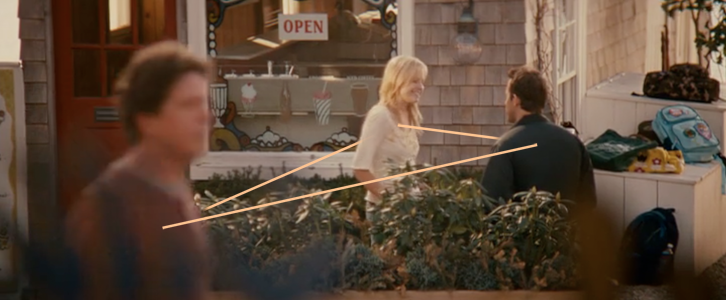
In “The Proposal”, during the engagement announcement scene, the cinematographer uses three groupings of actors (orange boxes of people grouped in a triangle with red lines) with one close to the camera, the next mid way, and the last group farther away. In the last grouping, the actors were grouped in a mini-triangle (blue lines) by the director.

Three-shots can easily be turned into triangle blocking based on distance from camera, actor height, and relative position if one actor stands while others sit. Sometimes the director uses a momentary triangle, as someone walks past in the foreground or background, to break up the obviousness of the blocking.

While still shots might reveal various compositions utilizing triangles, motion pictures will many times interrupt the posing aspect that the composition might encourage with movement. A cinematographer may also choose to rack focus between points of the triangle to create more eye movement.

Copyright © 2012 By CJ Powers
Photos © Touchstone Pictures

Movies Told in 8 Sequences

When a painter wants to capture an image on canvas from a photograph, he typically will divide the picture into quadrants in order to focus on the detail and maintain proper proportions. Filmmakers do something similar by dividing their story into 8 sections.

The question most often asked is “why 8?” when the story is based on a three-act structure. The answer comes from history. In the early days of the cinema, 20-minute reels were delivered to theaters with about 15 minutes worth of film on each reel. When the reel was played, a little dot in the top right corner of the film would appear toward the end of the reel to notify the projectionist it was time to switch to the next reel on a second projector, giving the audience a seamless uninterrupted experience.

The camera manufacturers built their equipment with 20-minute reels knowing the cinematographer would get about 15 minutes of story out of each reel. When television came along, the 15-minute standard was adopted and videotape was designed for about 15 minutes of programming on a 20-minute reel or cassette.

Directors and editors found themselves constantly working in 15-minute increments in order to tell their story, so they quickly adapted to the standard and learned how to tell stories incrementally through a series of sequences. Even television directors got on the bandwagon and tried to heighten the last scene on every reel to keep the audience riveted in hopes that they would continue watching after the commercials.

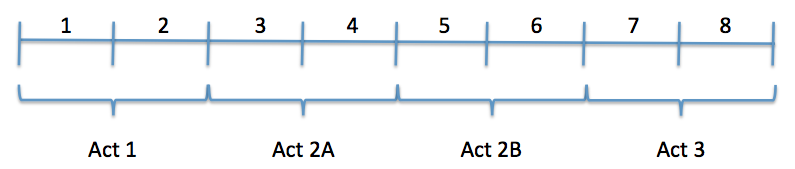
The typical 2-hour movie is therefore made up of 8 sections of 15 minutes each. Since dramatic screenplays are written in a way that one page equates to one minute of screen time, the average 2-hour movie is 110 pages in length. There is also an average of one scene per minute of screen time, which gives the screenwriter 12-15 scenes per sequence in order to tell the action plotline. A mixture of shorter scenes and sequences gives enough room to salt in an additional subplot or two.

Act 1 is comprised of two sequences. Act 2 is divided at the midpoint creating two sequences in Act 2A and two sequences in Act 2B. And, Act 3 is also made up of two sequences. In between each Act is a turning point that sends the main character in a different direction than expected, which catapults the viewer into the next segment of the story.

I recently wrote a coming of age story titled, “The Tree Jumper.” It’s about Jeremy, who is a geeky X-game enthusiast who falls in love with the head football cheerleader, Brianna. He struggles to understand the unconditional love that his blind grandmother teaches him that Brianna deserves, compared to the conditional love she receives from her quarterback and football MVP boyfriend.

Here is how the story unfolds in 8 major sequences:

S1: Jeremy uses his X-gaming skills to “soar” anonymously through the trees to save the MVP’s life during the football team’s team building rafting disaster.

S2: Jeremy becomes infatuated with Brianna and encourages her to enjoy “flying” in her cheerleading maneuvers, rather than being confined to the bottom of the pyramid by her fears.

S3: Jeremy learns that Brianna is dating the MVP and awkwardly tries to learn what it takes to court a girl so he can say and do the right things to win Brianna’s love away from her uncaring boyfriend.

S4: Chloe adores Jeremy so much that she agrees to help him win Brianna based on who he is, not old customs from days gone by.

S5: Jeremy becomes confident enough that he shares his love for Brianna publicly and brings the wrath of the MVP down on himself.

S6: The MVP and key players from his football team go out of their way to stop Jeremy from winning Brianna.

S7: Jeremy realizes that true unconditional love would free Brianna to choose whomever she desires to love and would honor her choice. He walks away so the MVP can continue his relationship with her.

S8: The MVP takes Brianna on a joy ride to help her break her fear of heights in his family Cessna and crashes in the trees hanging precariously over the gorge just out of the fire department’s reach. Only Jeremy, the tree jumper, can get to the plane and saves both Brianna and the MVP. Brianna has a blast “soaring” through the trees to safety and realizes that Jeremy’s love for her isn’t conditional like the MVP’s.

Each sequence breaks the story into manageable bites and is structured to fit the new 8-segment format for a movie of the week. It also establishes the proper parameters and durations for the three-act structure that feature films use. All because someone delivered 15 minutes worth of film on a 20-minute reel just shy of a hundred years ago.

Copyright © 2012 By CJ Powers