
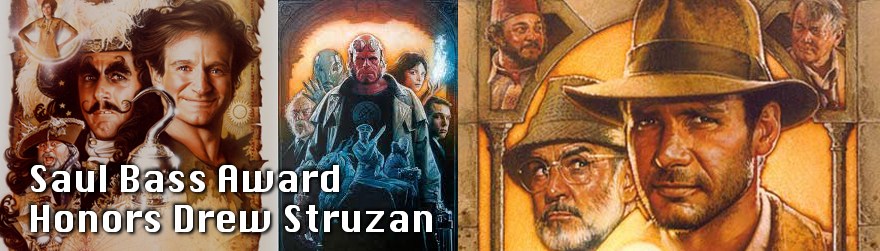
Saul Bass Award Honors Drew Struzan

StruzanThe Hollywood Reporter’s Key Art Awards created the Saul Bass Award to honor graphic designers in the film industry who created their own iconic and influential style. The recipient of the award must have a body of work that stands out among the competition and inspires others in the film industry.

The creative design community considers Saul Bass as the most iconic and influential graphic designers in filmmaking. His 40-year career inspired several generations of artists, designers, students and directors. He worked for Hollywood’s greatest filmmakers including Alfred Hitchcock, Otto Preminger, Billy Wilder, Stanley Kubrick and Martin Scorsese.
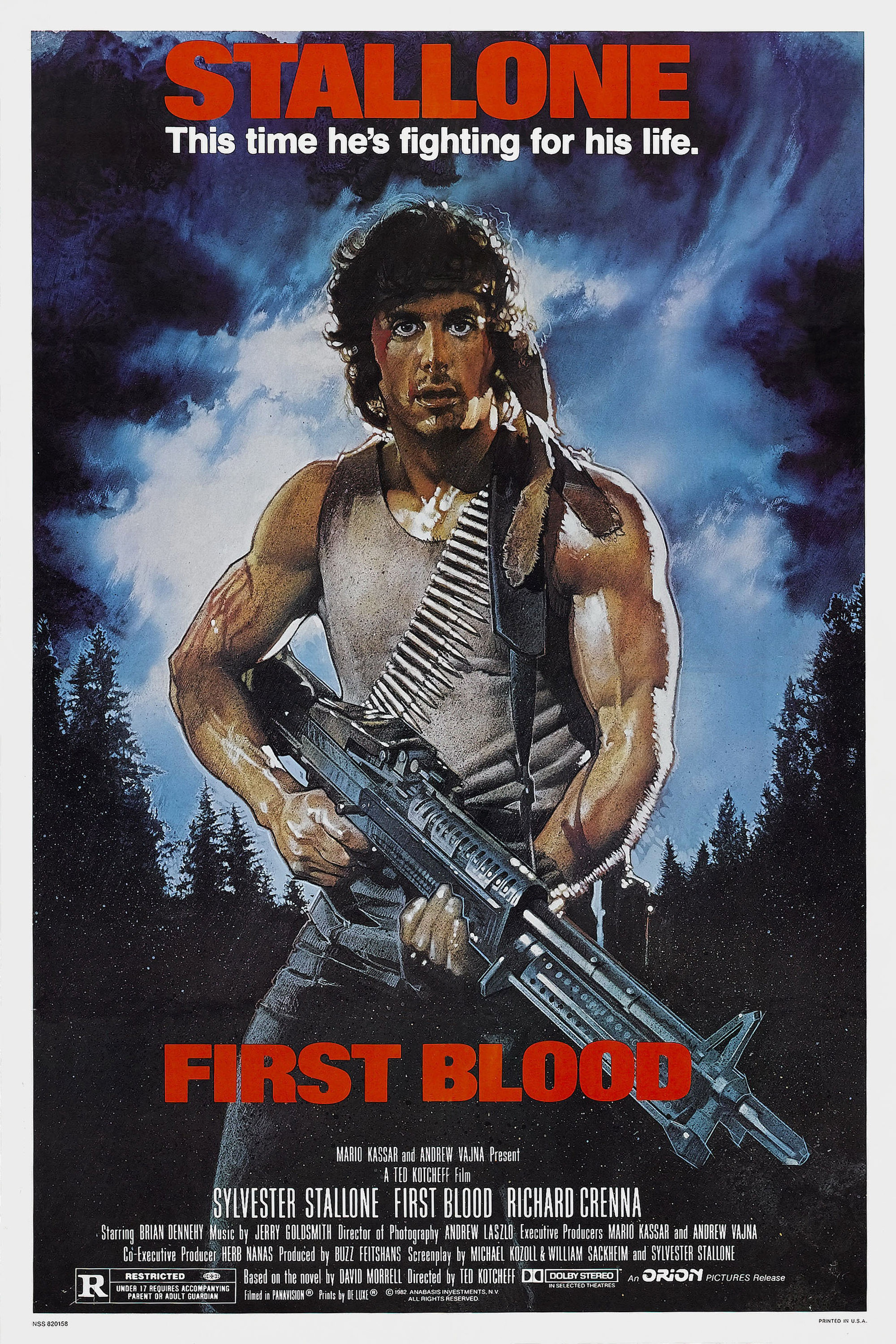
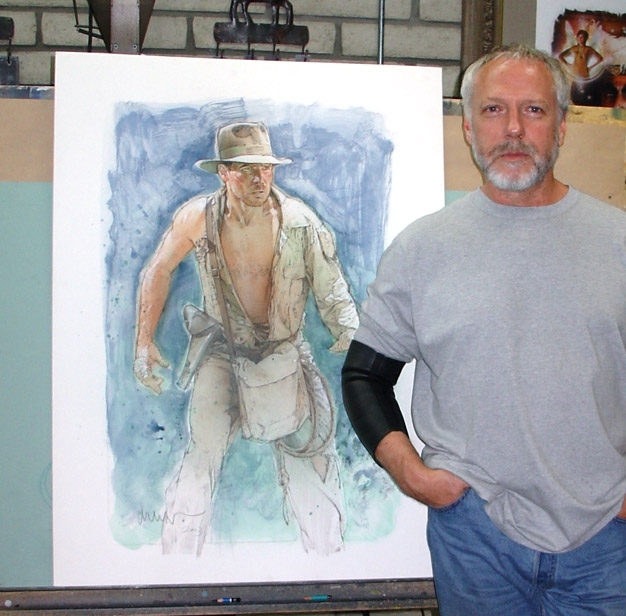
Rambo: First BloodThis year’s winner of the Saul Bass Award was Drew Struzan. He painted more than 200 posters over the past four decades including Back to the Future, Star Wars, Rambo, Indiana Jones, and Pan’s Labyrinth. His style is uniquely his and brings a sense of the film’s narrative to life, while creating a reminiscent sense of going to the movies.

Struzan got his start in the 70’s painting record covers for recording artists from Roy Orbison to Liberace. In 1975 his Alice Cooper cover caught a film producer’s attention and he’s painted posters ever since.
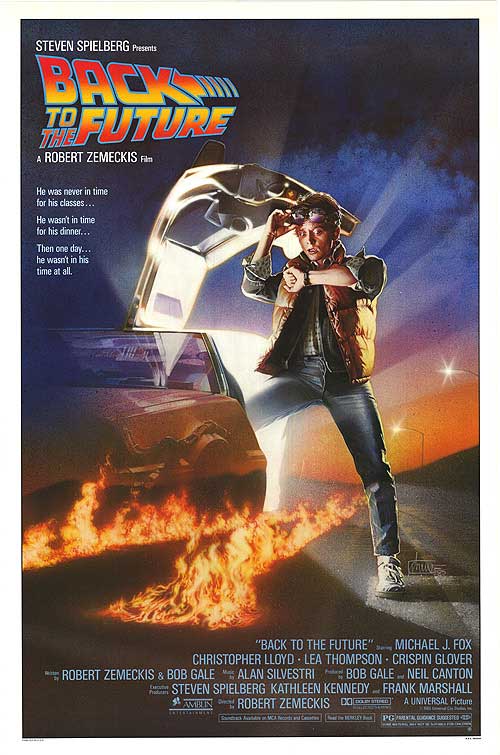
Back to the FutureMy favorite poster of his was for Back to the Future. It captured the key elements of the film, while expressing the feelings the movie generated in its audience. The surprised look on Marty McFly’s (Michael J. Fox) face, the fire trails and the streaks of light beaming out as the DeLorean fades into the past.

“My job,” says Struzan, “is to capture the spirit of the movie – How it feels. People will see it because they want to feel that emotion. It becomes iconic when they can have that feeling every time they look at the poster.”

Episode1Struzan has an eye for the nuances that a camera seldom catches. Whether it’s a pensive look or one of a startled character, Struzan worked to seize the feelings of the moment. His unique style drove a new generation of collectors to expand the practice of collecting movie posters to an all time high. This fueled the collection of original movie poster art by top collectors and museums worldwide.

It’s no wonder that The Hollywood Reporter’s Key Art Awards honored Drew Strazon for his life long work in 2014.


Copyright © 2014 by CJ Powers

Hollywood Fights Disclosure Laws to Learn Who You Are

© IvicaNS - Fotolia.comThere are two arguments in the world of media that concern audiences. First, is Hollywood wanting to know who you are and what you watch, so they can contour programming to fit your likes for the sake of building a stronger catalyst for their advertisers. Second, are filmmakers that make strong programs that attract new anonymous audiences as a repercussion of the show’s cultural influences.

One sets you up to influence your buying decisions of specific brands and the other impacts your cultural decisions to purchase more things and experiences over all. Either way you address the subject, it’s all about Hollywood training us to worship the economy above all else.

NETFLIX uses algorithms to determine a person’s viewing taste and then promotes similar films to that viewer. By turning on NETFLIX at a friend’s house, a person can see an entire promotion list of different shows than what he or she would see at home, unless the friend has very similar tastes.

This methodology is not limited to a single company. For years the cable industry has collected data on audience viewing habits, but by law was not able to share the information with the networks. However, now that cable providers also own programming to compete against Internet offerings, the networks are stuck behind laws that hinder their knowledge of who’s watching, while the competition already knows who you are and what you watch.

One of the reason’s advertisers shifted to support cable programs comes from the knowledge of what you watch. They wanted to save ad dollars by placing their spots only on the shows their target audience views. Not only would their budgets have a higher conversion rate in generating sales dollars, but they would also be able to conform their universal commercials into taste specific ones.

The resulting battle for this information puts the Video Privacy Protection Act of 1988 in peril, as companies fight to know “personally identifiable information” about you. This becomes even more important as companies like HBO, CBS, and ESPN all release new subscription services this fall to compete against NETFLIX.

Current court battles based on alleged disclosures of what you watch includes Hulu, Cartoon Network, Disney Interactive and AMC Networks. While some of the allegations include combining information with Facebook, others are more straightforward in pin pointing ad tastes.

Yes, big brother is alive and well in Hollywood and many companies know your viewing habits, cell phone IDs, and video device IP addresses. They have enough information to push key programming your way in a slow progressive manner to alter your cultural choices. But, what they want next is to sell this information about you for capital gains.

Can you imagine a new political arena where you are slowly fed certain programming over four years to change your conservative voting pattern into a liberal one? Or, what about training you over eight years to change your desires about where you live or the car you drive? These tools have been in place since the 90’s.

It wasn’t coincidence that had a half dozen shows promoting a black president and a woman president for a few years before the 2008 elections. In fact, if you look at a map of viewing choices per top television markets and overlap it with presidential results, you’d see an obvious correlation.

There is no longer a conversation about whether or not the media impacts society, it does. The court allegations of today is whether or not your personal information can be sold to other companies so they can present their messages to influence your decisions in the near future.

What are your thoughts?

Should your personal information be sold so you’ll only receive ads designed just for you instead of being heaped on by thousands of ads that you don’t care about?

Or, should the companies that provide your purchased services hold your private information?

Copyright © 2014 by CJ Powers

GLEN CAMPBELL…I’LL BE ME — Review

Glen CampbellSeldom do I recommend a documentary, as most fall short of great entertainment value. However, after watching GLEN CAMPBELL…I’LL BE ME, I felt compelled to let everyone know that it’s a picture worth seeing – especially for Glen Campbell fans. (In theaters October 24, 2014.)

The documentary follows Campbell on his “Goodbye Tour” that was a part of his and his family’s way of combatting his Alzheimer’s disease. He was diagnosed in 2011 and chose to go public, making history as the first celebrity to share his experience with the world.

The intense drama and the love of fans rooting him on gave rise to joyful tears, as I watched Glen and his wife Kim demonstrate unwavering love and devotion to each other through the tour. Even the doctors were amazed by how well Glen performed in spite of his memory loss, as if music was a special gift entwined by God into the fabric of his soul.

Glen and Ashley CampbellOther highlights included Glen’s daughter Ashley performing a feature piece with him and his kids Cal, Shannon and Ashley participating in the band. Heartfelt on-screen comments were also shared by Bruce Springsteen, Paul McCartney, Jay Leno, Vince Gill, Keith Urban, Brad Paisley, Steve Martin, and Taylor Swift among many others.

The film opens with rare vintage footage that reminds us of how humble, upbeat and happy of a man Glen was, especially on stage. With the tone set, the film openly shares struggles and celebrations Glen walked through during his tour, climaxing with his latest song, “I’m Not Gonna Miss You.”

Director and Producer, James Keach, is a graduate of Northwestern University and the Yale School of Drama. He appeared in over fifty feature films and has produced and directed theater in Chicago, New York, and Los Angeles.

James produced many films, but his recent favorite “Walk the Line” captured a nomination by the Producer’s Guild of America for Motion Picture Producer of the Year. Walk the Line also won a Golden Globe for Best Motion Picture and generated Reese Witherspoon’s Academy Award for Best Actress.

Glen CampbellWhen asked, James shared his final thoughts about the project and his experience…

“Here was a man that was told to hang up his guitar, go home and enjoy what life he had left. But he wanted to sing, laugh, make love, play music and celebrate life until it was taken from him. Glen always had a joke on hand, and was the most brilliant, country boy I had ever met. He called his disease “part timers,” and he always maintained a strong sense of humor and spirit. Glen defied all odds and performed 151 shows over a two-year period. We shot over 1,300 hours of footage of the tour. There were ups and downs, but the highs far outweighed the lows. Glen was full of love and light, and even in the darkest times of his confusion, he always showed signs of his true self.

“This is the most important film I have made in my career. In witnessing the Campbell family’s journey, I learned so many life lessons. Glen has taught me to love, and to truly live in the moment.”


Disclosure of Material Connection: I received one or more of the products or services mentioned above for free in hopes that I would mention it on my blog. Regardless, I only recommend products or services I use personally and believe will be good for my readers. I am disclosing this in accordance with the Federal Trade Commission’s 16 CFR, Part 255: “Guides Concerning the Use of Endorsements and Testimonials in Advertising.”