Solving Problems When You Don’t Feel Creative

CandleBoxTacksWhen I was in college, Oktoberfest was a big celebration in Wisconsin. One year, the local radio station had a competition to find the hidden medallion. The winner received thousands of dollars’ worth of prizes, major media coverage, and was honored in the parade. Every morning the radio station broadcasted a clue to help people find the medallion that was hidden somewhere within a half-hour radius of the tristate area along the Mississippi.

Known for my creativity, numerous people asked if I was going to solve the puzzle and reap the rewards. I decided to give it a try and found myself following the clues to within an inch of the medallion. I even rested my hand on the stone that covered the medallion. But I never lifted the stone to find it. Why? Because I had a functional fixedness bias from my childhood.

A common game we played in our childhood was called Hide the Thimble. The rules were that the person hiding the thimble had to place it in plain sight, so it could be seen from at least one angle without anything blocking it. My heightened observation skills made me a natural at winning that game. But in the case of the Oktoberfest medallion, there was no rule of it having to be in plain sight. I assumed the rule because of my functional fixedness.

The emotional pain I experienced when the station announced where the medallion was hidden, having had my hand on that very stone, was intense. I cringed when I realized that the reason the stone wobbled under my hand wasn’t that it was uneven, but because part of it was sitting on top of a medallion. Argh!

Today, I’m very conscious of any form of bias. I also practice interrupting patterns on a regular basis. The reason I work diligently at breaking away from functional fixedness is that innovation demands my mental freedom and the longer a person continues in functional fixedness the harder it gets to break free and think creatively.

Functional fixedness is a bias that hinders creativity—limiting people to only use an object in the way it was intended to be used. The opposite of functional fixedness is reflected in MacGyver’s ability to use common objects in a different way than originally designed. It takes a tremendous amount of creativity to use unrelated objects together for a solution, like using a cellphone camera as a mirror, a brick as a doorstop, or a quarter to unscrew a screw.

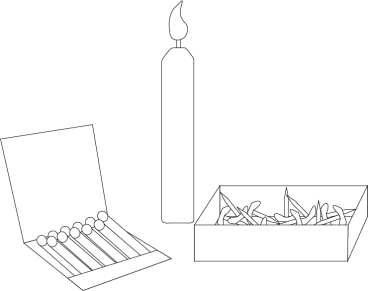
In moments when we feel less creative, psychologists suggest that we are likely caught in the functional fixedness mindset. This concept was first introduced by Norman Maier in 1931. By 1945, psychologist Karl Duncker designed a test to determine if a person held the bias or not. The test included a candle, a box of thumbtacks, and a book of matches.

The test subject was to solve a simple problem. The goal to find a way to hang a lit candle on the wall using only the materials provided. The person with a high degree of functional fixedness was not able to see the box of tacks as part of the solution. He could only perceive it as the container holding the useful thumbtacks.

The unhindered creative solution had the person dump the tacks out of the box. Place the box on the wall using thumbtacks and placing the candle in the box. Then the matches were used to light the candle. This simple solution is mentally blocked for many people who hold a bias that they are unaware of.

Unfortunately, many people who realize they are no good at solving these types of problems seldom take time to break the bias and improve their creativity. They typically state that they aren’t creative, allowing their functional fixedness to grow more powerful. The only way to reduce our unhealthy biases is to build and empower our creativity.

There are three steps I use to break free of functional fixedness:

Explore the Problem using Make-Believe

Today’s culture suggests that problem-solving is a logical practice because of functional fixedness. To use the right side of our brain, where most of our non-diagnostic troubleshooting skills reside, we have to make the problem abstract. This can be considered a form of play, which opens our mind up to all possibilities.

Sometimes I pretend that I’m living in a sci-fi world where normal rules of nature no longer apply. This creative world-building allows me to look at a problem from new vantage points because it distills the issue down to its core elements—surface issues that typically hold our attention due to bias fade away.

Drawn from Alternative Fields of Knowledge

Once I’ve exposed the bare essence of a problem, it is easy to see similar issues being worked on by professionals in other fields. This allows me to draw from their expertise in how they work the basics and transfer them to my situation. This process typically fuels my creative thought process and feeds me new perspectives and ideas worth exploring for my specific problem.

Play with the Inspired Possibilities

At this point in the process, my thoughts are freer of bias and I continue to play with the ideas. This is the stage where I keep all possibilities open for as long as I can, not wanting to take just the first solution that pops into my head. The playful stance during this phase of the process allows me to explore multiple solutions so I have a few to choose from.

Freeing our creativity requires the breaking of strongholds like functional fixedness. A bias never self corrects, so we must purpose to change our viewpoints. By acknowledging our bias, we can focus on strengthening our creativity and fuel our future with a greater ability to problem solve and innovate—making us a valuable resource for our company, community group, and family.

© 2019 by CJ Powers

If this article has helped you, please consider helping me offset the costs associated with this blog by clicking the button below.

Buy Me a Coffee at ko-fi.com

The New Season of Creative Mindfulness

fashion art coffee macbook pro

Photo by OVAN on Pexels.com

I remember the changes that occurred in business when upper management altered its focus to an innovative mindfulness called a paradigm shift. Every executive I knew was searching for a new way of looking at processes and conducting business. Changes in operations led to consolidations and the tossing out of unneeded practices. Even sales teams shifted their selling techniques to fit the changing marketplace.

During the fourth quarter of last year, a new mindfulness started to appear. Fresh research was published by Linked-In, Adobe, and the Forrester Group. All of the results and documentation pointed to the emergence of this new mindfulness being that of creativity. Executives at Fortune 500 companies started to pay attention to the fact that creativity was directly correlated to business success.

In his new book, Creative Calling, releasing on September 24, 2019, Chase Jarvis shares how the practice of creativity in business will soon be established as a standard for a healthy employee. The creator of the Creative Live website takes it a step further by insisting that creativity will be considered just as important to each day like exercise, nutrition, and meditation.

For this very reason, I have shifted the focus of this blog and my new podcast to help people grow their creative thinking and abilities. We are all born with creativity, which is seen in every child prior to them starting school, where we are taught to focus on logic.

The logical side of life is tactical in nature and the creative side is strategic. It didn’t take long for business futurists to figure out that within another decade Ai technologies will replace the vast majority of tactical jobs, leaving only strategic and creative positions available for people.

To help people start increasing their creative abilities and thought processes, Jarvis illustrates in his new book the I.D.E.A. system.

IMAGINE

The imagination can create hope and a vision for our future. By improving one’s ability to imagine things, a businessperson can bring clarity to new processes and gain an understanding of what is required to implement that new future. The imagination can also drive an individual’s focus to clarify their intentions on how to proceed.

DESIGN

Jarvis’ design phase is all about establishing a daily practice and conforming our lives to support expressions and transformation. The average person in business today fears change and is hesitant to move forward in what appears to be a blind expedition into the unknown. However, the strongest employees are the ones who are at the forefront of creating change.

EXECUTE

Creativity isn’t innovative or more than just a concept unless it is fleshed out. The businessperson has to learn how to execute their innovation, turning their vision into reality. Even the most ambitious plans can be accomplished one step at a time when a businessperson learns how to execute creative ideas.

AMPLIFY

The business world has turned into a community that requires the participation of many hands for the out-rolling of new projects, products, and services. Finding ways to impact our partners and engaging our communities, increases our productivity and success rate. This amplification process provides a natural byproduct of replicating the best part of ourselves in others.

Developing our own creative thoughts and abilities is critical for our survival in the coming years. This is due in part to the unprecedented challenges in our economy, environment, and technology. We can’t erase the past that put a powerful computer/phone device in the hands of every business person, so we must learn and master what the device can’t provide us—CREATIVITY.

© 2019 by CJ Powers

I hope this article has inspired you to develop your creativity. If you’d like to inspire me in return, please consider buying me a cup of coffee with the button below.

Buy Me a Coffee at ko-fi.com

Good Deadlines Drive the Imagination

clock close up time

Photo by Pixabay on Pexels.com

All projects need an end in sight to bring the creative flow to its natural conclusion. Yet many see the deadline as a dreaded device that squeezes the life out of a project. Disney Imagineer and Senior Principal Production Show Designer, Neil Engel, put a positive spin on deadlines when he says, “Deadlines can keep your imagination active, and ideas fresh and flowing.”

Engel’s perspective is about shifting our perspective to one that energizes activities, rather than causing the creative to freeze up. By shifting our attention to what motivates us and keeping the focus on the portion of the project being worked, Engel suggests that we can reframe our perspective and make the deadline just another objective.

After giving his viewpoint consideration, I realized the validity of making sure every deadline-based project is broken down into easily managed milestones. A fiction writer that has to write and deliver a manuscript in twelve months wouldn’t have to fret if he broke down the overwhelming 100,000 words into achievable milestones.

Most beginning novelists can write 1,000 words a day and pros can write twice that amount. By setting milestones for 1,000 words a day gives the slowest of writers a completed first draft manuscript in six months. A goal of 2,000 words a day converts the writer’s ideas into a first draft in half the amount of time.

The business salesman making cold calls can also breakdown his activities into milestones. If he makes 23 cold calls an hour, he is likely to get 3-7 prospects. Out of the 40 prospects during the day, he is likely to get 1-2 meetings. Out of seven scheduled meetings during the week, one or two are likely to convert into a sale.

If the boss is pressuring everyone to close one sale a week, the salesman might feel more pressure at the beginning of every week unless he focuses on the milestone process instead of that one deal that must be closed. In other words, our perspective makes the deadline nerve-racking or just another milestone.

A screenwriter doesn’t count the words, but the script pages with the total landing at 110-120 pages on average. The milestones for a first draft might be writing four pages a day, which would deliver the first draft in a month. However, most screenwriters that I know don’t go by page or word count, but by the number of scenes that the story requires.

The milestones for a screenplay are usually first broken out by reels, story sequences, or mini-movies. Then the story is broken down into smaller segments that meet the requirements of the beat sheet. When the writer focuses on just the key beats for any given day, there is little stress related to the deadline, which also reduces the pressure of on set rewrites—when everyone is waiting for the changed pages for that day’s shoot.

My past experiences confirm the accuracy of Engel’s perspective. I also agree with his view that some pressure is necessary to force the creative process to flourish. There is a reason all Broadway musicals take 8-12 weeks to rehearse. While some suggest producers can’t afford to pay for a longer rehearsal period, most pros agree that the show would become boring and flat for the performers if it extends past that standard period.

Engel presented the concept from a creative’s perspective when he says, “With too much time, a project can become overworked and lose its spontaneity or direction.”

For a successful project, it is critical that creatives stay fresh. They need enough time to do the job properly, which requires a strategically placed deadline. They also need to learn how to turn the deadline into a normal milestone to reduce the pressure to what is manageable in a normal day. By facilitating these two issues concerning deadlines, bosses and managers can get the most creativity and efficiency from their teams.

© 2019 by CJ Powers

If you’d like to buy me a cup of coffee…

Buy Me a Coffee at ko-fi.com