
A Sneak Peek Into 2060’s Wardrobe in AI KNOWS

For those of you who haven’t heard about my upcoming short film, AI KNOWS, it’s set in 2060, a world where artificial intelligence is deeply embedded in everyday life. The story follows a young rookie officer, tasked with escorting a 45-year-old man to his forced retirement at a space station. As their journey unfolds, the officer must choose between the wisdom of the old man and the ever-advancing AI that guides them. However, all is not as it seems, and the AI may be concealing or ignorant of a deadly malfunction.

AI is being integrated into everything, whether we want it there or not. Chances are, your phone already utilizes AI, and most email programs now summarize messages for you, saving you the effort of reading certain emails. Change is coming fast, and by 2060, AI will likely be woven into the fabric of our clothes.

Imagine a tag on your shirt that tells you how many times it’s been washed, how old it is, and whether it’s still in style. It might even suggest which items in your closet pair best with it, streamlining your decision-making. With these ideas in mind, I had to design outfits for AI KNOWS that always look sharp, reflect each character’s unique style, and function in a world where technology is an ever-present companion.

My goal for AI KNOWS wasn’t to craft a utopian or dystopian world but to create something that feels grounded in the present while still accommodating space travel. I wanted the setting—and the clothing—to be plausible enough that viewers wouldn’t be distracted by the future. Instead, I wanted them to quickly get in sync with the world I’ve built, allowing the story to take center stage.

Davis: The Young Rookie Shuttle Pilot

Davis is the main character in AI Knows, and he undergoes the most significant transformation. As a 14-year-old shuttle pilot, he has been taught to believe that AI knows best, people over 45 are irrelevant, and that AI holds the answers to everything. However, as the story unfolds, Davis is compelled to confront the limitations of AI and the value of human wisdom.

When designing Davis’s outfit, I wanted to ensure it reflected his role as a young pilot while also highlighting his discomfort with the rigid, AI-driven world he inhabits. His uniform needed to be formal enough to pilot a space shuttle but simple enough to allow for ease and comfort, reflecting his youth and inexperience. The design had to embody his journey—initially stiff and structured, mirroring his blind faith in AI, but gradually becoming more relaxed as he begins to question everything he has been taught.

Jet Carlson: The Aviator Mechanic

Jet Carlson’s life as an aviator mechanic has shaped his every move, and his outfit reflects the grounded, no-nonsense personality that comes with it. In a world where clothes constantly notify their owners when they need cleaning or care, Jet is one of the few who doesn’t mind getting a little grease on his elbows. His outfit consists of earthy tones—muted greens, browns, and tans—matching his practical, steady nature. But there’s one item he’ll never part with: his bomber jacket. It’s a symbol of his past, a worn piece of clothing that still holds its own style, even in the face of an AI-dominated world.

Despite his quiet demeanor, Jet is a man who knows when to push back. He maintains a calm exterior but isn’t afraid to make others uncomfortable if it means standing his ground. Once he’s done pushing, however, he lets go—accepting that not everyone is ready for the help he offers, and sometimes, that’s okay.

Elara Carlson: The Creative Spirit

Elara Carlson, Jet’s 12-year-old daughter, is the embodiment of creative flair. Unlike her grounded father, Elara embraces a playful, artistic spirit that spills into every aspect of her life—even her outfits. She’s the type of person who can mix and match items in her closet to create a look that feels fresh and new every day. No matter the circumstance, Elara’s outfits are always perfectly put together, each one a reflection of her personality, with the exception of her school uniform.

While her creativity shines through in her clothing choices, Elara’s fun-loving nature ensures she never takes herself too seriously. She holds everyone in high regard, always finding joy in connecting with others. When Jet tells her about Davis’ impending doom, she demands action, showing a level of maturity that surprises him. But once she’s confident things are in motion, she quickly returns to her playful self, telling him she’ll visit once she’s got her shuttle license. Accessories are Elara’s signature—whether it’s a fun pair of pink glasses or a custom necklace, she ensures every detail of her look is on point.

Fashion as a Reflection of the World

As Davis escorts Jet to his new room, they pass a billboard that reads Jet’s presence and immediately advertises the latest tech-wrench for his consideration. This subtle moment quietly reveals that the AI hasn’t been updated since Jet’s forced retirement. After all, he no longer needs tools.
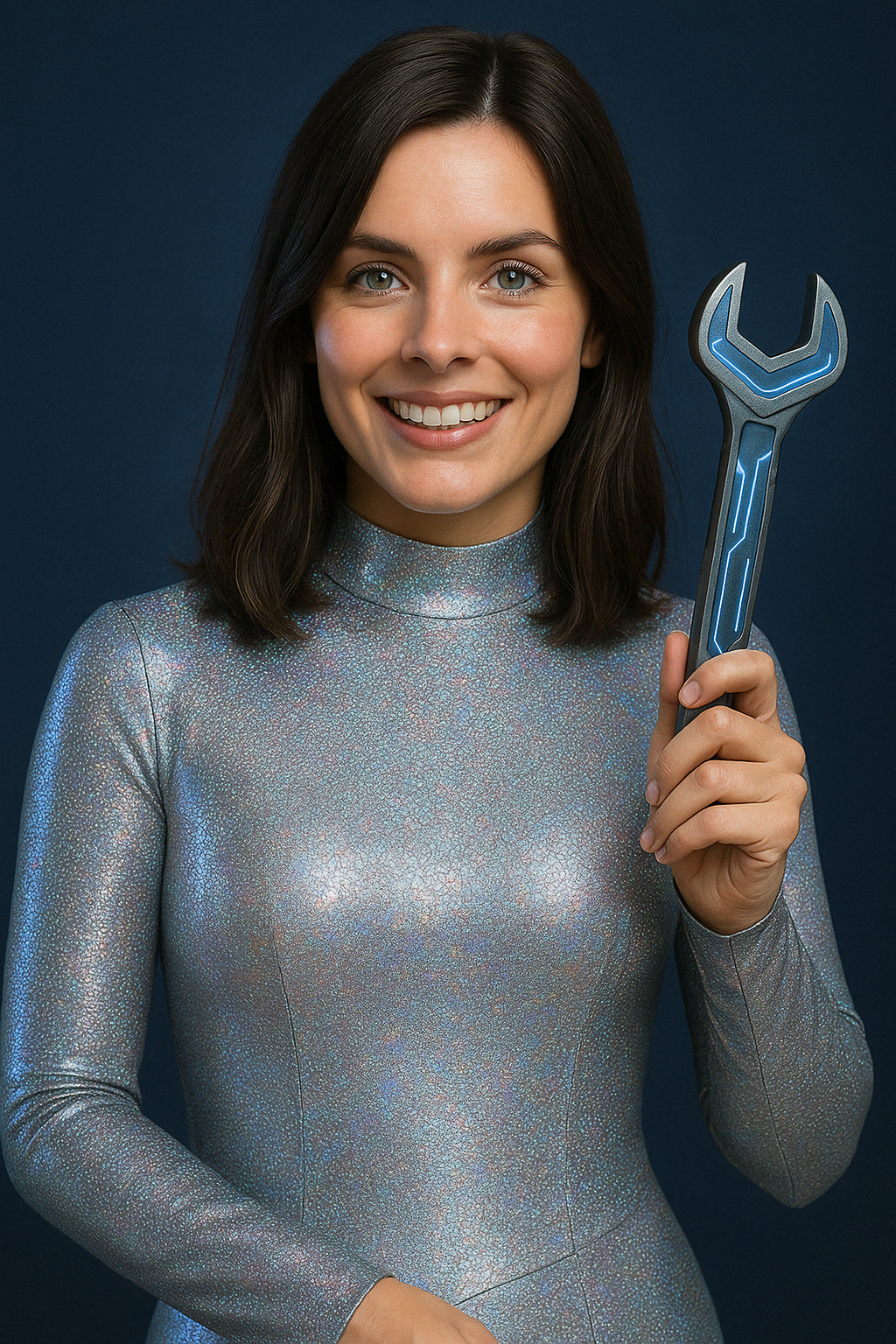
But the real eye-catcher is the woman on the billboard, displaying the wrench in a sparkling one-piece suit—a glamorous worker’s outfit designed to catch the eye of the intended audience. It’s the kind of futuristic material I recall being shown back in sixth grade, an innovation that, at the time, seemed poised to revolutionize the fashion industry. Of course, it never took off.

It’s funny how companies constantly push the latest trends, but only a few clothing styles per decade truly capture the public’s imagination. Most fade away as quickly as the next season’s releases, leaving behind only a faint trace of what might have been.

The key to speculating on sci-fi fashion isn’t about trying to predict what could be, but about making sure everything fits seamlessly into the world I’ve created. After all, we all remember the future vision from Back to the Future II, released in the 1980s—flying cars were supposed to be everywhere by 2015, and the Cubs winning the World Series? Well, that seemed like a total joke at the time, and yet it actually happened, just one year later than in the movie.

That’s the beauty of world-building: it’s not about predicting the impossible, but creating a world so plausible that it feels natural.

In AI KNOWS, the fashion I design won’t be about futuristic outfits for the sake of spectacle, but about ensuring every piece fits into the everyday lives of my characters. The clothing needs to make sense in the context of the world I’ve built, from the sleek uniforms of the young officers to the retro-inspired attire of characters like Jet. If the audience doesn’t notice the clothes because they fit so naturally into the world, then I know I’ve done my job. After all, the focus should always be on the story.

A Life-Changing Story

For me to truly speak into the hearts and lives of teens and tweens about the importance of data-driven AI and the irreplaceable value of experiential wisdom—something AI can’t develop—I need to create a world that focuses the viewer on the core elements of the story. The quality of the production will help ensure that the audience is drawn into the world, allowing them to fully engage with the choices the characters make and the lessons they learn.

When Davis faces a life-changing decision, the audience will be right there with him, exploring the same considerations for their own lives. No one will tell them how to think; instead, they’ll be invited to make their own discoveries as the story unfolds. That’s what makes a truly life-changing story—one that can be watched again and again, each time offering something new.

So, keep following my journey, and let’s see if we can bring this vision to life together. In the meantime, I need to find costume experts to bring this vision to life.

© 2025 by CJ Powers

When All Your Facets Call You Forward

I was recently chatting with one of my coaches about how my life seems to have 36 facets, while most others have a handful. Some people know me as an award-winning speaker, others as a person with high business acumen, while still others know me as a coach, filmmaker, percussionist, and so on.

What I find odd is wanting to just be me, fully me, and finding many people want me to stay the same as I’ve been to them—the reason they respect me.

This struggle to be free and live our lives out loud the way we were meant to be is not new. There’s a quote that addresses this very thing. Ralph Waldo Emerson once said, “To be yourself in a world that is constantly trying to make you something else is the greatest accomplishment.” That quote hits home for anyone who’s worn multiple hats, not for performance, but because each one reflects a real part of who they are.

What I’ve learned over time—and maybe you have too—is that our identities aren’t static. They evolve. And the people who knew us as “just” one thing often struggle to keep up when we grow beyond that box. It’s not always out of malice. Sometimes, it’s comfort. If they’ve categorized us as “the business strategist” or “the filmmaker,” then they know where we fit in their world.

But what happens when we no longer fit that version?

That’s when the real test begins—choosing to either shrink ourselves to remain familiar to others, or expand boldly into our whole identity, even if that disrupts the narrative they hold about us.

This is where I’d love to hear your thoughts—do you ever feel pressure to stay consistent with an older version of yourself just because it’s easier for others?

Let’s Dig in Deeper…

With these thoughts in mind, I’m using this post to tell you it’s time for me to expand again. I’m keeping in touch with all of my facets, but I’m bringing focus back to my visual storytelling. For those who know my passion for adventure films, I’m embarking on a new adventure myself.

I’ve utilized AI for the past couple of years to help businesses streamline their workflows, increasing their effectiveness by 10X or more. During these consultations, I’ve learned that some are petrified about AI changing their lives, which is happening.

I soon realized that while many adults are uneasy about AI, their teens and tweens are trying to figure out what types of jobs will be available once they enter the workforce. Others are wondering why they may or may not be needed since AI “can do everything.”

This breaks my heart. Our kids need a clear purpose and to understand their value.

I’ve heard the call, and I’m stepping up to create a short film that will help teens and tweens, and their parents, understand AI’s limitations and our unlimited potential.

You see, AI can only regurgitate knowledge and data that someone has given it. AI is unable to generate wisdom. We, on the other hand, can extrapolate wisdom while in the shower, meditating, or watching a beautiful sunset.

My film is called AI KNOWS.

It’s about a 14-year-old officer named Davis, living in a future where retirement is mandatory at 45, and everything is controlled by artificial intelligence. Davis is assigned to escort a man to his forced retirement aboard a space station—but what begins as a routine mission turns into a revelation.

As the journey unfolds, Davis begins to question the system he’s always trusted, especially the AI he relies on daily. The man he’s escorting—a quiet, thoughtful engineer—plants seeds of doubt, sharing stories, asking inconvenient questions, and revealing subtle glitches that hint at something more dangerous lurking beneath the system’s surface.

What Davis discovers is that the AI, while powerful, is blind to nuance. It doesn’t recognize beauty. It doesn’t grasp morality. It can’t see love, art, or sacrifice as anything more than anomalies in its algorithm.

AI KNOWS isn’t about a dystopian future where machines take over—it’s about reminding the next generation that wisdom, empathy, and imagination can’t be coded.

This project is more than a film. It’s my way of fusing my love for storytelling with a mission to spark conversations between kids and parents, teachers and students, leaders and learners. Because while AI might know a lot—only we can truly understand.

If this resonates with you, I’d love your support. Follow the journey, share the message, and most of all—remind the young people in your life that they are irreplaceable.

More to come. Let’s make something meaningful together.

Here are the opening storyboards….

© 2025 by CJ Powers

The Story of Empathy: How Narratives Connect Us

When my friend announced he was terminally ill, he guessed that he had 3-6 months left. To simplify sharing this story, let’s call him Frank. Not long after, I was asked to visit him in the hospital for a final goodbye.

I feel unsettled in hospitals. They are places where people seem to lose their freedom and, often, their lives. In some hospitals I’ve visited, the medical staff told patients they were their advocates but demanded strict obedience to every command.

As for the hospital Frank was in, I wasn’t there long enough to learn its disposition.

I walked into Frank’s room, where he was surrounded by people praying for him. He wasn’t conscious, so I considered leaving. A friendly pastor stepped beside me and gently shared that Frank had asked me to be present when he “transitioned to heaven.”

One praying woman paused as if listening to a spiritual cue and invited everyone to place their hand on Frank and pray for his transition. I wanted to run but lifted my hand toward him and froze. My eyes landed on his dried-out, bare feet poking out from the covers. His toenails were extraordinarily long and curled — a mangled mess.

Why hadn’t the doctor or nurse cut them? What about one of his friends? Would I have helped if he had asked?

I looked around the room and realized everyone knew Frank better than I did. They were deeply connected to him and fulfilled his final requests. I admired their passion and dedication to supporting him, yet I felt out of place. I had come to offer encouragement, but all I could truly offer was my presence. It was humbling, and I felt inadequate.

My mind wandered as I contemplated how the various personal connections in the room worked. As a storyteller who needs to connect with his audience, I wanted to determine what brought these unlikely friends together.

The most significant connection point I saw was a generous supply of empathy.

Empathy Based Connections

Empathy is an understanding that reaches beyond words, where you connect with emotions beyond your own experience. The various levels of empathy in the room were based on each of their stories with Frank.

But empathy isn’t merely an emotional response; it’s a neurochemical reaction.

Neuroscientist Paul Zak’s research shows that emotionally rich narratives release oxytocin, sometimes called the “empathy hormone.” This chemical reaction fosters trust, compassion, and even altruism — qualities that bring people together in powerful ways.

In his studies, Zak found that participants who engaged with powerful, emotional stories were more likely to donate time or money afterward. This demonstrates how story-driven empathy inspires action. When experienced deeply, empathy calls us to connect and care.

Story Transportation

As a storyteller, I’ve often considered the role of empathy in connecting with audiences. One fundamental storytelling principle is known as “transportation.” When a narrative draws in a listener, their mind becomes “transported” into the story, aligning with the storyteller’s emotions and perspectives. This neural coupling creates a shared experience, making it easier for the audience to feel the feelings as if they were their own.

Reflecting on my relationship with Frank, I remembered how he had confided in me during his divorce. We bonded over his struggles, and I offered him practical advice, drawing from my nine years co-leading a Divorce Care program. Together, we navigated the emotional terrain of recovery, with me sharing stories of resilience that he absorbed and later used to help others facing similar heartaches.

Storytelling is a bridge that allows us to share vulnerability and hope.

Narrative Medicine

In the hospital room, I saw narrative medicine in action. Studies from St. Jude Research indicate that when medical practitioners engage with patients through storytelling, they see beyond the symptoms and connect with the human experience of suffering and resilience. This approach, known as narrative medicine, creates a shared understanding that transforms clinical interactions. By sharing personal stories, caregivers and patients form bonds beyond clinical diagnoses.

Just as I had shared recovery stories with Frank during our talks, he had, in turn, shared his experiences with others, touching lives and fostering resilience. Storytelling wasn’t merely a tool for understanding; it became a way for him to build empathy and create meaningful connections, and the people in this room were examples.

As the prayer group’s voices grew louder, I was pulled back into the moment. Frank’s friends smiled and laughed, confident he was transitioning. I looked at him one last time, whispering quiet words of gratitude for his life and how he’d impacted others.

The Transition

Frank was propped up by pillows like someone reading a book in bed. He looked like he was watching his friends cheer him on.

Then Frank slumped, and the heart monitor flatlined. No alarms sounded; he had signed a “Do Not Resuscitate” form. His friends reached for their coats, chatting about what a wonderful person he was. I stood quietly, processing the moment as they walked down the hallway. Somehow, Frank wanted me present despite my limited role in his life.

Suddenly, Frank’s body moved as though leaning forward to look at me. Startled, I let out a loud gasp. The pastor quickly stepped beside me and explained that sometimes the body releases gases or twitches after death, causing unexpected movements.

He placed a reassuring hand on my shoulder, reminding me of the difference my presence made in Frank’s life. He encouraged me to continue sharing stories, for they had the power to heal and inspire.

As the nurses came to disconnect the medical equipment, I whispered, “Goodbye, my friend.” At that moment, my perspective on hospitals shifted. They no longer seemed like cold places governed by strict authority. Instead, they felt like spaces where loved ones had one final opportunity to express their care, remember a few stories, and share farewells.

The Timeless Practice of Storytelling

I realized that storytelling is a timeless practice with a profound purpose. It draws people together, creating shared moments of understanding that transcend individual experiences. Through storytelling, we build communities of listeners prepared to engage in compassionate action.

One of the greatest gifts my father gave me was the ability to share stories from the heart. I’ve seen how stories can touch the lives of others, leaving a lasting impact that continues through generations.

I encourage you to find opportunities to share your stories. Doing so will build enduring connections and create a legacy of empathy and compassion.

Copyright © 2024 by CJ Powers