
Collaboration: The Process of Aligning, Acting, and Achieving—Together

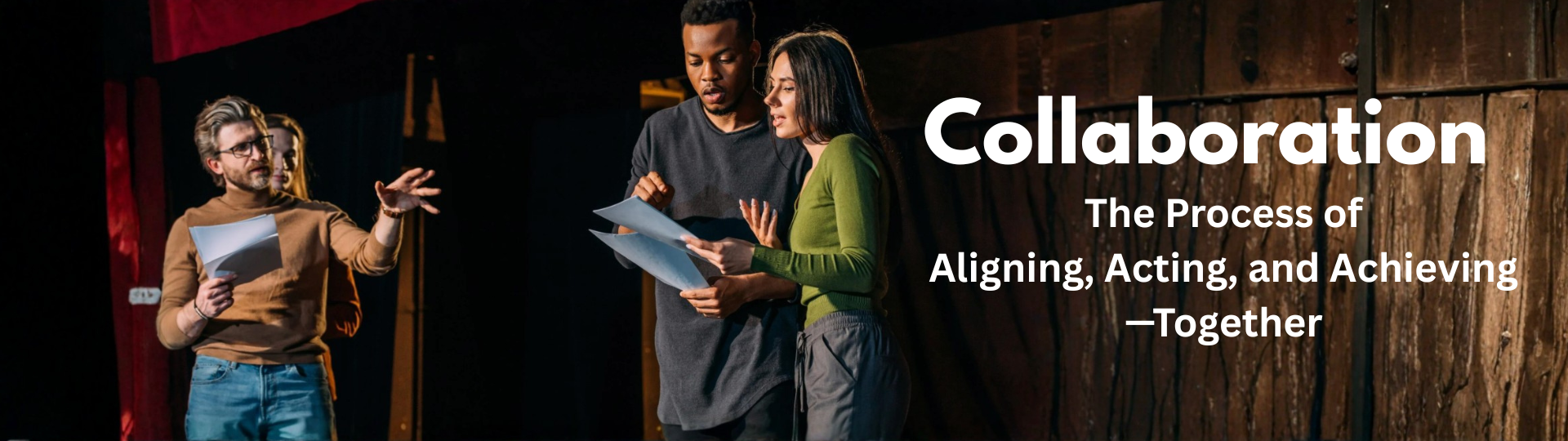
A theatre director collaborates with actors on stage during rehearsal, aligning vision, encouraging shared action, and building toward a successful production.

Collaboration is often spoken about as a goal, but rarely understood as a process—much less an enjoyable one.

Many teams assume collaboration happens when people agree, attend meetings, or divide up tasks. But agreement alone doesn’t move things forward, and activity without direction only creates motion, not progress.

True collaboration, the kind that produces meaningful results, requires something more intentional.

Director to Director: Learning Collaboration the Hard Way

Years ago, I took another directing class. I already had several TV shows and films under my belt. Still, I wanted to learn a few techniques from a director who had won numerous awards for directing shows on the legitimate stage. Her work was brilliant, and I knew some of her techniques would transfer.

Before our first class, knowing my background, she suggested that there was nothing she could teach me that I didn’t already know. I assured her that I’d be happy if I learned one technique that could improve my skill set. She agreed to teach me under the condition that she could ask me questions about film and television so she could learn from me as well. 

After the first month of classes, she suggested I learn to collaborate better with my actors and crew. While she enjoyed watching the outcome of my directing, she suggested I could have more fun and dive a bit deeper into the script through a balanced view of collaboration.

Her suggested form of collaboration follows a simple, but demanding pattern. Progress happens when people align, act, and achieve—in that order.

ALIGN: Collaboration Begins With Shared Direction

Sharing elements of direction was hard at first. As a director, the vision started with me, and most of the time, my direction was the only direction provided. However, my instructor suggested that, while I have a complete understanding of the entire show, the actors know their characters’ subtleties better. 

The costume designer, while she quickly picked up my vision, was the one who sculpted the final wardrobe. The same concept applies to the property master, the set designer, and all other department heads. Each one had to pass direction on to their teams, but first had to capture my approval.

When I realized that the department heads could all share some form of direction, I was able to work smarter, not harder. Their direction just needed to align with mine.

Alignment is the most overlooked and most critical step in collaboration.

To align means ensuring everyone is oriented toward the same outcome before action begins. It’s not about unanimous agreement or identical thinking. It’s about shared understanding.

I gave it a try. At first, each person had interpreted my vision a bit differently. Some were focused on the heart of the character transformation. Others prioritized the show’s visual quality. A few were motivated by what made them look good, even if their ideas didn’t fit the show.

Without alignment, a predictable pattern emerges: activity fragments, energy scatters, and frustration grows quietly.

Alignment requires slowing down long enough to ask:

  • What are we actually trying to achieve?
  • Why does this matter?
  • What does success look like together?

Once we named these answers out loud, something shifted. The tension in the room eased, not because conflict disappeared, but because clarity arrived.

Alignment doesn’t eliminate differences. It gives them a common direction. At that point, everyone felt heard and understood. When I had to turn down some ideas due to focus or vision, everyone aligned their ideas because we had become a cohesive team, and no one wanted to break the show.

ACT: Collaboration Comes Alive Through Ownership

Action is where collaboration becomes real—or reveals itself as theoretical.

Once alignment is established, movement must follow. But collaborative action isn’t about assigning tasks and hoping for the best. It’s about shared ownership and visible contribution.

Once the production team aligned on the outcome, we stopped debating ideas and started committing to actions. Roles became clearer. Deadlines became meaningful. Accountability became mutual instead of managerial.

Action requires trust. It asks people to step forward, not wait to be told. It also requires restraint—knowing when to act independently and when to coordinate.

Collaboration stalls when people wait for permission. It accelerates when people take responsibility within shared clarity.

The careful blending of these ideas creates a better show than any single person’s vision. In this case, mine.

ACHIEVE: Collaboration Is Measured by Results, Not Effort

Achievement is the natural byproduct of aligned action—but it’s often misunderstood.

Many teams celebrate effort. Fewer take the time to evaluate outcomes.

Achievement doesn’t mean perfection. It means progress that can be named, measured, and learned from. It gives collaboration credibility.

When our team finally delivered the initiative, it wasn’t flawless—but it was real. And because we reflected together afterward, the achievement became more than a result; it became a shared reference point for future collaboration.

The live audiences made it clear that something special had emerged from our production. Not because I was a great director, but because I learned how to collaborate and draw the best out of each person on my team.

Achievement reinforces trust. It proves that working together was worth the investment. It also feels good. Everyone in the cast and crew told me they would work with me again, anytime I needed them. Our joint achievement came from the trust we had instilled in each other.

Collaboration Requires Intention

Collaboration is not a personality trait or a meeting format. It’s a discipline.

When collaboration fails, it’s rarely because people didn’t care enough. More often, it’s because they skipped a step—acting before aligning, or celebrating effort without achieving clarity.

Strong collaboration asks us to slow down early, step up fully, and reflect honestly.

Take a moment to consider the spaces where you collaborate—at work, in leadership, or within your community.

  • Are you aligned on what truly matters?
  • Are you acting with shared ownership?
  • Are you achieving outcomes you can learn from together?

Progress doesn’t happen by accident. It happens when we choose to align, act, and achieve—intentionally, patiently, and together.

Copyright © 2026 by CJ Powers

Building Differential Strengths as Communicators, Networkers, and Team Players

Three key skills will define the most successful professionals in 2025: communication, connection, and collaboration. While these skills may seem fundamental, they have evolved into essential tools for navigating complex work environments, building relationships, and driving success.

To thrive in our dynamic world, we need to consider these skills from the perspective of the types of people who have built a strength while focusing on a single part of it: communicators, networkers, and team players.

The Strengths of Communicators, Networkers, and Team Players

Strengths are an intricate blend of innate talent, acquired knowledge, honed skills, an experiences gained from facing challenges. At the highest level, the finest communicators, networkers, and team players have mastered their craft, consistently refining their abilities through experience, learning, and mentorship.

Communicators

Communicators are the architects of understanding. They shape how information flows, ensuring clarity and engagement.

Talent: A communicator’s most essential talent is effectively conveying ideas—painting a picture everyone quickly understands. They possess natural eloquence and an innate understanding of tailoring messages to diverse audiences. They are also strategic thinkers, deliberate in crafting messages that resonate.

Knowledge and Skills: To excel, communicators master not only language and rhetoric but also the nuances of storytelling, persuasion, and emotional intelligence. They must be well-versed in the various communication channels, whether digital or in-person, and understand the role of technology in enhancing or hindering their message.

Experience: Effective communicators often learn through failures, such as missed opportunities, misunderstood messages, or poorly received content. These experiences teach them the importance of timing, tone, and context in their communication.

Craft: The highest level of communication strength involves predicting how messages will be received and adjusting them accordingly. This skill is often developed through mentorship, where communicators learn the delicate art of crafting persuasive, authentic, and clear messages that create lasting impact.

Networkers

Networkers are connectors who build and maintain relationships across diverse sectors, industries, and distances. They thrive on creating mutual value through connections that go beyond transactional needs.

Talent: Networkers excel at building rapport. Their key talent is empathy, which enables them to understand the needs and desires of others. They are naturally curious and possess an uncanny ability to make people feel heard and valued.

Knowledge and Skills: To be effective, networkers must develop a deep understanding of their industry and the industries they connect with. They should be proficient in reading people, understanding social dynamics, and maintaining professionalism while forming personal bonds. Networking skills also include strategic thinking, as successful networkers can leverage connections to create value for others.

Experience: A seasoned networker has made mistakes, such as misreading signals or overpromising. These experiences teach the importance of authenticity, follow-through, and timing in building long-lasting relationships.

Craft: The highest level of networking involves connecting people in ways that spark collaboration and innovation. Great networkers often learn this by working closely with mentors who teach them the subtleties of relationship management and help them build an extensive network of trusted contacts.

Team Players

Team players are the backbone of successful collaboration. They bring energy, enthusiasm, and support to group efforts, helping to turn individual contributions into collective achievements.

Talent: A team player’s innate talent lies in collaborating and contributing meaningfully in a dynamic group. They’re often skilled at fostering cooperation, managing conflict, and ensuring everyone’s voice is heard.

Knowledge and Skills: Team players must understand group dynamics, leadership principles, and how to manage conflict constructively. Their skills include active listening, giving and receiving feedback, and contributing to the group’s goals without seeking the spotlight.

Experience: Experienced team players have learned to navigate challenges like interpersonal conflicts, misunderstandings, or missed deadlines. They’ve gained wisdom from seeing how their actions, or lack thereof, affect the group’s success or failure.

Craft: The highest level of strength as a team player involves building a culture of collaboration that empowers others. Great team players learn this craft through direct experience, often observing and apprenticing with strong leaders who create environments of trust and mutual respect.

Why Communication, Connection, and Collaboration Matter in 2025

The rapid pace of change in 2025 means that traditional methods of working and leading are no longer enough. The ability to communicate clearly, connect with others meaningfully, and collaborate effectively will determine who thrives in an increasingly complex, interconnected, and fast-moving environment.

  • Communication enables individuals to express their ideas, needs, and feedback in a way that resonates with others. In an age of information overload, communicators who can cut through the noise and convey essential messages are highly valued. They clarify, simplify, and amplify their content to create the ideal message.
  • Connection is the key to building networks of trust and mutual benefit. In an increasingly remote and digital world, networkers who can forge and maintain strong relationships are the linchpins of personal and professional success. Their focus is to engage, relate, and build their relationships for the future.
  • Collaboration allows teams to achieve results greater than the sum of their parts. As organizations grow more cross-functional and global, team players who can work across diverse groups and bring people together will be crucial to achieving success. They focus on aligning, acting, and achieving goals as a team.

How to Develop Your Strengths as a Communicator, Networker, and Team Player

We must practice self-awareness and commit to continuous learning to build differential strengths in these areas. Start by identifying where your strengths lie and where there is room for growth.

  1. For communicators: Focus on refining your ability to adapt your message to different audiences and contexts. Practice active listening and learn to read nonverbal cues. Seek feedback on your communication style and aim to be more concise and impactful.
  2. For networkers: Invest in building genuine relationships rather than merely expanding your contact list. Be present, offer value, and seek to understand others’ goals and challenges. Build your personal brand through authenticity and integrity.
  3. For team players: Work on being adaptable in team settings. Focus on being supportive, cooperative, and solution-oriented. Learn to resolve conflicts constructively and encourage diverse perspectives in group discussions.

In 2025, the most successful professionals will excel as communicators, networkers, and team players. By recognizing the importance of each role and continuously refining the strengths associated with these key skills, individuals can thrive in an increasingly complex and fast-paced world. As you build your career or lead others, remember that true success lies in what you know and how well you connect, communicate, and collaborate with those around you.

Copyright © 2025 by CJ Powers