

Tag Archives: movie
12 Essentials of Directing Actors
 In watching and chatting with numerous actors and directors over the years, I’ve learned a few things that directors do poorly and several they do well. During this time frame the ideals have changed within the production world, so I’m writing only those key points that relate to actors giving a truthful performance. I hope directors will find these recommendations helpful.
- TAKE AN ACTING CLASS. Actors are vulnerable and sensitive people who need encouragement and an understanding director. The best way to inspire great performances is by understanding the acting process. To keep up with the latest trends, I take acting or an improvisational class every so often.
- MAKE A CONNECTION. An actor’s job is intense and exposed, which can cause them to feel overly sensitive or vulnerable. The director needs to come along side of them as a trusted advisor. Actors rarely need to be challenged or have an authority figure bear down on them, as most self-critique or compare themselves to their own detriment.
- KILL CRITICAL SPEAK. The director owns the set and must stop any cast or crew from saying anything negative to actors. Direction must only come from the director who fully understands the vision and can give proper and affirming recognition. If anyone on the set feels a need to make suggestions or confer with the director about someone’s performance, it must be done in private, if at all. The director MUST protect the actors.
- ASK QUESTIONS. The last thing an actor needs on set is an authoritarian or a director that bellows out commands or instructions. Each actor is an expert at her character and because the director is focused on everything, the professional actor will maintain that expert status. It’s therefore prudent for the director to change the actor’s performance inductively by asking questions. By drawing the actor into the thinking process, she is able to discover for herself what the character needs to do. This activity strengthens the actor’s ownership of the character and enhances her performance.
- TREAT ACTORS EQUALLY. An actor’s emotions can take its toll throughout the shooting day. Great directors try to keep an eye on each actor’s emotional status and take specific time to remind her that she is liked and respected. The director is a powerful leader that must share this treatment equally with all actors to maintain a mutually warm environment from which the actors can safely perform. Leaving an actor out of this personalized attention can send her reeling out of control.
- BE COURTEOUS. Directors can raise the performance bar by being courteous and avoid the common mistake of telling an actor how she blew it. By saying, “What was that? You can’t bellow out your lines. Let’s do another take and give me less,” the director increases the actor’s fear and stiffens her next take. Instead, a director might consider saying, “I’d like to try something a little different on this next take. I wonder if you could maintain your emotional intensity and drench the other character with a dangerous calm.” This gives the actor more to work with and inspires creativity and performance.
- AVOID COMMON ACTING PROBLEMS. Acting is self-conscious and self-judgmental, which many times can cause an actor to act from her head instead of her heart. The director must work with the actor to make sure she is focused on the character and not herself. This approach will avoid numerous problems that typically rise during any given shooting day and help to draw out an honest or truthful performance.
- PROMOTE RELAXATION AND FOCUS. Relaxation is important to make sure the actor doesn’t project her voice as if on a stage. It will also impact the way she carries herself. When a scene calls for tension, it will naturally grow from the relaxed state and appear in her hands, walk, voice and face. Anytime anxiety creeps in, the actor becomes stilted in her performance. A director can improve the performance by reminding the actor of what she’s done well. Even redirecting her focus off of her feelings and back onto the character will reduce the temporary lack in confidence.
- CLARIFY SUBTEXT. Reviewing subtext during rehearsal will help an actor focus on each line, glance or action. Every element of her performance must lead to her character’s super objective or what she is fighting for. The subtext can be clarified with a verb to be played, a character she plays to, and an intended effect that her character wants as the outcome.
- KILL ANTICIPATION. It is difficult for a director to have an actor play a part “naturally” in a specific way, as the mere mention of doing it naturally makes the performance stilted. Within that moment the actor gets trapped in her head and starts to anticipate a line or action. She might also purposely hold back in an attempt to be more natural, which creates an awkward lag and reveals that the actor has done this moment several before in rehearsal. One of the best ways to avoid this conundrum is to walk the actor through the character’s thinking process, while salting in moment-by-moment clues as the performance unfolds – Just like in real life.
- KILL INDICATING. It’s common for an actor to increase the visible size of her performance in hopes of reaching the audience or allowing them to see her character’s personality. Unfortunately, the lens is only kind to subtle performance and the actor finds herself overworking and destroying her character in the process. Having the actor think about a secret or some internal struggle during the performance, allows the audience to see that there is more depth to the character without an over-the-top performance. Giving direction to the actor as if you’re speaking to the character also generates this subtle secrecy effect.
- SPEAK IN VERBS. Many actors memorize certain actions to help them “do business” during their scene and it weakens their performance because it doesn’t naturally flow from the character. Instead of having an actor pull something out of her bag of tricks, the director can share verbs that stimulate creative ideas that develop new actions based solely on the character. An example might come from a script line like, “She keeps up with her dodging in and out of shadows.” The immediate thought an actor might come up with is moving from tree to tree peering around as she tries to keep up with the other character. However, the director can bring to bear an arsenal of variations on this movement by asking the actor to “trail” the other character. Or, he can step up the intensity with each word suggested: follow, track, pursue, hunt, stalk, or chase. Each verb intensifying the action and giving a new mental picture for the actor to perform.
If I were to add a “don’t” to the list for amateur directors, I’d have to recommend NOT ever demonstrating how you’d like something played. This act instantly reduces the director’s credibility to zero and he doesn’t get what he’s asks for, as his performance never plays out the way it was in his head. It is also insulting to the actor who is the expert on her character, who would never do things like the director demonstrated. This is not to take away from the director showing an actor their blocking, as he walks the actor down the path, while discussing the character’s motivation.
The key is to remember that the actor is an expert at her character and the director can’t be due to his high level of knowledge on the entire picture. However, the director will know what works and what doesn’t and must use questions to help the actor create variations of performance until the director gets what will work best on screen – Something the actor trusts the director to accomplish.
Copyright © 2013 by CJ Powers
Illustration © shambulin – Fotolia.com
The Twilight Saga: Breaking Dawn Part 2 – Review
I’m always fascinated to sit with fans when reviewing a movie. They can give me the core elements that are missing or clarify what’s on target. The fan I sat next to was more impressed with the book than the movie. The heartfelt details were left out in order to build the film into an event with a battle scene that would draw a larger audience.
 The idea of going more universal in its appeal was successful, as the theater was filled with a lot of men and people over 35 years of age. The Hollywood reporter announced that 21% of the audience was male, which was significantly higher than previous installments of The Twilight Saga. This drove the box office to exceed $140MM its opening weekend.
The franchise came a long way in four films. The first seemed to be put together with duct tape, bad acting and production values that barely rivals a vlog. Thanks to the millions of screaming teen and tween girls that watched it, the box office dollars suggested that the franchise needed to step up and become an event film. After practicing with the next two films, the team was able to get it right for its finale.
That is not to say everyone should run out and see the film, especially if you don’t like watching numerous decapitations by vampires ripping heads off of people. I’m merely suggesting that the production company finally put some of its box office dollars onto the screen, raising it to an “A” level film experience.
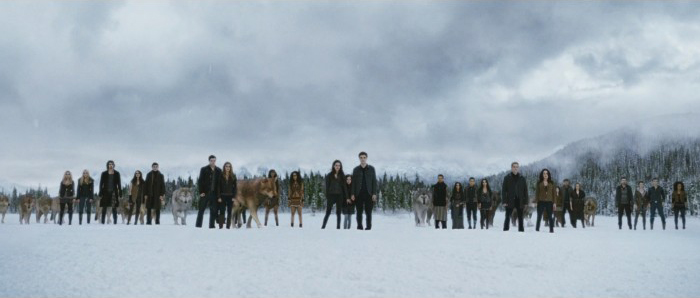 The film is still aimed at teen girls, although I’m a bit disturbed that parents would allow their young girls to watch such gruesome battle scenes. The good news of course, not that its really good news, is that there is no bloodshed in the movie since all of the warriors are already dead. When a head is torn off of a body, it just disables them until they can be burned alive.
 What ever happened to the trend of teens and tweens watching princess stories? When did our society shift to girls watching vampire decapitations in The Twilight Saga, and kids killing kids in The Hunger Games? Have parents fallen asleep or are there no wholesome and moral filmmakers left to make uplifting stories that edify?
I don’t recommend this film for anyone. There is too many decapitations for kids to watch and too little of the thinned out, cutesy story for adults to watch. Yet, it was entertaining for those who have never scene wolves and vampires duke it out, not to mention the vampire child who grows to full maturity in seven years. Hmm, I wonder how she’ll turn out since her mother was more of a warrior than the nurturing type.
If I were you, I’d save my money unless you are a die-hard fan needing a fix. Then again, true fans prefer the book. For the rest, I’d save my money for the release of The Hobbit and Les Mis – Both will be strong Oscar® contenders.
 CJ's Corner