
The Last Stakeout

The first time Jim followed his son, he told himself it was instinct.

Detective Jim Callahan had spent twenty-two years reading body language, spotting lies, and noticing tiny changes in routine that other people missed. So when sixteen-year-old David suddenly became secretive, protective of his phone, and vague about where he was going, Jim’s internal alarms started ringing.

That afternoon, Jim stood across the street beneath the shadow of an old brick awning, pretending to study the reflection in a storefront window.

David emerged from a catering business carrying two large silver warming trays with both hands.

Jim narrowed his eyes. “That’s odd,” he muttered.

David looked around nervously before loading the trays into the back of his friend’s pickup truck.

Jim slipped deeper into the shadows. “Catering trays? For what?” His curiosity sharpened.

A few hours later, Jim found himself hiding beside a newspaper machine near the downtown shopping district. He felt ridiculous, but not ridiculous enough to stop.

David exited an upscale bakery carrying a large white box edged in gold ribbon.

Cake box.

Expensive cake box.

Jim’s mind raced through possibilities faster than he cared to admit. A party? A girl? A lie?

Something worse?

Before he could follow, a voice growled behind him.

“You planning to arrest your own kid, Jimmy?”

Jim spun around.

His father, Frank Callahan, stood with his arms crossed, disappointment etched across his weathered face.

Jim exhaled hard. “Dad, don’t sneak up on me.”

Frank smirked. “Funny hearing that from a man hiding behind a newspaper machine spying on his son.”

Jim straightened. “David’s been acting strange.”

“He’s a teenager,” Frank replied. “That’s the job description.”

Jim glanced toward the bakery window. “Something’s going on.”

Frank studied him quietly.

“What’s really going on,” he said, “is that you’ve spent so many years looking for trouble that you forgot not everything suspicious is bad.”

Jim scoffed. “You don’t understand.”

“Oh, I understand perfectly.” Frank stepped closer. “You want to get to the crux of the matter before anyone else knows there’s a matter at all.”

Jim crossed his arms.

Frank shook his head slowly.

“Jimmy… sometimes people need enough space to do what they think is right…and important, without judgment hanging over their shoulder.”

Jim laughed bitterly. “Seriously? You’re lecturing me about judgment?” he asked. “It took me years to break free from your critiques. Years. So don’t stand there acting enlightened.”

Frank looked wounded, but for only a moment before nodding.

The words landed harder than Jim expected.

“You’re right,” Frank admitted quietly. “I did learn the hard way.”

He looked in the direction David had gone.

“And I’m hoping you can learn from a single hint instead of twenty years of regret.”

Jim said nothing.

Frank sighed.

“Well,” he muttered, stepping away, “I guess some lessons still need experience.”

Then Frank disappeared down the sidewalk.

Jim watched him leave, stubbornness hardening in his chest.

By sunset, Jim was crouched behind a weathered shed near the rear of a small lakeside hotel.

The sky blazed orange and crimson across the water. Waves rolled softly against the shore while music drifted faintly from somewhere near the beach patio.

Jim spotted David again.

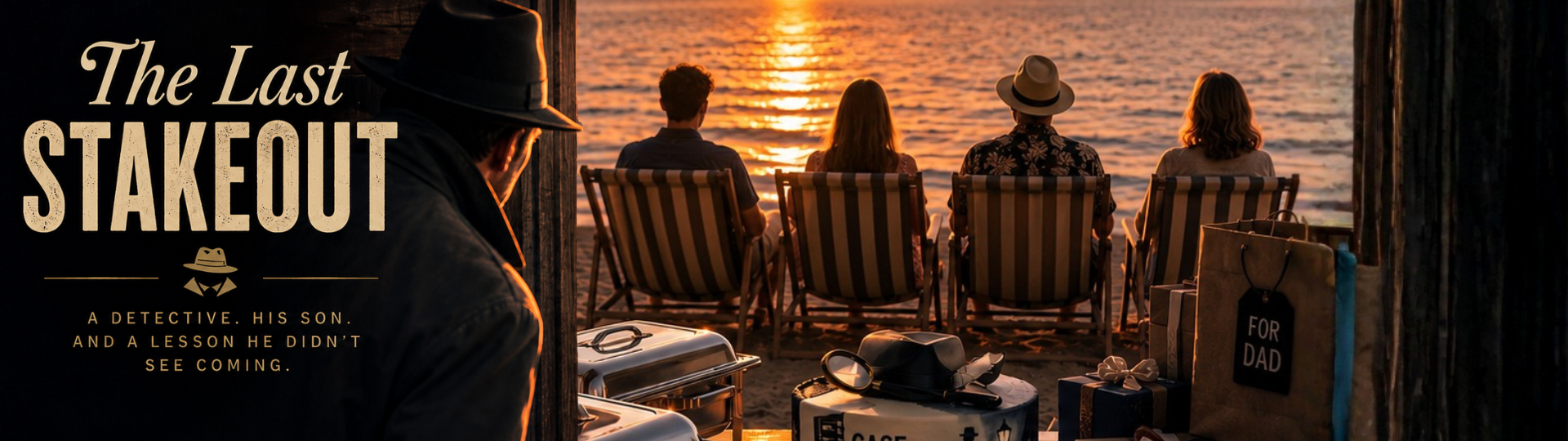
The teenager walked casually toward a row of reclining beach chairs, carrying a tropical drink topped with a tiny paper umbrella.

Jim narrowed his eyes.

“Oh, this is it,” he whispered.

David sat down facing the lake.

Jim noticed several people in chairs lined up beside his. All facing the lake.

Jim’s pulse quickened.

He moved swiftly around the side path, staying low, heart pounding with certainty, about to catch David red-handed.

He burst around the chairs dramatically.

“I’ve caught—”

“Happy Father’s Day!”

Jim froze.

David stood grinning beside his sister.

Frank sat laughing in one of the beach chairs.

Jim’s wife held her hands over her mouth, trying not to laugh at the stunned expression on his face.

Behind them sat the silver catering trays.

The gold-edged cake box rested on a table nearby. The cake itself was decorated like an old detective noir novel, complete with a chocolate magnifying glass, a fondant fedora, and the words:

CASE CLOSED, DAD.

A pile of wrapped gifts sat beside it, with ‘Dad’, ‘Son’, and ‘Jim’ written across the tags.

Jim blinked several times.

“You… all this was…”

“For you,” David said.

Jim looked at his father.

Frank raised his tropical drink slightly. “Told you to chill, Jimmy.”

Everyone laughed.

Jim rubbed the back of his neck, embarrassed beyond words.

Then he looked at David.

His son wasn’t hiding something terrible. He was trying to do something meaningful.

Jim finally smiled.

“Dad,” he said softly to Frank, “you were right.”

Frank leaned back in his chair. “That’s my favorite sentence.”

Jim chuckled and shook his head.

“Sometimes,” Jim admitted, “we need to give people a chance to do what they think is right and important.”

The sun dipped lower over the lake as his family gathered around him, and for the first time all day, Detective Jim Callahan stopped searching for what was wrong and simply enjoyed what was right.

Copyright © 2026 by CJ Powers

Busy but Unfulfilled

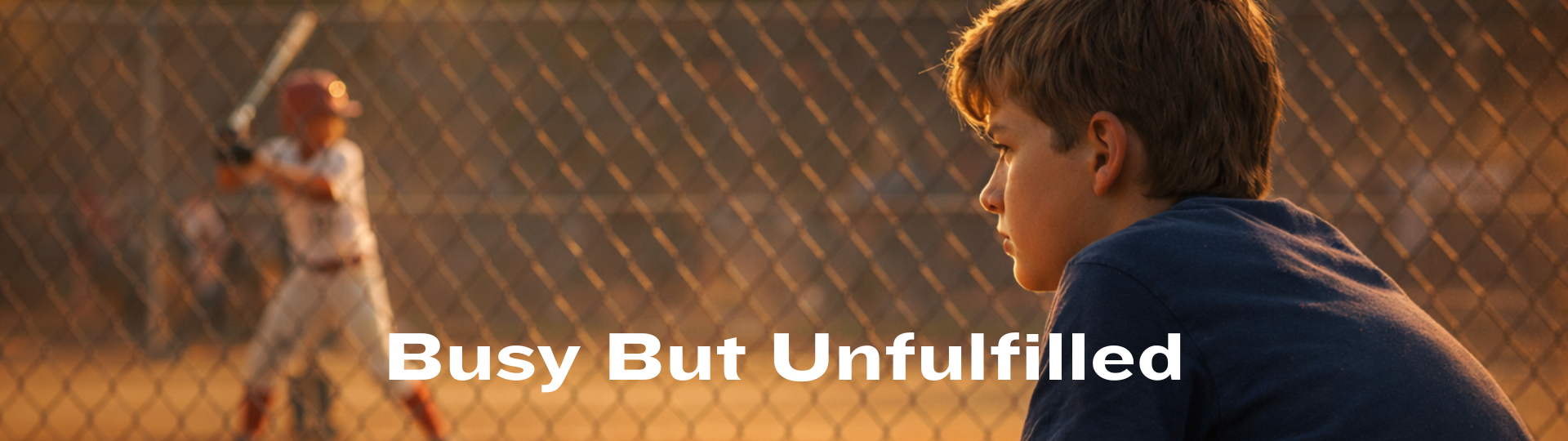
During a lazy summer’s afternoon, Billy sits on the aluminum bleachers at his friend Jeff’s baseball game, his phone resting loosely in his hands.

Sometimes he watches the game. Other times, he disappears into his phone. Neither holds his attention for long.

The game on his phone used to excite him. Now it feels predictable. He knows every move. Every outcome. Win or lose, nothing really changes.

Jeff taps his shoe with the bat, clearing his cleats, and steps back into the batter’s box.

Billy looks up as he hears a man shout from the bench, “Three balls, one strike. You can do it, Jeffrey.”

He lowers his phone and scans the scoreboard.

The bases are loaded. Two outs. Last inning. Jeff’s team is down by two runs. To win, everyone on base has to make it home.

Billy leans forward.

He feels the pressure before Jeff does. In the next few seconds, Jeff will either win or lose the game for two dozen families holding their breath in the stands.

The pitcher wipes his hands on his pants. Jeff wipes the sweat from his brow.

The pitch comes.

Jeff swings. CRACK!

The ball soars toward right field and slams into the chain-link fence, sticking for just a moment before dropping. Runners sprint. The right fielder grabs the ball and throws it in.

The ball moves fast—second base, then third.

Jeff slides.

He’s late.

Billy cringes. For a split second, it feels like everything has gone wrong.

Then the crowd erupts.

Billy realizes the runners have already crossed home plate. All three of them. The game is over. Jeff’s team has won.

Players rush the field. Teammates lift Jeff onto their shoulders. They carry him toward home plate as cheers echo across the diamond.

Billy watches, stunned.

His video game has never put him here—never asked anything of him. No one depends on him. No one’s joy or disappointment rests on what he does next.

This does.

When his mom picks him up after the game, Billy slips his phone into his pocket instead of turning it back on.

“Mom,” he says, “can you sign me up for baseball?”

She smiles. “That’s a change. What made you decide?”

Billy looks back at the field.

“In a video game, nothing changes,” he says. “But out there… on a team, everyone matters.”

Copyright 2026 by CJ Powers

The Garden of Eden: Where We Clarify, Simplify, and Amplify Our Message

Were you taught, like I was as a child, that the Garden of Eden was a paradise? 

"The Garden of Eden: Where We Clarify, Simplify, and Amplify Our Message" by CJ Powers

If not, let me explain that it was a place where everyone had innate abilities that they used daily. Fun and laughter, along with exploration, were a part of everyday life. Then, during the cool of the day, when people naturally walk, talk, and are present with others, God walked with Adam.

The communication was in person and personal, fostering relational closeness. Man’s conversation with God fit the normal, gentle rhythm of the day. At that time, proximity drove the culture of community.

Anna’s Passion for Gardening

I met Anna and learned about her passion for gardening. Her dream was to take an empty lot in her community and revitalize it so those in her village could join in and build relationships. She wanted it to be her Garden of Eden.

She knew that the shifts in the economy had negatively impacted many in the community. Her instinct was to convince those living nearby to meet in the cool of the day and plant, water, and weed a new garden, where conversations would heal hearts and invigorate the community.

Everyone loved the concept and shared their thoughts, offering various ideas on how the community garden could function. Some people wanted flowers, others preferred vegetables, and a few envisioned a venue for special events with a small stage at one end of the lot. 

Communicating the Point of Your Vision

With her ears filled with an abundance of ideas, Anna recognized she needed to clarify one key point: the garden would be a space for everyone. Anna thought through what she had said to elicit a diverse onslaught of ideas, realizing that her initial message hadn’t been properly received. 

Her vision was not adequately communicated, and various people placed their ideas over hers. Anna knew she’d have to go back to each person she talked with and help them understand her vision. She took time to think through how to prepare and came up with three steps.

THE FIRST STEP WAS TO CLARIFY what she pictured and to understand the vision herself. This is often done by focusing on a specific topic, stripping away any unnecessary details, and honing in on the core message she wanted to communicate. 

When you clarify your thoughts, you can deliver your points concisely and with confidence.

Anna reminded everyone of the vision at every meeting or gathering: the garden was to be a shared space that brought the community together—a space for planting, learning, and connecting.

THE SECOND STEP WAS TO SIMPLIFY her message so people of various ethnic backgrounds, levels of education, and mindsets could understand her message. Many of her neighbors were not familiar with gardening, and some spoke English as a second language. So she created a visual flier that used easy-to-understand language and symbols to convey her message: “Come grow with us, no experience necessary!” 

It was straightforward and welcoming to all, including children, elderly neighbors, and non-native English speakers. She used words that people at the sixth-grade reading level could understand, ensuring that the idea would be grasped by everyone in the neighborhood, regardless of background or education.

THE THIRD STEP WAS TO AMPLIFY her message and get the word out to everyone beyond the flyers and meetings. She wanted people to feel the same passion she had for the community space. 

She gathered people on a Friday night under a full moon. She shared a memorable story about how the garden could bring the community together, improve the environment, and create lasting bonds. 

She shared stories of other cities that had turned empty lots into thriving gardens. She even told a personal story about her grandmother’s garden, where Anna spent countless afternoons learning the value of planting seeds and watching them grow.

By weaving these stories into her presentation, Anna was able to amplify the idea, turning it from an abstract project into a vivid picture that everyone could see, feel, and embrace. Her words painted a picture of the garden as a gathering place—a place where people of all backgrounds could meet, learn, and grow together.

Engaging Your Audience

Anna ended the story by suggesting everyone take a few moments before heading home to greet someone they’ve never met. Then she did the same, working her way through the crowd and inspiring everyone she met.

Within three short weeks, the community garden was a huge success. What started as a vague idea became a clear, simple, and amplified vision that brought people together. By clarifying her message, simplifying it for the whole community, and amplifying it with a story that touched hearts, Anna made her dream a reality.

Word spread through the community, and the little lot garden became a popular place to meet for holidays, weekends, and relaxing with close friends. Is it time to create a special place in your community?

Copyright © 2025 by CJ Powers