
Creativity without a Box

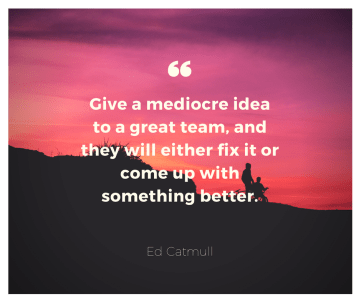
Give a mediocre idea to a great team, and they will either fix it or come up with something better.I just finished reading a short article in Forbes about a creative specialist who consults with CEOs of Fortune 500 companies. I laughed at the absurdity of his latest book that tries to convince executives that successful businesses once started inside of the box, and then started to think outside of the box, and now must find a new box. The irony is especially rich as the latest surveys clarify the company of the future is one that operates without a box.

Creative experts pushed corporations out of their offices and placed them into large rooms where everyone’s paths would cross. The idea was more networking and a broader understanding of what everyone else manages. Unfortunately the amount of actual work being accomplished dropped significantly. Today’s surveys reveal that creatives need private areas to innovate.

The makers of Red Bull, one of the most creative out of the box thinkers in the food industry, conducted a survey that showed 60% of respondents needed a private space in order to explore their creativity. This does not diminish their ability to collaborate, as 30% of the respondents stated they collaborate in these private spaces.

The creative expert’s book went on to say that true ingenuity needs structure, analysis and brainstorming. This is in stark contrast to Ed Catmull’s book, “Creativity, Inc.: Overcoming the Unseen Forces That Stand in the Way of True Inspiration.” Catmull, co-founder with Steve Jobs and John Lasseter of Pixar Animation Studios, clarified the importance of the company’s communication structure not mirroring its organizational structure.

During his tenure as president of Pixar and Disney Animation, Catmull learned that the more structure and analysis you put on creatives, the more mediocre their work. But, “give a mediocre idea to a great team, and they will either fix it or come up with something better.” In other words, you can’t use logic to control creatives without killing their creativity.

Creatives must take risks to innovate and corporate executives must focus on risk mitigation. These contrary ideas must remain separate in order for innovation to catapult the company into the next decade and beyond.

This can be done by allowing creatives to talk to anyone they need to talk to within the company regardless of hierarchy. And, their managers must make it safe for creatives to take risks by fending off the executives that are risk adverse.

There is no longer a new box to find. There are no logical points of control that can manage people to be more creative. There is only the fun and freedom it takes to create within a team—never saying no, only saying yes, until the next best idea rises above the previous one.

© 2017 by CJ Powers

Breaking the Deterrents of Creativity

StripAll too often I hear someone say that they’re not creative, but I know it’s far from the truth when I see the cool ideas they generate. What they might mean is that they are too muddled down in their own habits to see life from a new perspective. Or, they are so regimented in their schooling, which was originally designed to train students for factory work, that they find it hard to break free of their rhythm in the name of progress.
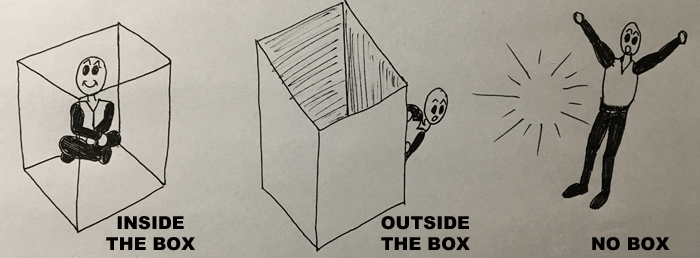
The greatest deterrent to creativity is the discipline and habits that individuals form to fit into a logical society. However, our culture is now changing and requires creativity to survive, so its time to change gears and learn how to create and innovate. Here are three steps that a person can take to increase their creativity.

1. Break Habits. People talk about how ideas pop into their head while showering or doing anything mundane like eating breakfast. Those things do tend to happen when we first get up, but soon dissipate with the rigors of a work filled day. To counter the effects of habits we need to purposely change our life patterns.

By parking in a new space, sitting in a different place during a meeting, or walking a new way back to your office can fill your senses with new observations. The fresh experience will generate unfelt reactions, altered thinking, and a form of circumstantial genius that allows you to take in data that you’ve never considered before—all of which will fuel your creativity.

The above cartoon demonstrates the breaking of a habit. The ant that said, “A,” broke the habit of repetition. The ant that joined in, albeit skeptically, by saying, “B,” supported the change. Unfortunately, the next ant was confused because he didn’t focus on the unexpected.

2. Focus on the Unexpected. Boredom sets in when we find ourselves trapped in a reoccurring scenario day after day. When we focus on the unique or unexpected circumstance, we open our minds to consider new perspectives and ideas.

The person that focuses on the newfangled experience reenergizes their faculties of observation and creativity. This also opens the door to developing new patterns that can lead to success, especially when focused on the possibilities that come from the change.

Had the 7th ant focused on the change and said, “A,” the 8th ant would have most likely said, “B”—affecting permanent change. Unfortunately the focus on the change was missing, which encouraged the 8th ant to go back to the same boring, yet comfortable pattern as usual. Creativity lost its opportunity because the last ant wasn’t willing to live in the moment.

3. Live in the Moment. The person that drives to work at the exact same time and takes the same route rarely lives in the moment. The person who lives in the moment creates fresh opportunities and experiences a heightened sense of reality that feeds his or her creative soul. The new stimulus can help us capture information in a new and exciting manner.

The freshness from living in the moment is invigorating for positive people and fear ridden for those who see the cup as almost empty. Perspective plays a major role in the fear factor, which can paralyze those who seldom see the world through the eyes of hope.

The 5th ant above was living in the moment and made an exciting change. The 6th ant was also living in the moment, but was so uncomfortable with change that he questioned the new direction by dragging his proverbial feet. The 7th ant was perplexed and didn’t want to return to the old boring life, nor did he want to support the unknown. His ability to live in the moment wasn’t based on wonder, but instead based on fear.

These three steps allow our mind to meander and draw information from various memories in a new fresh way. Being purposeful in breaking old habits like the ones that no longer serve our vision, can open us up to an unforgettable adventure. By focusing on this change and paying attention to how it unfolds empowers us to turn the unexpected into a vision-boosting rocket. And, living in the moment helps us to steer change into a positive result.

While these three steps drive creativity, it’s our participation that determines success or fear formed failure. Embrace a positive mindset and start breaking habits today.

© 2017 by CJ Powers

Creativity—No More Corporate Box

Failures within the Fortune 1,000 world have become critical over the past ten years. To learn how to protect corporations from bad decisions, IBM polled 1,500 CEOs to learn the #1 leadership competency required to survive the future. The answer was “Creativity.”

Two years ago a dozen corporate futurists also stated that creativity was moved to the number one slot of the top ten skills list needed for advancement. Business analysts stated that the only growth companies were those that thrived in creative environments with innovators on staff.

The flurry of activity surrounding creativity in the corporate sector suggested that HR departments needed to set up creative training sessions, adjust hiring scripts and find ways to compensate those who created beneficial solutions. But hundreds of HR departments did nothing.

Over the years HR has become a science, while creativity remains an art form. It’s hard to scientifically measure the value of a creative to determine which one should be hired. It’s also difficult for a director, who was taught that people are supposed to work in the figurative box that the company made, to design a program that trains logical people to play in a box-less environment.

BOXsm

Corporations needed to build the box lifestyle for employees during the days of industry in America. By the time the personal computer was invented, corporations needed people who thought outside of the box. For our future, corporations need to hire people who don’t work, but play, not in or out of a box, but in a box-less environment.

And they don’t get it.

Who doesn’t get it?

Well, let’s start with SEARS or any other relator that is headed toward bankruptcy. The list is getting longer every year. Just think about SEARS having survived for 124 years both inside the box and outside of it, but now that a box no longer exists, the company has no clue how to survive. Some are guessing its doors will close during its 125-year anniversary.

I was once taught that business is always moving. If its not moving forward with growth, then it’s moving backwards with decline. A business is incapable of standing still. I was also taught that innovation (creativity) was the only thing that could grow a company exponentially. Creativity is movement.

The companies throughout history that disrupted their business market with new innovative solutions always captured 40-90% of the market and forced all other competitors to share the leftovers.

The fact that progress is impossible without change stumps numerous leaders. But a creative knows that change is inevitable and chooses to create the change rather than worrying about what may or may not take place by the hand of others.

Creatives are the leaders of our cultural future.

© 2017 by CJ Powers