
For those of you who haven’t heard about my upcoming short film, AI KNOWS, it’s set in 2060, a world where artificial intelligence is deeply embedded in everyday life. The story follows a young rookie officer, tasked with escorting a 45-year-old man to his forced retirement at a space station. As their journey unfolds, the officer must choose between the wisdom of the old man and the ever-advancing AI that guides them. However, all is not as it seems, and the AI may be concealing or ignorant of a deadly malfunction.
AI is being integrated into everything, whether we want it there or not. Chances are, your phone already utilizes AI, and most email programs now summarize messages for you, saving you the effort of reading certain emails. Change is coming fast, and by 2060, AI will likely be woven into the fabric of our clothes.
Imagine a tag on your shirt that tells you how many times it’s been washed, how old it is, and whether it’s still in style. It might even suggest which items in your closet pair best with it, streamlining your decision-making. With these ideas in mind, I had to design outfits for AI KNOWS that always look sharp, reflect each character’s unique style, and function in a world where technology is an ever-present companion.
My goal for AI KNOWS wasn’t to craft a utopian or dystopian world but to create something that feels grounded in the present while still accommodating space travel. I wanted the setting—and the clothing—to be plausible enough that viewers wouldn’t be distracted by the future. Instead, I wanted them to quickly get in sync with the world I’ve built, allowing the story to take center stage.
Davis: The Young Rookie Shuttle Pilot

Davis is the main character in AI Knows, and he undergoes the most significant transformation. As a 14-year-old shuttle pilot, he has been taught to believe that AI knows best, people over 45 are irrelevant, and that AI holds the answers to everything. However, as the story unfolds, Davis is compelled to confront the limitations of AI and the value of human wisdom.
When designing Davis’s outfit, I wanted to ensure it reflected his role as a young pilot while also highlighting his discomfort with the rigid, AI-driven world he inhabits. His uniform needed to be formal enough to pilot a space shuttle but simple enough to allow for ease and comfort, reflecting his youth and inexperience. The design had to embody his journey—initially stiff and structured, mirroring his blind faith in AI, but gradually becoming more relaxed as he begins to question everything he has been taught.
Jet Carlson: The Aviator Mechanic

Jet Carlson’s life as an aviator mechanic has shaped his every move, and his outfit reflects the grounded, no-nonsense personality that comes with it. In a world where clothes constantly notify their owners when they need cleaning or care, Jet is one of the few who doesn’t mind getting a little grease on his elbows. His outfit consists of earthy tones—muted greens, browns, and tans—matching his practical, steady nature. But there’s one item he’ll never part with: his bomber jacket. It’s a symbol of his past, a worn piece of clothing that still holds its own style, even in the face of an AI-dominated world.
Despite his quiet demeanor, Jet is a man who knows when to push back. He maintains a calm exterior but isn’t afraid to make others uncomfortable if it means standing his ground. Once he’s done pushing, however, he lets go—accepting that not everyone is ready for the help he offers, and sometimes, that’s okay.
Elara Carlson: The Creative Spirit

Elara Carlson, Jet’s 12-year-old daughter, is the embodiment of creative flair. Unlike her grounded father, Elara embraces a playful, artistic spirit that spills into every aspect of her life—even her outfits. She’s the type of person who can mix and match items in her closet to create a look that feels fresh and new every day. No matter the circumstance, Elara’s outfits are always perfectly put together, each one a reflection of her personality, with the exception of her school uniform.
While her creativity shines through in her clothing choices, Elara’s fun-loving nature ensures she never takes herself too seriously. She holds everyone in high regard, always finding joy in connecting with others. When Jet tells her about Davis’ impending doom, she demands action, showing a level of maturity that surprises him. But once she’s confident things are in motion, she quickly returns to her playful self, telling him she’ll visit once she’s got her shuttle license. Accessories are Elara’s signature—whether it’s a fun pair of pink glasses or a custom necklace, she ensures every detail of her look is on point.
Fashion as a Reflection of the World
As Davis escorts Jet to his new room, they pass a billboard that reads Jet’s presence and immediately advertises the latest tech-wrench for his consideration. This subtle moment quietly reveals that the AI hasn’t been updated since Jet’s forced retirement. After all, he no longer needs tools.
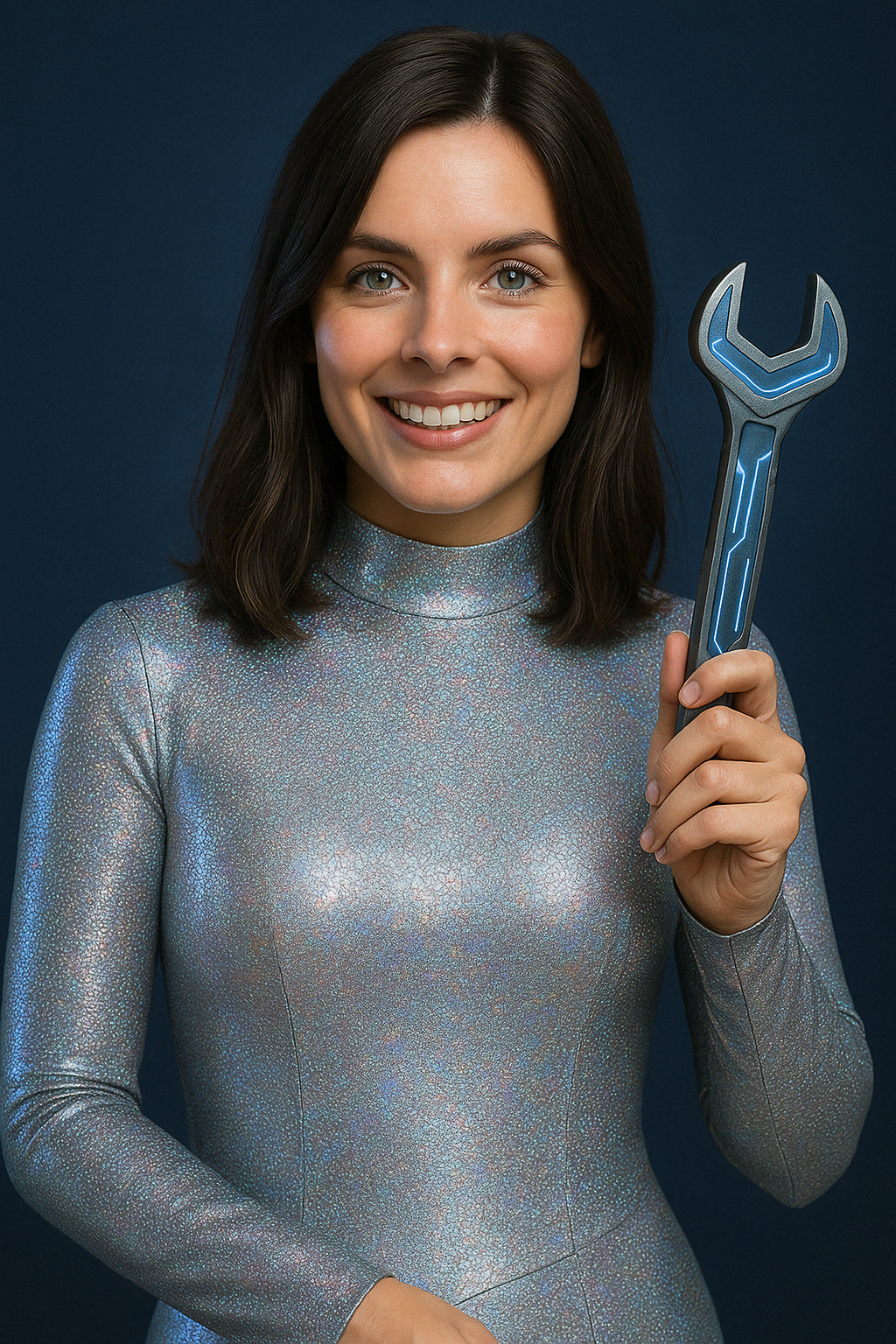
But the real eye-catcher is the woman on the billboard, displaying the wrench in a sparkling one-piece suit—a glamorous worker’s outfit designed to catch the eye of the intended audience. It’s the kind of futuristic material I recall being shown back in sixth grade, an innovation that, at the time, seemed poised to revolutionize the fashion industry. Of course, it never took off.
It’s funny how companies constantly push the latest trends, but only a few clothing styles per decade truly capture the public’s imagination. Most fade away as quickly as the next season’s releases, leaving behind only a faint trace of what might have been.
The key to speculating on sci-fi fashion isn’t about trying to predict what could be, but about making sure everything fits seamlessly into the world I’ve created. After all, we all remember the future vision from Back to the Future II, released in the 1980s—flying cars were supposed to be everywhere by 2015, and the Cubs winning the World Series? Well, that seemed like a total joke at the time, and yet it actually happened, just one year later than in the movie.
That’s the beauty of world-building: it’s not about predicting the impossible, but creating a world so plausible that it feels natural.
In AI KNOWS, the fashion I design won’t be about futuristic outfits for the sake of spectacle, but about ensuring every piece fits into the everyday lives of my characters. The clothing needs to make sense in the context of the world I’ve built, from the sleek uniforms of the young officers to the retro-inspired attire of characters like Jet. If the audience doesn’t notice the clothes because they fit so naturally into the world, then I know I’ve done my job. After all, the focus should always be on the story.
A Life-Changing Story
For me to truly speak into the hearts and lives of teens and tweens about the importance of data-driven AI and the irreplaceable value of experiential wisdom—something AI can’t develop—I need to create a world that focuses the viewer on the core elements of the story. The quality of the production will help ensure that the audience is drawn into the world, allowing them to fully engage with the choices the characters make and the lessons they learn.
When Davis faces a life-changing decision, the audience will be right there with him, exploring the same considerations for their own lives. No one will tell them how to think; instead, they’ll be invited to make their own discoveries as the story unfolds. That’s what makes a truly life-changing story—one that can be watched again and again, each time offering something new.
So, keep following my journey, and let’s see if we can bring this vision to life together. In the meantime, I need to find costume experts to bring this vision to life.
© 2025 by CJ Powers
 Young filmmakers rarely use a love triangle within their movies. They miss the tremendous amount of conflict and story development that rises naturally from the mix. Their eyes are closed to the internal stories tumbling within the souls of each character and how it externally manifests itself in humor and drama.
 CJ's Corner