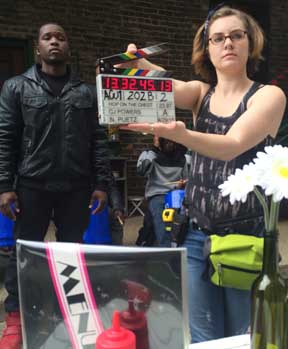
 Mentoring in the moment is an important function of giving back. Not only does it give me an opportunity to help new upcoming filmmakers move up a level in the business, but it also gives me a fresh perspective on what unforeseen industry changes might be slowly approaching.
In a recent conversation with a young female director, I was asked, “What are the three most important things that a director brings to a script?” After answering, I realized that there are indeed three specific things a director brings to a script that determines the success of a film.
STORY
The director brings the story to life by attaching his vision to it. He is responsible for finding the holes in the story and making it whole. He also has the power to determine how it is to be told and position it so the audience can easily understand and embrace it. If the story fails, it’s the director’s fault.
One first time director argued the point with me by suggesting he was not at fault, but his bad writer was to blame. I asked him if he was sure and he confidently defended his position. Once I could see that he put his entire defense into the bad writer, I asked why he chose to make the film when he knew the writing was so bad. His argument proved him to be either a bad director or a foolish one for shooting an unworthy story.
STRUCTURE
The director determines the beats of the film and the visuals that will best depict the story. He is responsible for the development of the characters and the emotional highs and lows of the picture. He even holds the responsibility to inspire his team to perform admirably within the confines of the budget.
An experienced director with 35 plus features under his belt told me that he left the structure of the film to the writers and director of photography, while he focused solely on the actors. I asked him how the film was translated from the page to the screen without his artistic touch. He suddenly realized that he had given up his artistic choices to chance happenings – When the written word happened to match well with the visual depiction.
STYLE
All directors have an artistic style that evolves into something that few can replicate. When a person watches a Woody Allen movie, everyone knows it’s his, even if his name was left out of the credits. Just sharing director names at a party immediately invokes the look, feel and overall style of his work within the person’s mind. Consider Hitchcock, Spielberg, and Nolan. It’s hard to say those three names without seeing their style show up in your mind’s eye.
I recently chatted with an up coming director who was struggling with his first short film. Every time someone helped him improve his story, he lost interest in it and started over. I realized that something about the suggestions must have spun the style of his show within his mind to become something he was no longer passionate about. This was disconcerting since directors always spin the suggestions into their own version that matches their stylistic vision.
Directors put their fingerprint on everything they do. It shows up in the perspective from which the story is told to the structure of its emotional beats to the overall look and feel that is presented. The director owns the success of a film and has the three key tools that place his fingerprint onto his work.
Copyright © 2015 by CJ Powers
 CJ's Corner