7 Steps to Being a Great Director

I was recently asked by a newbie filmmaker how he could become a great director. The answer I shared was a quote.

“Contrary to popular belief, filmmaking is not a job. It’s not really even a career. It’s an Artistic Lifestyle! And that means in order to work at your art, you will need to live and breathe filmmaking every day.”

Director Peter D. Marshall

Having communicated with Peter several times, I came to understand and agree with his perspective on this answer. Below is my understanding of his answer in seven easy steps that will turn any filmmaker into a great director.

Study the Human Condition

Directors are observers. They watch others attentively and learn why they do the things they do. Directors also compare people’s actions to help them understand how we are the same, and different.

Marshall defines the act of directing as “the art of visually telling a compelling story with believable characters who make us feel something.”

To entertain a person, a director must reveal something that the audience has never experienced before. To make them feel something, the director must navigate or direct the audience through new experiences. And, to empower the audience with the theme, the director must inspire them to rise from the human condition with hope for their tomorrow.

Studying the human condition is the most important task of a director. He must understand, not judge, everyone around him. This is something that needs to be practiced daily.

One approach is observing normal people living through normal conditions. By witnessing their behaviors and choices, you can learn what motivates people to do the things they do. Understanding motivations give the director a great tool for working with actors to achieve realistic performances.

Study the Storyline

Directors must know the story better than anyone else on set. Instead of focusing on cool effects or cinematic compositions, the director must ask himself how each tool, crew, and cast member adds to the story. This is where the details count.

The director must do a deep dive into each scene, character, and setting. He must know the why behind every action, comment, and motivation. He must know the backstory prior to the script’s first page, and he must know the proverbial pages that follow the final “The End.”

All productions are forced to make changes during the shoot and post-production, which can turn a good story into a disaster. However, changes at the hand of a director who has studied the story to great depth can ensure a successful outcome. There is no shortcut to studying the storyline. The director must own the story.

Direct the Performance

Every actor I’ve worked with needs a director that fits their style. This is only possible if the director learns various acting techniques and develops listening skills. Directors also must learn the best ways to approach various actors and communicate what they need to hear in order to alter their performance for the positive.

This actor/director relationship is critical to the show’s success. The most important element of the relationship is trust. Actors must be able to trust that the director is not going to have them looking bad on screen. This trust is also a form of protection for the actor, who must make themselves vulnerable in being someone they are not.

Good actors surrender to the in-the-moment feelings and impulses of their character. The director must make the set a safe place to keep the actor’s emotions intact. To do so, they must praise great performance often and workshop the differences when the story needs the character to address the scene from another perspective.

Understand Editing

When reviewing a script, a director can make better on-set choices if he takes the time to read the script from an editor’s perspective. This empowers him to make more visual decisions from the standpoint of cutting between shots and camera placement—not to mention camera movement.

By learning how editors think, a director can better block scenes, create montages, and capture natural movement with the characters. This skill will also help the director to get to the point of a scene when in a time crunch. This also improves the director’s use of dolly, trucking, and crane shots.

Learn the Psychology of the Camera/Lens

Directors who have worked on the legitimate stage seem to have a better understanding of the camera and lens as compared to the theater.

For instance, when a director moves a character downstage toward the audience, it’s like using a telephoto lens to capture an intimate close-up. The opposite is also true. When a director diminishes the character by moving them upstage, away from the audience, he can accomplish a similar effect by using a wide-angle lens that reduces the character on screen.

The composition also plays an important role in the psychology of the image. The on-screen character can be dramatically and emotionally impacted in the audience’s mind based on their angle and placement. This is more than memorizing the name of shots, as the composition can convey a wide variety of emotions.

The director must learn where to place the camera in order to make the audience feel in a specific way. A poorly placed camera can take the audience out of the story and force them to realize they are no longer involved in a story but rather watching a movie—killing the hard work of the cast and crew.

Explore Blocking Techniques

Not only do various lenses play a big role in the look of a film, but the position of the actors to the camera also plays a significant role. The director’s blocking techniques impact the relationship of the actors to the camera. This “choreography” of actors, bits, and extras creates a harmony of movement that is believable or not.

The director that decides to be artistically random doesn’t understand what the audience requires for believability and to understand the story. Blocking should never be done without the audience in mind. Plus, the direction shouldn’t be so things look good on set but instead look good through the camera lens.

Blocking is often deciding what to exclude from a shot or how to focus the audience on a specific thing/moment. It’s the technique that allows the director to limit the audience’s gaze to what they need to see and understand to advance the story. If the blocking takes away from the audience’s emotional experience or understanding of the story, it must be re-blocked.

Focus on Production Value

All too often, directors pay little attention to production value. They forget the importance of Sound, Cinematography, Set Dressing, Props, Editing, Visual FX, Costumes, Stunts, etc. All these elements play a huge role in the audience’s believability in the story. When any of them are missing, audiences can sense the film is a “B” level film.

When I shot Mystery at the Johnson Farm, I met with several other independent filmmakers. We all got together for a weekend and took turns showing and critiquing our films. It became obvious who had a solid budget and who had to cheat, except for my film. Everyone thought I spent a couple of weeks shooting on a real farm, but the truth is that not one single shot was taken on a farm.

I shot a few blocks away from a downtown suburban area just outside Chicago. The choice of camera angles, sound effects, foley work, and ambiance made the audience feel like they were on a farm. To sell the feeling, instead of using the standard four soundtracks typical of an indie pic at the time, I used 16 tracks. The layering made a subtle difference that few could speak to, but they were all convinced the film was shot on a farm.

Closing Tips

The biggest difference comes not from the director’s skills but his self-confidence. He must have a positive mindset, a relentless creative style, a passion for expression, and make choices based on his genre-based taste. Also, maintaining a high level of passion for the craft will always add the right amount of polish to any project.

Now find a way to practice these 7 steps daily.

Copyright © 2023 by CJ Powers

12 Essentials of Directing Actors

Movie director.In watching and chatting with numerous actors and directors over the years, I’ve learned a few things that directors do poorly and several they do well. During this time frame the ideals have changed within the production world, so I’m writing only those key points that relate to actors giving a truthful performance. I hope directors will find these recommendations helpful.

  1. TAKE AN ACTING CLASS. Actors are vulnerable and sensitive people who need encouragement and an understanding director.  The best way to inspire great performances is by understanding the acting process. To keep up with the latest trends, I take acting or an improvisational class every so often.
  2. MAKE A CONNECTION. An actor’s job is intense and exposed, which can cause them to feel overly sensitive or vulnerable. The director needs to come along side of them as a trusted advisor. Actors rarely need to be challenged or have an authority figure bear down on them, as most self-critique or compare themselves to their own detriment.
  3. KILL CRITICAL SPEAK. The director owns the set and must stop any cast or crew from saying anything negative to actors. Direction must only come from the director who fully understands the vision and can give proper and affirming recognition. If anyone on the set feels a need to make suggestions or confer with the director about someone’s performance, it must be done in private, if at all. The director MUST protect the actors.
  4. ASK QUESTIONS. The last thing an actor needs on set is an authoritarian or a director that bellows out commands or instructions. Each actor is an expert at her character and because the director is focused on everything, the professional actor will maintain that expert status. It’s therefore prudent for the director to change the actor’s performance inductively by asking questions. By drawing the actor into the thinking process, she is able to discover for herself what the character needs to do. This activity strengthens the actor’s ownership of the character and enhances her performance.
  5. TREAT ACTORS EQUALLY. An actor’s emotions can take its toll throughout the shooting day. Great directors try to keep an eye on each actor’s emotional status and take specific time to remind her that she is liked and respected. The director is a powerful leader that must share this treatment equally with all actors to maintain a mutually warm environment from which the actors can safely perform.  Leaving an actor out of this personalized attention can send her reeling out of control.
  6. BE COURTEOUS. Directors can raise the performance bar by being courteous and avoid the common mistake of telling an actor how she blew it. By saying, “What was that? You can’t bellow out your lines. Let’s do another take and give me less,” the director increases the actor’s fear and stiffens her next take. Instead, a director might consider saying, “I’d like to try something a little different on this next take. I wonder if you could maintain your emotional intensity and drench the other character with a dangerous calm.” This gives the actor more to work with and inspires creativity and performance.
  7. AVOID COMMON ACTING PROBLEMS. Acting is self-conscious and self-judgmental, which many times can cause an actor to act from her head instead of her heart. The director must work with the actor to make sure she is focused on the character and not herself. This approach will avoid numerous problems that typically rise during any given shooting day and help to draw out an honest or truthful performance.
  8. PROMOTE RELAXATION AND FOCUS. Relaxation is important to make sure the actor doesn’t project her voice as if on a stage. It will also impact the way she carries herself. When a scene calls for tension, it will naturally grow from the relaxed state and appear in her hands, walk, voice and face. Anytime anxiety creeps in, the actor becomes stilted in her performance. A director can improve the performance by reminding the actor of what she’s done well. Even redirecting her focus off of her feelings and back onto the character will reduce the temporary lack in confidence.
  9. CLARIFY SUBTEXT. Reviewing subtext during rehearsal will help an actor focus on each line, glance or action. Every element of her performance must lead to her character’s super objective or what she is fighting for. The subtext can be clarified with a verb to be played, a character she plays to, and an intended effect that her character wants as the outcome.
  10. KILL ANTICIPATION. It is difficult for a director to have an actor play a part “naturally” in a specific way, as the mere mention of doing it naturally makes the performance stilted. Within that moment the actor gets trapped in her head and starts to anticipate a line or action. She might also purposely hold back in an attempt to be more natural, which creates an awkward lag and reveals that the actor has done this moment several before in rehearsal. One of the best ways to avoid this conundrum is to walk the actor through the character’s thinking process, while salting in moment-by-moment clues as the performance unfolds – Just like in real life.
  11. KILL INDICATING. It’s common for an actor to increase the visible size of her performance in hopes of reaching the audience or allowing them to see her character’s personality. Unfortunately, the lens is only kind to subtle performance and the actor finds herself overworking and destroying her character in the process. Having the actor think about a secret or some internal struggle during the performance, allows the audience to see that there is more depth to the character without an over-the-top performance. Giving direction to the actor as if you’re speaking to the character also generates this subtle secrecy effect.
  12. SPEAK IN VERBS. Many actors memorize certain actions to help them “do business” during their scene and it weakens their performance because it doesn’t naturally flow from the character. Instead of having an actor pull something out of her bag of tricks, the director can share verbs that stimulate creative ideas that develop new actions based solely on the character. An example might come from a script line like, “She keeps up with her dodging in and out of shadows.” The immediate thought an actor might come up with is moving from tree to tree peering around as she tries to keep up with the other character. However, the director can bring to bear an arsenal of variations on this movement by asking the actor to “trail” the other character. Or, he can step up the intensity with each word suggested: follow, track, pursue, hunt, stalk, or chase. Each verb intensifying the action and giving a new mental picture for the actor to perform.

If I were to add a “don’t” to the list for amateur directors, I’d have to recommend NOT ever demonstrating how you’d like something played. This act instantly reduces the director’s credibility to zero and he doesn’t get what he’s asks for, as his performance never plays out the way it was in his head. It is also insulting to the actor who is the expert on her character, who would never do things like the director demonstrated. This is not to take away from the director showing an actor their blocking, as he walks the actor down the path, while discussing the character’s motivation.

The key is to remember that the actor is an expert at her character and the director can’t be due to his high level of knowledge on the entire picture. However, the director will know what works and what doesn’t and must use questions to help the actor create variations of performance until the director gets what will work best on screen – Something the actor trusts the director to accomplish.

Copyright © 2013 by CJ Powers
Illustration © shambulin – Fotolia.com

Directors Stage Shots and Block Actors with Triangles

The human eye moves around a room or watches a scene based on leading lines and points of focus. The art of capturing the eye and encouraging its movement in a specific direction is done through composition. There are many types of composition like “L”, leading lines, rectangles, spirals, etc. The study of these forms is typically taught using the rule of thirds, or the golden rule section or ratio.

The cinematographer is well equipped to use these various techniques, but he first must learn what the director is trying to accomplish with the actors as they rehearse or block out their movements. The director will try to create emotional energy within the scene and shift the power between characters. It’s the cinematographer’s job to capture that engagement by racking focus, using a crane, or creating movement with a dolly. The goal of the set up is to help the audience feel and understand what the actors are emoting.

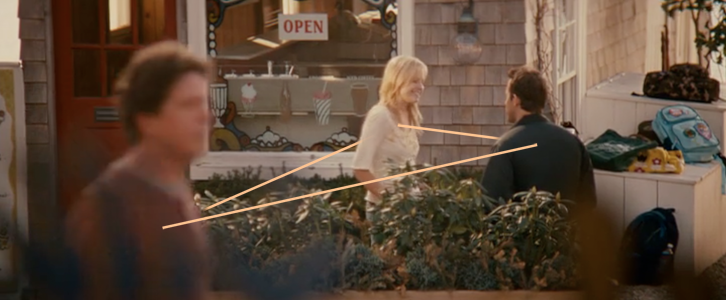
The more actors on set, the more difficult the staging of the shot becomes. The simplest way for the director to capture the essence of the scene and leverage the ability of his cinematographer is to block the actors in groupings of triangles. This can be done by height, distance from the camera, or with three various groupings.

Director sets shot with triangular grouping of actors.

The director blocks the actors in three groupings within a triangle.

In “The Proposal”, during the engagement announcement scene, the cinematographer uses three groupings of actors (orange boxes of people grouped in a triangle with red lines) with one close to the camera, the next mid way, and the last group farther away. In the last grouping, the actors were grouped in a mini-triangle (blue lines) by the director.

Three-shots can easily be turned into triangle blocking based on distance from camera, actor height, and relative position if one actor stands while others sit. Sometimes the director uses a momentary triangle, as someone walks past in the foreground or background, to break up the obviousness of the blocking.

While still shots might reveal various compositions utilizing triangles, motion pictures will many times interrupt the posing aspect that the composition might encourage with movement. A cinematographer may also choose to rack focus between points of the triangle to create more eye movement.

Copyright © 2012 By CJ Powers
Photos © Touchstone Pictures