Visual Practice Leads to Innovation

animal zoo ape baboon

Photo by Skitterphoto on Pexels.com

I reviewed several hundred movie posters yesterday to remember which movies stirred something within me. I wanted to create a list of 20 films and then study the movies to learn what the directors had done to capture my heart with their story.

However, flipping through the pictures not only reignited those past feelings, but it also sparked my imagination with ideas worth keeping for future innovations. The experience also gave me the idea to share those steps with you. They are simple enough that a monkey can do it—sort of.

Did you know that track lighting was invented as a result of a monkey picture?

Back in the early 1960s, the designer who came up with the idea for track lighting while working at Lightolier, was browsing through a National Geographic magazine and spotted a picture of a monkey. He allowed the visual stimulus of the incredible photograph to play around in his head. He imagined the monkey running around inside a house moving lights to where ever it was needed. That imagery of moveable lighting led to the invention of track lighting.

We can use the same techniques to spark our imagination in four steps.

BROWSE IMAGES

Scanning through images in newspapers, magazines, and online is an easy way to spark an emotion. When you find a few that grab your attention or interest, set them to the side for the next step. I like to skim through Pinterest and then capture the images that stir me into one of my boards.

WRITE DESCRIPTIONS

Pull out a piece of paper or open a WORD document and write out good descriptions of the image. You can write in prose or bullet points. Try to use strong verbs to describe as much as you can as it relates to why you were stirred by the image. Make a good selection of your words to clarify the action within the image and the feelings it exudes.

MAKE CONNECTIONS

Review the problem or challenge at work that you are facing. Glance through the pictures and descriptions you’ve written. Then force yourself to find any correlations that are possible. It’s okay to stretch yourself in this step. The key is to not ever limit your connections with made up rules in your head.

BRAINSTORM IDEAS

Make a list of possible considerations based on the correlations you’ve discovered. Play with the ideas in your head, expanding them creatively to things you would not normally consider. Then determine the top three ideas worth looking into for its business potential.

Whenever I run through this process I always gain insights that are useful. The connections are many times abstract, but they are present and become fuel for my imagination, driving my next steps of innovation.

As I finished looking through the movie posters, I suddenly realized that all the posters I selected were about a specific story concept. The protagonist decided to be himself regardless of the system demands placed on him and when he got to the end of his rope with failure imminent, his friends stepped in and empowered his success.

I hope this article empowers the success of your next innovation.

© 2019 by CJ Powers

Just in case you wanted to be a blessing today…

Buy Me a Coffee at ko-fi.com

The Creativity of Burning Ice—What Doesn’t Come Next

charcoal on fire

Photo by Anastasia Zhenina on Pexels.com

My first winter campout was filled with contrasting activities that saved my life. Pitching a canvas tent in three inches of snow seemed odd and the packing of snow around the base of the tent felt counterintuitive, yet it was a great insulator that kept me warm inside.

The freezing night air suggested I wear every piece of clothing that I brought to bed, but my scoutmaster recommended we sleep in our underwear. My sleeping bag did the trick in keeping me warm in my shorts, while my roommate hardly slept in his layers of clothing because he shook all night from his sweat trying to freeze.

The next night included a hazing ritual for those who braved the winter camping experience. One at a time, we were taken from seclusion to the bonfire area for the testing of our manhood (something that would not be allowed today). When it was my turn, I was told that if I screamed from the pain, I would fail the test.

I was taken to a fire pit that was two feet wide and six feet in length. I felt the heat rising from the bed of hot coals and was instructed to take off my boots and socks. After blindfolding me, I was turned around a few times and then instructed to walk across the hot coals to prove myself manly. Being a teen raised by a cop and a teacher, I figured the scouts couldn’t afford a lawsuit, so I decided that the spinning around was to disorient me. I assumed that I was no longer in front of the coals.

I willingly took a bold step forward and felt my feet on the hot searing coals. I was blocked by onlookers from turning back, so I moved quickly across the hot embers. Once my feet hit the ground, I turned back as I pulled off my blindfold and watched the guys cheering as they pointed down to the long pit of ice I had crossed.

My eyes, having seen the hot coals, coupled with my mind knowing what comes next, connected with the extreme temperature change felt by my feet moving from the ground to the ice. This caused my mind to interpret the contrasting temperature to be hot rather than cold. My senses had been fooled.

When our mind thinks it knows what comes next, we are naturally biased based on our previous experiences. This bias reduces our creative ability, surrendering our thoughts to the logical side of our brain. To increase our creativity, we must learn how to explore what does not come next.

School taught us that every action has an equal and opposite reaction. When we engage our creativity, we find that this rule can kick in by immediately bringing to mind the opposite of our initial thoughts. If we think about things that make us feel hot, the contrasting items that make us cold subconsciously pop into our mind as well.

This natural phenomenon can help us ponder alternative solutions for a problem at work. By exploring the various contexts that arise, we are able to consider things that can expand our perspective. Contemplating things that are not directly connected to the obvious next steps, opens our mind to a new world of possibilities and solutions that would otherwise never be considered.

After the invention of the small 9” television screen that was mounted in the huge box to hold all of its tubes, who would have thought that we could carry a portable 9” television built into our flat tablets or phones?

Only by exploring the things that don’t come next can we find uncommon solutions that change the face of our market. To be a company that innovates, the workers must learn how to explore what doesn’t come next to spark new perspectives and ideas.

A simple exercise that you can do right now is called “What’s Not Next.”

Consider what you are doing right now. You probably know without much thought what you’ll be doing next (after reading this article). However, the exercise asks you to consider the opposite—what you will not do next. Explore the possibilities and consider any correlation to what you are currently doing.

Then ask yourself how what doesn’t come next impacts what does come next.

This exercise forces you to be open-minded and allows you to strengthen your creativity by changing your perspective. By picking arbitrary times throughout the week to explore this exercise, you will expand your ability to switch perspectives more rapidly and increase your ability to solve problems caused by a changing marketplace.

© 2019 by CJ Powers
Please consider helping me offset the costs of publication, as I work on my next book The Creative You. Your support is welcome.

Buy Me a Coffee at ko-fi.com

Solving Problems When You Don’t Feel Creative

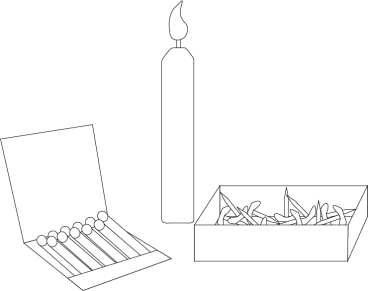
CandleBoxTacksWhen I was in college, Oktoberfest was a big celebration in Wisconsin. One year, the local radio station had a competition to find the hidden medallion. The winner received thousands of dollars’ worth of prizes, major media coverage, and was honored in the parade. Every morning the radio station broadcasted a clue to help people find the medallion that was hidden somewhere within a half-hour radius of the tristate area along the Mississippi.

Known for my creativity, numerous people asked if I was going to solve the puzzle and reap the rewards. I decided to give it a try and found myself following the clues to within an inch of the medallion. I even rested my hand on the stone that covered the medallion. But I never lifted the stone to find it. Why? Because I had a functional fixedness bias from my childhood.

A common game we played in our childhood was called Hide the Thimble. The rules were that the person hiding the thimble had to place it in plain sight, so it could be seen from at least one angle without anything blocking it. My heightened observation skills made me a natural at winning that game. But in the case of the Oktoberfest medallion, there was no rule of it having to be in plain sight. I assumed the rule because of my functional fixedness.

The emotional pain I experienced when the station announced where the medallion was hidden, having had my hand on that very stone, was intense. I cringed when I realized that the reason the stone wobbled under my hand wasn’t that it was uneven, but because part of it was sitting on top of a medallion. Argh!

Today, I’m very conscious of any form of bias. I also practice interrupting patterns on a regular basis. The reason I work diligently at breaking away from functional fixedness is that innovation demands my mental freedom and the longer a person continues in functional fixedness the harder it gets to break free and think creatively.

Functional fixedness is a bias that hinders creativity—limiting people to only use an object in the way it was intended to be used. The opposite of functional fixedness is reflected in MacGyver’s ability to use common objects in a different way than originally designed. It takes a tremendous amount of creativity to use unrelated objects together for a solution, like using a cellphone camera as a mirror, a brick as a doorstop, or a quarter to unscrew a screw.

In moments when we feel less creative, psychologists suggest that we are likely caught in the functional fixedness mindset. This concept was first introduced by Norman Maier in 1931. By 1945, psychologist Karl Duncker designed a test to determine if a person held the bias or not. The test included a candle, a box of thumbtacks, and a book of matches.

The test subject was to solve a simple problem. The goal to find a way to hang a lit candle on the wall using only the materials provided. The person with a high degree of functional fixedness was not able to see the box of tacks as part of the solution. He could only perceive it as the container holding the useful thumbtacks.

The unhindered creative solution had the person dump the tacks out of the box. Place the box on the wall using thumbtacks and placing the candle in the box. Then the matches were used to light the candle. This simple solution is mentally blocked for many people who hold a bias that they are unaware of.

Unfortunately, many people who realize they are no good at solving these types of problems seldom take time to break the bias and improve their creativity. They typically state that they aren’t creative, allowing their functional fixedness to grow more powerful. The only way to reduce our unhealthy biases is to build and empower our creativity.

There are three steps I use to break free of functional fixedness:

Explore the Problem using Make-Believe

Today’s culture suggests that problem-solving is a logical practice because of functional fixedness. To use the right side of our brain, where most of our non-diagnostic troubleshooting skills reside, we have to make the problem abstract. This can be considered a form of play, which opens our mind up to all possibilities.

Sometimes I pretend that I’m living in a sci-fi world where normal rules of nature no longer apply. This creative world-building allows me to look at a problem from new vantage points because it distills the issue down to its core elements—surface issues that typically hold our attention due to bias fade away.

Drawn from Alternative Fields of Knowledge

Once I’ve exposed the bare essence of a problem, it is easy to see similar issues being worked on by professionals in other fields. This allows me to draw from their expertise in how they work the basics and transfer them to my situation. This process typically fuels my creative thought process and feeds me new perspectives and ideas worth exploring for my specific problem.

Play with the Inspired Possibilities

At this point in the process, my thoughts are freer of bias and I continue to play with the ideas. This is the stage where I keep all possibilities open for as long as I can, not wanting to take just the first solution that pops into my head. The playful stance during this phase of the process allows me to explore multiple solutions so I have a few to choose from.

Freeing our creativity requires the breaking of strongholds like functional fixedness. A bias never self corrects, so we must purpose to change our viewpoints. By acknowledging our bias, we can focus on strengthening our creativity and fuel our future with a greater ability to problem solve and innovate—making us a valuable resource for our company, community group, and family.

© 2019 by CJ Powers

If this article has helped you, please consider helping me offset the costs associated with this blog by clicking the button below.

Buy Me a Coffee at ko-fi.com