Review: Mirror Mirror

It only took one glance at the “Mirror Mirror” movie poster to understand the film was a comedy. It was bright, colorful and humorous. However, the entire movie was done in a dark motif that confused its audience and left most humorous gags lacking any type of chuckling response from the audience. Even the normally hilarious Nathan Lane brought few smiles.

CJ Powers Reviews Mirror Mirror

In his attempt to make a “Princess Bride” version of Snow White, director Tarsem Singh managed to kill the comedy and scare the kids. Numerous children left the movie, although some came back for a time, but left again once the film became a bit more intense. It made me wonder why a studio would present the work of an intense drama director as a children’s comedy.

This depiction of Snow White was told from the evil queen’s viewpoint, until just before the end when it shifts to Snow White. This vantage point gave a clear understanding as to why the director chose to make the entire film dark. This unique combination might have worked with dark humor, but the comedy was filled with trite comments, childlike slapstick and grade school humor.

The anti-magic and anti-tax messages aimed at kids were a bit unique and out of place. While I could understand wanting to help children embrace a conservative perspective in life, the story’s sound advice was well over the heads of the kids in the audience – Well, at least for those who weren’t cowering in fear of the dark forest.

This film is definitely not suitable for small children, even though the dark forest only drummed up a PG rating. Nor is it suitable for adults, as most in the audience missed a great deal of humor due to the confusing juxtaposition of silly comedy played within a dark motif. My recommendation is to wait for this one on video so you can say you watched another Julia Roberts film.
Dinner with WGN Critic Dean Richards and Documentary Producer John Digles

Seldom do I find myself in a fancy enough restaurant where every course is paired with the proper wine to heighten the food’s flavor, let alone sharing great conversation with those in the industry. But last night was just that kind of a night and I must add that executive Chef Jean-Louis Clerc, who specializes in French and international foods made the most incredible duck I’ve tasted in years.

Dean Richards CriticDean Richards, known for his movie and entertainment reviews at WGN, joined me in giving the chef an A+ rating. The flavors were so perfect that it was easy for Dean to let his Oscar picks slip prior to his official announcement during his Sunday Morning show this past weekend.

Dean and I were mostly in agreement with the amount of politics that play a role in the Oscar voting process, but we did differ on a handful of choices. Unfortunately, that doesn’t bode well for me since he is running at an annual accuracy rate of 97% with his Oscar picks.

Dean is thinking that “The Artist” will win best picture, but I’m holding out for “The Help”, which made me feel for those discriminated against and put laughter in my soul in the process. When it comes to best actor, we agreed on George Clooney, even though we both would prefer to see the Oscar given to Jean Dujardin for his portrayal in “The Artist,” as his acting was phenomenal since he had no dialog to work with.

Best Supporting Actor was a no-brainer with Christopher Plummer’s performance in “Beginners.” We were in agreement with Best Actress going to Viola Davis, although Meryl Streep certainly deserves the win. We both felt like the Best Supporting Actress would go to Octavia Spencer. Beyond that, our tastes diversified and I found hearing about his life experiences with numerous stars far more fascinating than our varied tastes in film.

John Digles Producer ActorProducer and actor John Digles added greatly to the evening. We both were raised in cop families and found our passions for filmmaking to be similar enough to exchange contact info. John just released his PBS documentary “The 95th“ on Hulu and is hoping it gets strong viewership. When I asked him about selling it to the History channel, he pointed out that it was more artistic and personal than what they prefer, as he had spent three years getting to know the veterans he filmed.

During one scene he follows a WWII sniper to France were he walks the steps he took during the war and based on the angle of a particular steeple, finds the exact place he took a bullet and prayed to survive. In that very moment of filming the documentary with the vet’s first return to the site, the sniper was finally able to get past the shock and fear he had experienced in the war that haunted him. His countenance changed.

John’s latest film is “Design”, which he produced and starred in.  He just returned from the Sundance film festival where he networked and negotiated several deals. This daunting task came a bit easier for John as he is an expert on marketing to Millennials using transmedia storytelling, the latest in effective techniques.

The night ended with me determined to watch Dean Richards on the WGN Morning News and John Digles’ documentary on Hulu. Not to mention my determination to return to the Waterleaf restaurant for more international cuisine.

Directors Stage Shots and Block Actors with Triangles

The human eye moves around a room or watches a scene based on leading lines and points of focus. The art of capturing the eye and encouraging its movement in a specific direction is done through composition. There are many types of composition like “L”, leading lines, rectangles, spirals, etc. The study of these forms is typically taught using the rule of thirds, or the golden rule section or ratio.

The cinematographer is well equipped to use these various techniques, but he first must learn what the director is trying to accomplish with the actors as they rehearse or block out their movements. The director will try to create emotional energy within the scene and shift the power between characters. It’s the cinematographer’s job to capture that engagement by racking focus, using a crane, or creating movement with a dolly. The goal of the set up is to help the audience feel and understand what the actors are emoting.

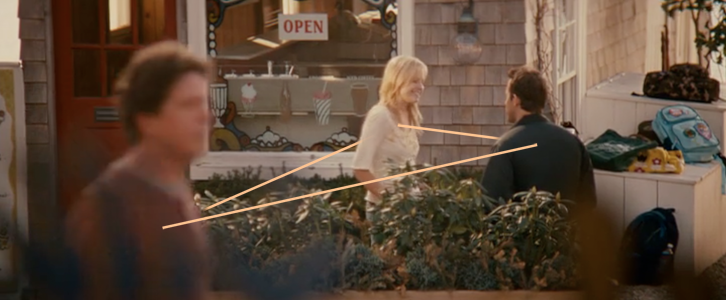
The more actors on set, the more difficult the staging of the shot becomes. The simplest way for the director to capture the essence of the scene and leverage the ability of his cinematographer is to block the actors in groupings of triangles. This can be done by height, distance from the camera, or with three various groupings.

Director sets shot with triangular grouping of actors.

The director blocks the actors in three groupings within a triangle.

In “The Proposal”, during the engagement announcement scene, the cinematographer uses three groupings of actors (orange boxes of people grouped in a triangle with red lines) with one close to the camera, the next mid way, and the last group farther away. In the last grouping, the actors were grouped in a mini-triangle (blue lines) by the director.

Three-shots can easily be turned into triangle blocking based on distance from camera, actor height, and relative position if one actor stands while others sit. Sometimes the director uses a momentary triangle, as someone walks past in the foreground or background, to break up the obviousness of the blocking.

While still shots might reveal various compositions utilizing triangles, motion pictures will many times interrupt the posing aspect that the composition might encourage with movement. A cinematographer may also choose to rack focus between points of the triangle to create more eye movement.

Copyright © 2012 By CJ Powers
Photos © Touchstone Pictures