4 Time Management Techniques for Busy Writers

Guest Blog by Lisa England, JourneyCraft

One of the most exciting recent developments in my blogging life is getting topic requests from readers. Like all writers, I want to communicate as effectively as possible—and one of the best ways is by finding out what you (the reader) want to know!

It’s especially nice when readers take the time to share.

Today’s audience-sourced topic arose recently, while I chatted with a filmmaker friend. “You seem to get so much done as a writer,” he told me. “How do you manage your time?”

It’s a great question—and one I’m happy to address today.

Myth-Busting

But first off, let me say: I am not always productive. No creative person is. Yet, with some personal experimentation, and disciplined decision-making based on the results, we can boost our likelihood of both starting and finishing our creative projects.

And once finishing—and moving on—becomes our habits, they are (thankfully!) as hard to break as our old habits of unproductiveness and procrastination.

I should also say that I do not believe that a busy life is an excuse for neglecting creative work. Yes, each life is different. Some of us have children at home. Others have aging parents. Some face high-pressure executive jobs. Others work multiple minimum-wage positions to pay the bills. Yet no matter what stage of life we find ourselves in, or what time-management challenges we face, all of us can learn to do it better.

For my part, I am married. I have a full-time job as a copywriter and strategist for a digital agency. I have another soon-to-be full-time job launching City Beast Studio, a sequential art and multimedia intellectual property development firm. And I do Rise of the Tiger which (counting gallery exhibitions, artistic collaborations and the weekly writing) is quite a part-time job.

Here are five ways I juggle that busy schedule to make writing my priority.

1. Discover your best writing hours.

I’m a firm believer that our best hours should be devoted to our most important pursuits. Start by making a list of your priorities. If you’re serious about writing, then it ought to be pretty high on that list. So why do you relegate your creative work to the leftover hours—the times when you feel crappy, hate every word you scribe, and feel so depressed about your future, you may as well stab yourself with your pen?

Your writing deserves better.

For myself, personally, I had to come to a point where I admitted: my best hours are early morning. And that means I have to  rise between 4 AM and 6 AM every morning to get several hours of good work in before I head to my day job. For others, that best time might be the dead of night or on lunch break.

If you don’t know your best time, experiment. But once you discover your peak hours, channel all your ingenuity toward allocating that time for writing. Block it off on the calendar, if you must. Whatever you do: keep that time sacred for you and your work.

2. Record goals in a visible area.

Once you know your best writing time, decide what you want to accomplish long-term, then this month, then this week. Record your weekly goals (and possibly the long-term ones, if you feel the need) in a highly-visible area, preferably where you write.

I have mine above my desk on a white board. Not only does it feel GREAT to check things off that list . . . but it keeps me focused while I’m in my writing room.

Personally, the writing times I’ve wasted most were times when I had only an amorphous idea of what I wanted to write. I would fiddle with one thing one day, another thing the next, always tossed about by my own whims and uncertainty of what I should be doing.

Save yourself the trouble, by taking the time to decide and then posting those decisions where you can see them every day.

3. Embrace small chunks of time.

One of the biggest time-management lies we writers tell ourselves is that if we don’t have a huge block of free time, or a whole day open just to write, we cannot get anything done. This simply is not true.

Most of us do not have long, uninterrupted days to spend writing. (And if we did, our writing actually might not be as good as when we write around the chaos of everyday life!) For most of us, our writing time consists of an hour here, two hours there, or (for some of us) even less.

Instead of bemoaning this phenomenon, embrace it. Believe that you can get valuable work done in a short span of time, and that those smaller units of work will add up to something much greater.

Once you embrace those smaller time chunks, you’ll be amazed what you can do with them.

4. Throw out #1-3 and just do something.

This is actually what I told my friend, who asked how I get so much done. “I have a pact with myself,” I told him, “to get something done, toward my goals, every single day.” It may be as small as writing a blog post. It may be as grand as finishing a manuscript or delivering a graphic novel treatment.

Whatever it may be, I make sure I’ve done something. That way, I am always moving forward.

And therein lies another grand deception we tell ourselves: that the small things don’t count. Well, they do count. They add up fast. And once we’re busy doing small things heartily, suddenly big things are getting done.

So what are you waiting for? Shut off your internet and go write on your current work in progress—be it a novel, short story, screenplay, comic script, or client project. Even in just ten or fifteen minutes you can tackle something. And when you have, you’ll be further ahead than you are now.

It’s all in how you manage your time.

Erin Bethea Interview: THIS IS OUR TIME – Review

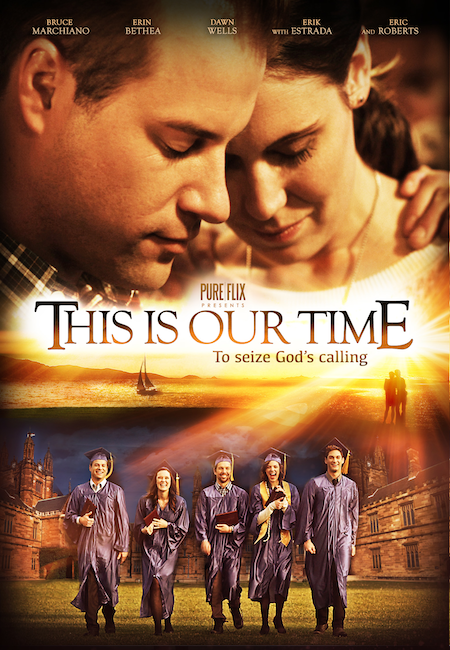
I had a  comfortable conversation with Erin Bethea last week. She is one of the ensemble actors starring in This is Our Time!, which releases on DVD Tuesday, April 16, 2013.

erin betheaHere is a small portion of our conversation:

CJ: You’ve had experience working with new directors, experienced directors, and now a female director. What was it like working with Lisa Arnold?

ERIN: What is great about working with Lisa is that she wrote the script and is a talented writer. She really knew the story well.

CJ: Did that background help Lisa cast the roles?

ERIN: She is amazing at casting. She knew what she wanted and got it…a perfect cast. They picked people that were the characters. When I met them, they were just what I expected and we built strong friendships, just like our characters.

CJ: What was it like working under Lisa?

ERIN: She has a quiet grace on set. Not too dynamic…she’s gentle and gracious. She is subtle, but pushes you in a way you don’t realize. I would happily do anything with her again.

This is Our Time PosterCJ: There are a lot of Christian films about good people becoming better people, which make finding a unique role difficult. What was a unique aspect of your character Alé that you hadn’t played before?

ERIN: I do play a lot of the same roles in faith-based films, but Alé is the first sold out believer, instead of the person that is not yet quite there. She was warm and friendly. I wished I were more like that girl. She has a warmth…she’s sweet.

CJ: The story was about the character of Ethan finding what gift God had given him and choosing to live it out loud. It seemed like your character was Ethan’s archetype or role-model that encouraged him to step up his life to God’s calling. What was it like to play such a powerful role-model with humility?

ERIN: It was a bit of a challenge. I wanted to keep Alé likeable. Because she’s everyone’s favorite, you don’t want to play her in a way where she becomes annoying. We all know amazing people who don’t realize how amazing they are, and she didn’t’ realize the gift she brought to others. She was just being who she was, so her seemingly perfection didn’t come across contrived.

CJ: In the film, Alé inspires everyone in the story. In what way did she inspire you personally?

ERIN: We shot in India in an actual leper colony for three days. For three days I really lived out her ministry. You can’t walk away from something like that without being impacted, challenged, and being other’s minded.

CJ: Do you find that the audience wants you to be that person in real life?

ERIN: There is an expectation that is placed on you as an actor. Fans are taken aback when they find out that you are not like the person they fell in love with on the screen.

CJ: As a Christian actress, are you limited to always playing the good guy? Wouldn’t it be refreshing and expand your acting chops if you played a bad guy?

ERIN: I would so love to play a bad guy. Please, someone put me in a film as a bad guy. I just want to play a villain…a rotten person. A friend of mine has a theory that nice girls can play bad people really well by playing the exact opposite of who they are.

CJ: Christian movie fans seem to put a lot of expectations on Christian films. Do you have any thoughts on the matter?

ERIN: I think that Christian films in general have a different set of expectations. People will accept certain things in a secular film that they won’t accept in a Christian film.

CJ: But what about films like Les Miz, which in my mind is one of the greatest stories of redemption ever told.

ERIN: I loved Les Miz. It was a great story of redemption. But if it were made as a Christian film, there would be an uproar over there being a prostitute in the film, and rightfully so. We are called to something higher.

CJ: We do have a higher standard to live by. But, how much greater is the value of redemption when the person’s devastating choices are revealed in the storyline?

ERIN: Storytelling…when Christians see that the arch of the story has redemptive qualities…if they see it embrace people…they get behind it like they did with The Blindside.

CJ: You seem genuinely thankful for the acting roles you’ve received. You must have fun playing the various characters.

ERIN: Making a movie is pretty much the most fun thing on this planet. You make friends on set that will be your friends for years.

CJ: Erin, thank you so much for your time today and chatting about your experiences.

ERIN: Thank you, CJ. It was a pleasure meeting you.

Copyright © 2013 by CJ Powers
Disclosure of Material Connection: I received one or more of the products or services mentioned above for free in hopes that I would mention it on my blog. Regardless, I only recommend products or services I use personally and believe will be good for my readers. I am disclosing this in accordance with the Federal Trade Commission’s 16 CFR, Part 255: “Guides Concerning the Use of Endorsements and Testimonials in Advertising.”

5 Keys to Managing the Press

media interviewMotion picture releases force actors, directors and writers to deal with the press more often than most business or political figures. Yet, those in filmmaking get taught about how to manage the press far less often than those in the political or Fortune 100 arenas. To help balance this affect, I decided to cover the basics of managing the press.

DON’T CONTROL THE PRESS: The press is made up of professionals and attention getting bloggers who use people skills to get human stories. No one likes to be controlled and the press is no different. It’s a people business that is all about promoting various levels of celebrities. The key to managing the press is to understand who is reputable and what audience they serve. Without this basic knowledge, you will send a message that has a high chance of being misquoted to the wrong people.

BUILD LONG TERM RELATIONSHIPS: Developing relationships with the right reporter, who attracts the right audience, empowers you to get a clean message to the right people. This ideal takes time to nurture, as both the filmmaker and the reporter need to develop trust in each other.

PACKAGE YOUR STORY FOR THE RIGHT REPORTER: Journalists and reporters are always interested in the right story, but much of their time is sorting through a myriad of stories that don’t fit their audience. For instance, a church sending Easter service information to a sports writer is a waste of everyone’s time. All too often press releases don’t get to the right editor or journalist because no one took time to research their ideal audience and who writes what they read.

DON’T GRAB FREE PRESS, PROVIDE FREE NEWS: Every newspaper and radio station knows that you want free press to promote your film, but no one wants to help you, unless they benefit from it. By providing the right reporter with the right content for the right audience, your story becomes news worthy. This makes the press look good, while you’re introducing your film to a new audience – Everyone wins.

KNOW WHAT’S ON AND OFF THE RECORD: Everything is on the record unless agreed to otherwise, and the tape recorder is turned off and the pencil set down. Giving background information isn’t typically quoted, but helps the reporter gain an understanding of the circumstances in order to build their story properly. With this all said, it’s important to understand that the person being interviewed must be careful in their responses to make sure the reporter doesn’t take anything out of context.

By managing the press with the above 5 keys, word about your film will get out to your primary audience, who will be inspired to support you with high ticket sales. They might even re-tweet your promotional information to help their friends.

Copyright © 2013 by CJ Powers
Photo © wellphoto – Fotolia.com