Knowledge Vs. Wisdom in Screenwriting

© Pixelbliss - Fotolia.comThe audience is always amazed when a character displays wisdom, rather than just knowledge. In fact, when the main character just spews out knowledge, they become two dimensional and preachy – As seen in numerous faith-based films.

The key is to have the main character demonstrate, not preach the wisdom needed in life. This demonstration draws the audience into the story and inspires them to implement the character’s principles within their own life. To accomplish this ideal, the writer needs to understand the difference between knowledge and wisdom.

British broadcast journalist Miles Kington simply explained it when he said, “There is a difference between knowledge and wisdom. Knowledge is knowing that a tomato is a fruit, not a vegetable. Wisdom is knowing not to include it in a fruit salad.”

This topic was also discussed for decades using the perspective of book sense versus street sense. Everyone understands that learning about something and experiencing it first hand is very different. The thinking process alone and the conclusions drawn by those gaining knowledge or wisdom from a particular situation will generate significantly different outcomes depending upon his or her vantage point.

The same holds true for characters on the screen. This results in the audience buying into an argument from the character demonstrating gained wisdom versus discarding the information from a character who preaches the shared truth.

To demonstrate a character’s wisdom takes a substantial amount of time in crafting visual depictions on the screen that reveal the wisdom, while preaching characters can be written within minutes. Also, to demonstrate wisdom, it requires a director who can draw a performance out of an actor, rather than one who commands a specific performance.

Over the past few months I’ve consulted with a professional screenwriter in the Asia Pacific region for a major motion picture that will be first released in the east and then followed in the west. Since one of the media companies involved is a media ministry, the screenwriter chose to write several preaching scenes in act three.

While the knowledge expounded in the third act was accurate based on the media ministry’s beliefs, it killed the story. Thankfully, the decision-makers have agreed to a rewrite, which was a wonderful surprise – Yet, expected.

You see, the entire movie was about the main character gaining wisdom. In act one, she clearly lacks knowledge and by act two is manipulated into a poor lifestyle thanks to a dangling carrot of knowledge. But, the tables soon turn and she realizes the difference between wisdom and knowledge. By choice, she seeks wisdom and witnesses it’s impact on life, causing her to desire it all the more. But, instead of act three helping the audience to see the benefits of this newly acquired wisdom, she becomes a preacher that tells everyone knowledge.

Demonstrating wisdom causes the audience to desire a drink from the same cup that brought wisdom to bear in the first place. Knowledge is rarely accepted as a solution in any character’s life and most audiences discard it as not being proven or worth testing in his or her own life.

The key to inspiring an audience to greatness starts with a great character driven screenplay that demonstrates the wisdom gained, not the expounding of easily discarded knowledge. I find it ironic that faith-based screenwriters, who want to inspire their audience through the passing on of wisdom, choose to leave wisdom out of the stories and instead gives voice to the preaching of knowledge. Then again, it takes a significant commitment and some twenty revisions to write wisdom into screenplays and most faith-based screenwriters believe in going with one of his or her first three “God-inspired” drafts, for fear of losing the original message planted within his or her heart.

However, there is a difference between cultivating a planted message and killing it. The better the craftsman, the greater chance the message will rise to a place of understanding through demonstration to its audience. Therefore, faith-based screenwriters must learn to embrace rewrites, knowing that they will eventually get his or her writing up to the level that God actually intended. For without the demonstration, there is no reception of the message. And, even Jesus shared parables that demonstrated wisdom, rather than expounded knowledge.

Copyright © 2015 by CJ Powers

23 Blast Fails to Deliver an Incredible True Story

23 Blast ReviewAs a coach, I taught my football players how to execute the 23 Blast. It was a significant play and always gained more yardage than the 23 or the 23 power. The main reason it succeeded was due to overloading blockers advancing through the three hole at the line of scrimmage. In other words, two blockers would blast through, leading the 2 back through the 3 hole.

It was more than powerful and seldom defended with anything that might stop the play before a 5-7 yard gain. But it couldn’t be done with every play or the defensive line would just plug up the hole and allow the linebacker to leap over the mess to tackle the runner for a loss.

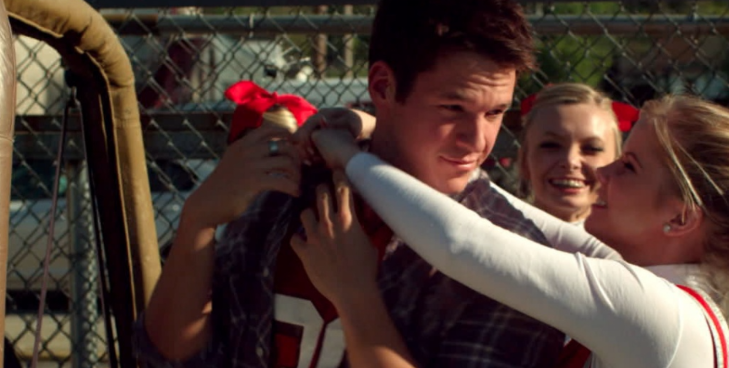
23 Blast, the movie, wasn’t anywhere near as powerful as one would hope. Thanks to the terrible music selection and slow paced editing, the film barely made it to a warm and fuzzy status enjoyed by Hallmark Channel fans. I suppose that wouldn’t be so bad, if it weren’t supposed to be a hard-hitting football story.

The one redeeming quality of the film was the cast. The young actors did an incredible job with their authentic performances and helped me through the boring segments. In fact, the performances inspired me to look up the actors and find out what other films they were in.

23 Blast ReviewThe film was based on the true-life story of Travis Freeman, a boy who went blind and decided to continue playing football with the encouragement of those around him.

Having coached in a league with a blind player, I can tell you it’s both difficult to watch and extremely inspiring, especially when the team succeeds. Unfortunately, the film didn’t raise the inspirational level of impact to anything that resembled the real thing.

23 Blast is now available on video. The DVD comes with extra features including the Travis Freeman Story, an update on his friend Jerry Baker, bloopers, and a behind-the-scenes featurette with director Dylan Baker. The most fascinating part of the extras was the apology for the scene where the antagonist drinks beer.

I’ve got to say it was weird for three reasons. First, the antagonist lived a life filled with bad behavior and the audience understood that his drinking binge was one of those bad behaviors. However, the apology suggested that the antagonist was a bad person and someone needed to apologize for his life. But, the antagonist wasn’t a bad person. He was a person who lived in the shadow of greatness and he never felt that he could compete, which led him to choose a pity party lifestyle – Clearly a person who needed encouragement, not condemnation.

Second, the scene was done tastefully, while depicting a true-life situation. It depicted fact and needed no apology for having captured the essence of the two boy’s relationship. The only people in the audience that might require an apology are those who live in their own world or at least live in denial about reality.

Third, the drinking scene put drinking in perspective and made the protagonist’s life choices worth following and the antagonist’s life choices worth avoiding. No one should ever have to apologize for creating a scene that properly demonstrates right choices made by positive role models like the protagonist.

The bottom line is that 23 Blast is worth watching to see the great new actors and a realistic role-modeling scene about life choices. But, it’s also worth avoiding because the bad music and slow paced editing deflates the energy that football typically brings to the screen.

87th Academy Award Nominations

Academy AwardsThe Oscar® nominations were released for the 87th Academy Awards that will air February 22nd. I have added links to the legally available screenplays that I could find.

Best Picture
“American Sniper”
“Birdman”
“Boyhood”
“The Grand Budapest Hotel”
“The Imitation Game”
“Selma”
“The Theory of Everything”
“Whiplash”

Best Actor
Steve Carell, “Foxcatcher”
Bradley Cooper, “American Sniper”
Benedict Cumberbatch, “The Imitation Game”
Michael Keaton, “Birdman”
Eddie Redmayne, “The Theory of Everything”

Best Actress
Marion Cotillard, “Two Days, One Night”
Felicity Jones, “The Theory of Everything”
Julianne Moore, “Still Alice”
Rosamund Pike, “Gone Girl”
Reese Witherspoon, “Wild”

Best Supporting Actor
Robert Duvall, “The Judge”
Ethan Hawke, “Boyhood”
Edward Norton, “Birdman”
Mark Ruffalo, “Foxcatcher”
J.K. Simmons, “Whiplash”

Best Supporting Actress
Patricia Arquette, “Boyhood”
Laura Dern, “Wild”
Keira Knightley, “The Imitation Game”
Emma Stone, “Birdman”
Meryl Streep, “Into the Woods”

Best Director
Alejandro González Iñárritu, “Birdman”
Richard Linklater, “Boyhood”
Bennett Miller, “Foxcatcher”
Wes Anderson, “The Grand Budapest Hotel”
Morten Tyldum, “The Imitation Game”

Best Animated Feature Film
“Big Hero 6″
“The Boxtrolls”
“How to Train Your Dragon 2″
“Song of the Sea”
“The Tale of the Princess Kaguya”

Best Adapted Screenplay
“American Sniper,” by Jason Hall
“The Imitation Game,” by Graham Moore
“Inherent Vice,” by Paul Thomas Anderson
“The Theory of Everything,” by Anthony McCarten
“Whiplash,” by Damien Chazelle

Best Original Screenplay
“Birdman,” by Alejandro G. Iñárritu, Nicolás Giacobone, Alexander Dinelaris Jr. & Armando Bo
“Boyhood,” by Richard Linklater
“Foxcatcher,” by E. Max Frye and Dan Futterman
“The Grand Budapest Hotel,” by Wes Anderson & Hugo Guinness
“Nightcrawler,” by Dan Gilroy

Best Cinematography
“Birdman,” Emmanuel Lubezki
“The Grand Budapest Hotel,” Robert Yeoman
“Ida,” Lukasz Zal and Ryszard Lenczewski
“Mr. Turner,” Dick Pope
“Unbroken,” Roger Deakins

Best Visual Effects
“Captain America: The Winter Soldier”
“Dawn of the Planet of the Apes”
“Guardians of the Galaxy”
“Interstellar”
“X-Men: Days of Future Past”

Best Documentary Feature
“Citizenfour”
“Finding Vivian Maier”
“Last Days in Vietnam”
“The Salt of the Earth”
“Virunga”

Best Documentary Short Subject
“Crisis Hotline: Veterans Press 1″
“Joanna”
“Our Curse”
“The Reaper (La Parka)”
“White Earth”

Best Film Editing
“American Sniper,” Joel Cox and Gary D. Roach
“Boyhood,” Sandra Adair
“The Grand Budapest Hotel,” Barney Pilling
“The Imitation Game,” William Goldenberg
“Whiplash,” Tom Cross

Best Original Song
“Everything Is Awesome,” from “The Lego Movie,” by Shawn Patterson
“Glory,” from “Selma, by John Stephens and Lonnie Lynn”
“Grateful,” from “Beyond the Lights,” by Diane Warren
“I’m Not Gonna Miss You,” from “Glen Campbell: I’ll Be Me,” by Glen Campbell and Julian Raymond
“Lost Stars,” from “Begin Again,” by Gregg Alexander and Danielle Brisebois

Best Production Design
“The Grand Budapest Hotel,” Adam Stockhausen and Anna Pinnock
“The Imitation Game,” Maria Djurkovic and Tatiana Macdonald
“Interstellar,” Nathan Crowley and Gary Fettis
“Into the Woods,” Dennis Gassner and Anna Pinnock
“Mr. Turner,” Suzie Davies and Charlotte Watts

Best Live Action Short Film
“Aya”
“Boogaloo and Graham”
“Butter Lamp (La Lampe au Beurre de Yak)”
“Parvaneh”
“The Phone Call”

Best Animated Short Film
“The Bigger Picture”
“The Dam Keeper”
“Feast”
“Me and my Moulton”
“A Single Life”

Best Sound Editing
“American Sniper,” Alan Robert Murray and Bub Asman
“Birdman,” Martin Hernández and Aaron Glascock
“The Hobbit: Battle of the Five Armies,” Brent Burge and Jason Canovas
“Interstellar,” Richard King
“Unbroken,” Becky Sullivan and Andrew DeCristofaro

Best Sound Mixing
“American Sniper,” John Reitz, Gregg Rudloff and Walt Martin
“Birdman,” Jon Taylor, Frank A. Montaño and Thomas Varga
“Interstellar,” Gary A. Rizzo, Gregg Landaker and Mark Weingarten
“Unbroken,” Jon Taylor, Frank A. Montaño and David Lee
“Whiplash,” Craig Mann, Ben Wilkins and Thomas Curley

Best Costume Design
“The Grand Budapest Hotel,” Milena Canonero
“Inherent Vice,” Mark Bridges
“Into the Woods,” Colleen Atwood
“Maleficent,” Anna B. Sheppard and Jane Clive
“Mr. Turner,” Jacqueline Durran

Best Foreign Language Film
“Ida” (Poland)
“Leviathan” (Russia)
“Tangerines” (Estonia)
“Timbuktu” (Mauritania)
“Wild Tales” (Argentina)

Best Makeup and Hairstyling
“Foxcatcher,” Bill Corso and Dennis Liddiard
“The Grand Budapest Hotel,” Frances Hannon and Mark Coulier
“Guardians of the Galaxy,” Elizabeth Yianni-Georgiou and David White

Best Original Score
“The Grand Budapest Hotel,” Alexandre Desplat
“The Imitation Game,” Alexandre Desplat
“Interstellar,” Hans Zimmer
“Mr. Turner,” Gary Yershon
“The Theory of Everything,” Jóhann Jóhannsson