Inspiring Leaders Develop 3 Easter Eggs of Success

© apops - Fotolia.comMy son gave a great talk at a large conference of social web developers. While the talk didn’t come together until a few days before his presentation, it was extremely well received and life changing for the participants. Others also grew by watching his talk on the web weeks later.

When Chris explained how he put his talk together, I realized that he followed the Dale Carnegie method of preparation. Carnegie was a leader who felt it was important to be constantly learning and growing, so as to always be prepared for any opportunity to speak. Carnegie had a large reservoir of information he could draw from at any point in time to give a great talk.

Chris prepared by gathering known information from within his own reservoir, organized it and personalized it for his audience. While it only took a few days to “create” his talk, Chris had taken months in preparing the information – A task he takes for granted.

I wanted to learn how the talk went so I asked him a few questions. Chris immediately suggested that his talk was successful for three reasons. It just so happens that he listed the same three Easter eggs of success that inspiring leaders take time to develop.

1. DEVELOP TRUST

Inspiring leaders are authentic. They address their employees from a point of reality, even when casting a vision for the company’s future. This creates a level of hope within each employee, as they comprehend how things could work and understand their role in making it happen. To support this new hope, inspiring leaders invite participation from every employee.

The results are products and services that each employee thinks and feels is in place because of their part in the process, yet no one is able to separate out their portion from the whole. The item also becomes a symbol of trust that each employee placed in the inspiring leader to see the vision come to fruition.

2. DEVELOP PERFORMANCE

Building trust is simplified when the inspiring leader sells the benefit of the process to each employee. The newly agreed upon benefit also drives the employees to higher levels of performance. This is especially true when the atmosphere is one of curiosity and play, rather than pressure and deadlines.

The strong inspiring leader is able to navigate a course of action based on quick but calculated decisions, the established process being an adventure for the team to explore together, and a playful time of creative exercise. All of which raises the bar of outstanding performance among peers.

3. DEVELOP EMPLOYEES

Developing employees over time is the most practical of activities that inspiring leaders engage in. The reinforcing of the employee’s optimism is critical to the company’s long-term success. Related by perspective is the opportunity to turn all failures into educational experiences, especially when coupled with a focus on igniting the enthusiastic potential within each worker.

This emphasis on individuals encourages confidence of character and voice. Self-assurance becomes the very driver that turns standard employees into the gifted. Without the employees, the company has no future potential and will eventually be overtaken by the next big thing.

Inspiring leaders build trust by focusing on their resources. They also work to refine their abilities and seek to promote the best in others. When evaluating the gifts, skills and talents of their team, they work hard to draw out a higher level of performance than what the worker thought was innately possible.

Copyright © 2015 by CJ Powers

A Creative Approach to Productivity

Andrew CarnegieAndrew Carnegie never intended to use right-brain thinking to increase production volume between the night shift and the day shift, but he stumbled upon it the day he wrote the number of items produced by the night shift on the cement entryway floor with chalk. That morning the day crew surmised what the number represented and by the end of the shift, erased the old number and replaced it with a larger one.

The night shift didn’t want to be beaten, so they got creative in reducing the process steps and placed a larger number on the floor at the end of the shift. The day shift wasn’t about to be undone, so they came up with creative ways to increase volume and capacity. This continued for several weeks until the factory was consistently producing more items than before the chalk incident.

The funny thing was “when” Carnegie wrote the number on the floor that started it all. He had come from a meeting were he asked leaders to increase productivity by 10% and they fought him with a myriad of comments about how it was impossible to create double-digit growth. But thanks to right-brain thinking on the part of the workers, Carnegie saw triple-digit growth within several weeks.

While some might suggest that friendly competition was to be praised for the growth, it was actually the creative juices of brainstorming that looked at the processes differently. The idea of reworking what had always worked is a right-brain event. Dropping unnecessary steps is also a right-brain activity.

The left-brain was represented in the meeting that said no to a double-digit increase based on the way it had always been done. The left-brain also suggested that there is a ceiling for everything and therefore no reason to conclude that a ceiling can be broken.

When I managed the receiving department at a warehouse retail store, I timed my team’s ability to breakdown pallets and move the merchandise to the sales floor. When the store manager required us to do it his way, the team broke down 4-6 pallets during the four-hour window. This was due mostly to his required set up that was easily interrupted by unscheduled truck deliveries and the top-priority customer service team accessing stored items for customers.

When I asked the team to come up with a creative solution that avoided the customer service pathway, they were able to breakdown 12-14 pallets. Then I asked how we could better facilitate the process to avoid truck deliveries and customer service people. One person came up with a circular approach requiring less physical steps that allowed the team to breakdown 18-20 pallets.

Then it happened. I stumbled upon a guy over one weekend that lined everything up the length of receiving using half of the pathway, so anyone could get in and out without any interruptions. I also noticed that every time he broke down a pallet, he immediately packed it out in the store, dramatically reducing the workload of the night crew.

This creative approach solved the problem of having congested aisles during sales hours. It also reduced the number of non-packed out items returning to the back room at the end of a shift, again reducing the workload of the night shift.

Unfortunately, no one in upper management noticed the increase in productivity, so everything eventually went back to business as usual. The reason was simple, it takes right-brain creativity to find a new way of increasing productivity, but it takes left-brain logic to manage and sustain it as the new process going forward.

Copyright © 2015 by CJ Powers

The Toy Story 2 Argument: People vs. Ideas

jacket illustration: © Disney • Pixar

jacket illustration: © Disney • Pixar

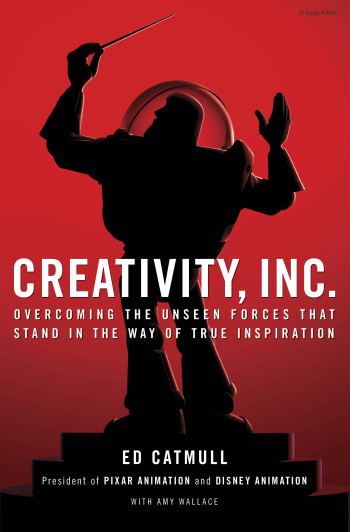
Ed Catmull offers business lessons from Pixar and Disney in his book, “Creativity, Inc.” I agreed with his perspective on the value of people over ideas, which runs counterintuitive with the majority of production companies.

Most of his philosophy came about during his work on Toy Story 2, a production that originated as a direct to video release, but took a sharp turn and became one of the most successful theatrical sequels of all time. Unfortunately the success and its lessons came at a great cost that formed Catmull’s philosophy.

The argument comes from the business value that either the people or the ideas are more important. The determination of what a company values most determines the processes that exploits that value. If ideas are more important, then the company churns their employees in search of great ideas, but if the people are more important they see to their needs knowing that they will create great ideas.

“If you give a good idea to a mediocre team, they will screw it up,” says Catmull. “If you give a mediocre idea to a brilliant team, they will either fix it or throw it away and come up with something better.”

Putting a team of the right people with the right chemistry together is the necessary precursor to getting the right ideas. But not everyone agrees with this philosophy. When asked among industry peers the responses to people vs. ideas generate a 50/50 response. This statistically suggests that no one is responding to fact or experience, but rather are all guessing, picking a random answer, as if flipping a coin.

“To me, the answer should be obvious: Ideas come from people,” says Catmull. “Therefore, people are more important than ideas.”

The key is determining what makes the people the right people for a project. Some would suggest character alone is sufficient, while others state the importance of mastering one’s craft or holding years of experience. I find that what makes for an ideal person to join a team is one who subscribes to a continuous pursuit of knowledge, the endless exploration of their craft, and a willingness to learn from peers.

“In the end, if you do it right, people come out of the theater and say, ‘A movie about talking toys— what a clever idea!’ But a movie is not one idea, it’s a multitude of them. And behind these ideas are people,” says Catmull. “The underlying goals remain the same: Find, develop, and support good people, and they in turn will find, develop, and own good ideas.”

It’s no wonder that master craftsmen are drawn to others who have mastered their craft. Nor is it strange that excellent creatives gravitate to projects that attract like-minded creatives.

Copyright © 2015 by CJ Powers