
 Last Saturday I interacted with several generations at a friend’s 95th birthday. Typically during events of that nature I get to learn a lot about people and observe things that get tucked away in my brain for future use. But this time a person brought up my latest novel (Steele Blue) and asked, “How were you able to write an entire novel? Isn’t it such a daunting task?”
I answered, “It’s not all that difficult if you write it 500 words at a time.”
Now, I’m aware that my answer was a bit simplistic when you consider story structure, character development, and the other intangible elements that must be carefully crafted into a novel. But the person’s face suggested a concern about how to overcome very large and overwhelming projects.
Last week I happened to be consulting with a CEO of a marketing communications firm that specializes in elite professional speakers. The question raised to me was very similar and went something like this, “How do you manage the myriad of elements it takes to make a movie?”
Again my answer was simple, just like you’d give an answer to the question, “How do you eat an elephant?” One bite at a time.
There are three steps I take to break down the overwhelming into manageable bites:
STEP ONE: Assess the project scope.
The 50,000-foot view is a great starting point to understand the maximum effort required for a project. However, a 10,000-foot view makes for better decision making because it includes all departments and freelancers that will have their hands in the mix.
Before I break down a movie script to determine budget and schedules, I must first understand the “why’s” of the project and who will be heading up the departments necessary to capture and translate the vision into a reality. This insight immediately tells me what size ballpark we’ll be playing in and the rough estimate of the cost to produce the picture.
As a director, I’ve found that Anthony DeRosa, who’s worked on numerous Nickelodeon and Disney projects, is one of my favorite producers to work with. The reason is because he and I have a shorthand of quickly determining if a script is a $3MM, $12MM, or $40MM project. It allows us to quickly assess what level of actors will be tapped for the show and what team might be best to spitball the visual effects budget.
The bottom line is that only speaking at the level of vision and goals is not sufficient for breaking down daunting tasks. It must be broken down for each department head to fill in the blanks of what he or she knows is needed to accomplish the task.
In the case of an author or consultant, the work needs to be looked at from the standpoint of available time slots. No consultant can work on more than four projects in a given day because it takes time to ramp up and review the previous day’s work, plus have enough time to do something significant to move the project forward. Most experienced executives will try to limit their productivity to no more than two projects on any given day so they have enough time to meet quality standards.
STEP TWO: Look for natural breaks.
When you look at a work of art you see the whole that makes an impression. But when you study it, you see all the segments that make up the whole. In a story there is always (or at least should be) a beginning, middle and end. In film you have the three-act structure.
In nature, you see patterns of fractal art. Take a closer look at a tree. Its trunk branches out into large branches. Each large branch then, in the same artistic fashion, extends out with more branches. This pattern continues until you have a full balanced tree of branches. Next the leaves come in, and the piece of art is complete.
Finding the natural breaks in a project reduces the pressure and allows for the steps to be aligned to a calendar for easy management.
When I was at a large technology company I was tasked to sell $480MM in switching equipment to one customer. After meeting with the CEO, I learned that I needed to get the written and signed consent from certain key vice presidents before the sale could be completed. I then learned from each V.P. that I needed agreement from key directors, who needed buy-ins from senior managers.
It took me two and a half years to collect support from all players. Everyone added great insights to the project, which also altered the configuration to exactly what the company needed. I closed the deal after a long presentation of input to the executive board including the new offer for $750MM.
That meeting was the easiest close I had ever experienced because I had reduced the entire project down to 300 pieces of research, presentations and sign-offs. The CEO was thrilled because he knew the $480MM project didn’t fit, but loved the perfect custom package, and the future profits the new offer provided.
STEP THREE: Develop specific action plans.
Zig Ziglar, arguably the greatest salesman of our time, shared a story about a father giving a party for his newly available daughter. The father hushed the crowd and told the eligible bachelors that the first man to swim the length of the pool without being bitten by the alligators that he stocked in the pool for the night, would receive $100MM and his daughter’s hand in marriage.
A splash was heard at one end of the pool, and after a series of frantic strokes a young man emerged at the other end. The father asked the young man what drove his decision to risk his life: his daughter’s hand in marriage or the $100MM. The pale looking man answered, “Neither. I just want to know who pushed me in.”
Clearly the young man didn’t know what he was doing or why he had “won.” No one is capable of knowing if they achieved a goal unless they first set it in writing and objectively measure the outcome of their activities. Before taking action, people also need to know what’s in it for them, which is the strongest motivator that we hold dear.
A written action plan must include the following: measureable objectives, motivational benefits, self-assigned awards for success, resources needed to accomplish the tasks, and the next steps for the portion of the project during that stage.
With these three steps in place, the daily tasks are reduced to simple steps that are easily accomplished with little emotional concern.
 I was thrilled to be a part of the management team that created and implemented an ethical business model, especially since it was acknowledged and rewarded by the Better Business Bureau (BBB). We received Honorable Mention for businesses in the 1-9 employee category at the 2017 Torch Awards for Marketplace Ethics.
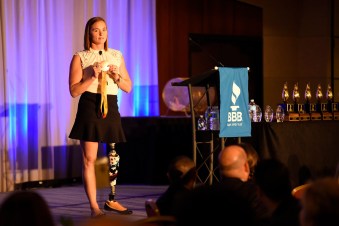 ABC 7’s Hosea Sanders hosted the event and handed out the awards. Melissa Stockwell, Army war hero, mother and three-time world champion Paratriathlon medalist was the keynote speaker. The event was well attended by 400 plus Illinois business leaders.
 During the selection process I was inundated with 25-30 hours of paperwork. Our final document answering the questions of the third party counsel was just shy of 50 pages including process and event documentation for standards adhered to and lived out.

 I led a master class and several workshops at a conference last week. My goal was to take the students through the mastery cycle without them knowing it. The outcome was eye opening during the debriefing stage of the conference – The time when reality revealed where on the master craftsman scales each person landed.

