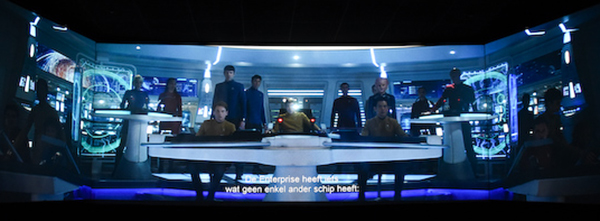
Star Trek is one of the most revered science fiction franchises that hold tightly to its canon. The 13 motion pictures and 6 television series all follow the production bibles that have painstakingly been kept corruption free for 50 years. Even the independent fan films have focused on excruciating details to honor the canon.
A recent copyright infringement suit sped its first part of judgment thanks to the accuracy of the canon and the many production companies that continued adhering to the rules of the franchise world without exception. Many Star Trek bible elements have been released and highly supported by the fans, forcing production companies to scrutinize every aspect of their production in order to stay true to its canon.
But in the faith-based films that include stories based on the Bible, a canon of 66 books, few production companies adhere to it. The Young Messiah was released last March and was touted as one of the best faith-based films of 2016, but it broke canon with little repercussions.
The film is a story about Jesus at age seven and his family’s departure from Egypt to return back to Nazareth. This fresh childhood perspective gave audiences an explorative glimpse into how their future Savior grew into his religious identity.
Breaking canon in the name of “creative license” is something that Star Trek storytellers would never do. But, the makers of The Young Messiah had no problems stepping away from canon. According to the book of John, one of the 66 books within the Christian canon, Jesus performed his first “sign” or miracle at the wedding in Cana of Galilee. But, in the film, which takes place years earlier, he brought a dead bird back to life, healed his sick uncle and restored sight to a Rabbi.
While the director intended these signs to reveal the humanity of Jesus, which it did, it broke canon and distorted the truth for its viewers. This creates conflict between those defending faith-based films and those who teach from the canon in real life. And it doesn’t end there.
Back in the 1960’s a group of historical revisionists decided to adjust the thinking of the church through the media. They created a story that Jesus’ hands weren’t actually pierced when he was put on the cross because the Greek word for hand also included the wrist. They also stated that Jesus’ hands would’ve torn open due to his weight, and therefore, he was actually pierced in his wrists when they crucified him.
This notion broke canon, but evangelists liked the “new revelation” and spread the word throughout the world. Today, most pastors who weren’t around for the origin of this story teach that Jesus was pierced in his forearms, albeit close to the wrist. They shifted to the forearm because the wrist is just a series of bones that couldn’t be pierced, and the canon said not a bone in his body was broken, which piercing his wrist would have done. These further adjustments took congregations even farther away from the purity of the canon.
By the way, a couple years ago I interviewed a nurse who worked for an orthopedic hand surgeon. She said that Jesus could easily have been pierced in his hands because of the vast network of ligaments that crisscross like a web inside of the hand, which is also strong enough to hold the body’s weight without tearing.
This Easter a new faith-based film that has broken canon will be released by the title of The Shack. The most obvious departure from canon is that God the Father shows up as God the Mother. Canon states that God wanted to be called the Heavenly Father, but historical revisionists are pushing for God being able to show himself as anything he wants, which meets the canon of the Hindus and Universalists, not the Christians.
What I don’t understand is how Christians, whose lives depend on its writings, are so willing to break canon in the name of creative license, but Star Trek will do everything in its power to maintain their sacred canon. Even J. J. Abrams during the filming of Star Trek 2009 talked about the difficulty in maintaining canon, but how it was well rewarded by the audience’s appreciation.
So, why do faith-based films not follow canon? I’d love to hear your thoughts on the matter, especially since Star Trek is make believe (suggesting that canon doesn’t matter) and Christianity is reality (suggesting canon is critical).
 Sophisticated audiences and new filmmakers eventually learn that they need to know how to “read” a film. It’s a technique used by artists that understand the significance of cinema—not TV, video or streaming, but CINEMA.
 CJ's Corner