Finding Your Voice

After spending a few minutes with me you’ll find that I tell a lot of stories. I come by it naturally, as my dad told stories every night at the dinner table. His daily adventures as a cop were thrilling, hilarious, or absurd. And yes, he did get shot in the line of duty and lived to tell the incredible story.

Even in his death, dying in a mysterious plane crash during a freak storm, he guided me with clues into a life of storytelling. I found myself hunting down every unanswered and mysterious story behind his death. My curiosity grew, as I delved deeper into the 100 out-of-place coincidences that I discovered.

5357__ROlJiMzo6Later in life I’d hear Hannah Brencher share about how our voice, as a writer or filmmaker, is birthed in our experiences and emotions. Brencher said, “Live and then write it down.” It’s such a simple activity that develops our voice, yet it’s all too often overlooked.

The process solidifies our experiential and emotional patterns rising from our soul to our consciousness—the very thing that determines our life passions. Once we see these patterns outside of ourselves, our minds are capable of standing firm in our beliefs and perspectives. The repetitive nature of the process also strengthens our resolve and gives us the tools to help others.

But our value is of little worth to those we inspire, unless it’s coupled with the elements that can seed their life for great results. To bring a sense of fulfillment to our followers, we must find a way to teach, rather than just inspire them. We must transcend the typical story by salting in life elements that can be embraced by those we serve with our words and films.

Brencher shared how she went camping with no more than the idea of camping on her mind. She wasn’t prepared, and had no idea how to build a campfire useful for warmth and cooking. Thankfully a guy one site over lended a hand and built her campfire. He also replenished it later that evening and fueled it again to cook breakfast.

That afternoon he broke camp to continue his travels. She too left, even though she paid for two nights, because she still didn’t know how to make a fire. In that moment she realized that inspiring people is nice, but teaching them how to inspire themselves is better. The experience raised a new passion in her that would permanently alter her voice. She learned that as a writer she needed to give everything she had, not just the inspirational pieces.

Give everything you have “in the moment you are asked to give it all,” became Brencher’s new moto. It’s a moto for those with little to share and those with a lot. The size and strength of our voice is not what’s important, but the value we bring to others.

Brencher’s voice was uniquely hers and couldn’t be copied by anyone else, except through plagiarism. No one is able to create a similar voice that can stand the test of time. It’s only when we dig deep within our personal experiences and emotions will our voice rise and be like none other.

Spending a couple decades listening to my dad share true-life stories, coupled with a rise in my curiosity from the 100 bizarre coincidences associated with his death, sent me on a journey of countless experiences and emotions that forged my voice…. A voice that was like none other. A voice that hopefully inspires and teaches.

Maybe it’s time for you to consider journaling to bring your needed voice to the forefront.

© Copyright 2018 by CJ Powers

When Your Muse is Missing

doubleyolkThis morning I cracked open a couple of eggs for an omelet and was delighted to find that one of my eggs had a double yolk. I quickly looked up the odds, which I thought would’ve been one in a million, to see why the old tales of good fortune turned the event into a sign of good luck. I was shocked to learn the odds were only 1:1,000. I even saw a man’s picture of 11 double yolk eggs in a frying pan—almost a perfect dozen.

The moment inspired me to write a blog entry referencing this new muse of mine. Oh, it wasn’t stirring enough to write a passionate post, but it was enough to get my gears moving. I decided that if I was able to turn a silly little event into the spark of creative thought, there must be a simple trick to help creatives develop something when his or her muse is missing.

Use A System

“When the creative muse isn’t around, look for systems and strategies to generate good ideas.”
—Jim Jaskol, Ride Control Engineer

I’ll never forget the system I was taught in the Bell Labs Think Tank. The instructor had us look over a new product that was ready for release. He wanted us to brainstorm 100 ways the device could be used. “Once you run out of ideas,” he said. “Think about its use from the perspective of your grandmother. And then from the viewpoint of a child, and so on.” The product released six months later promoted from two perspectives, one of which I had brainstormed. It was a thrilling experience, thanks to the instructor’s system.

Engage In Educational Play

“Understand the problem, do the research, play hard looking for the potential options, sleep on it, and let your subconscious do the rest. Great solutions make a wonderful breakfast.”
—Bobby Brooks, Concept Architect

The number of times I have a great idea pop into my brain during my morning shower is too numerous to count. There is something about playful exploration that continues to reside in your brain well into your slumber that activates the right side of the brain. I can attest to how the brain works while you’re asleep to solve the problem playfully pondered that day. But for it to work, the left side of the brain must first understand the problem and what a solution might look like. Then sleeptime gives rise to the right side of the brain with no limitations.

Create An Environment

“You can’t flip a switch and make someone else creative, but you can set up an environment in which the switch is more often on.”
—Alex Wright, Show Designer

The first time I wandered through an animation studio I couldn’t help but notice all the toys and gadgets cluttering the creative’s work space. There was enough unique stimulus to power multiple feature length films. Several years later I was working as a consultant at Kraft Global Foods and found their new office space designed for creatives to be off the charts. The entire environment didn’t have any hint of “office” in it. The space was designed to feel vacation-like, while being broken up by inspirational and motivational designs to stimulate the workforce. Within minutes of being in that space the Vice President and I solved the five-year-old problem.

Originality comes from the juxtaposition of systems, educational play, and environment. While having a muse simplifies the development of an idea, how we address creativity when the muse is missing determines how consistent we are and how professionally we can create on demand.

Can you imagine how this post was inspired by double egg yolks showing up in my omelet this morning? For my logical friends, I’m sorry that you can’t see the connection, or how one led to the other. But you can rest assured that my omelet was very tasty.

© 2018 by CJ Powers


Write, Read and Watch—Lessons from Marvel’s Jim Krueger

Jim_CJ_Art

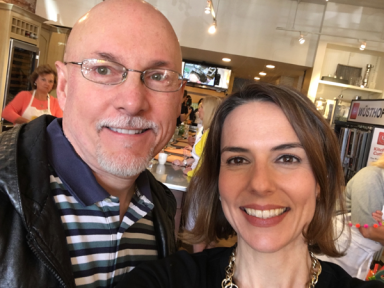
I got together with a couple dozen creatives over the weekend for a workshop on story. It was a great time of networking with like-minded artists. Jim Krueger, a storyteller, comic book writer, novelist and filmmaker, was the keynote speaker. He’s most known for his works (including Earth X) at Marvel. He also won the prestigious Eisner Award for Justice (DC Comics).

Jim pointed out the three things that all writers need to do each day: write, read, and watch.

WRITE

Writers need to write everyday to strengthen and mature their “voice.” Jim, who tries to write four hours every day, believes that the writing process helps us to pour out the very thing that can fix our broken world. He also suggested that we have to know ourselves in order to find those internal nuggets of value that are worthy to be shared.

He gave us an exercise to write down our top 10 films that we love followed by the top 10 films we hate. The correlation was amazing and helped us to discover the passion that stirs within us. Within the stories we hated was an internal “No” wanting to be expressed. This pensive drive reveals the “Yes” that we want everyone to embrace—the very thing we must write about to be fulfilled.

READ

Screenwriters need to read the best scripts in the genre in which they write. Authors need to read the best books in the genre they write. Studying the best allows us to improve our techniques, while also learning what has already been done. Unique character reveals, rhythms, and pacing become second nature when we immerse ourselves in the writings of the best.

Being able to spot in others’ works what makes us feel good, and why, helps us understand how to craft our own stories that inspire. This is an important base element in writing that will attract followers and build a fan base. It’s the fulfillment of a natural need, according to Jim, who said, “People need to feel good about themselves after watching your story.”

WATCH

Since our world was transformed from a literary to a visual culture, Jim recommended that writers watch feature films and long form television to study what’s being created for the market and what is well received. While he didn’t intend to do a commercial for Movie Pass (now $6.95 for a monthly subscription program), he did recommend going to the movies often for study purposes.

James Patterson, who writes first thing every morning, shared in a class that I took a couple years ago, how he heads to a theater and watches a feature film after his morning writing session. Since he goes daily, he doesn’t always stay for the entire picture, but learns what he can about the market, what’s been done in the realm of stories, and any story techniques that he can observe and capture.

After convincing us that we all needed to be writing, reading and watching, Jim shared that the rules of story must also be followed with no exception. “Rules as a storyteller are never to be broken, only worked around with loopholes,” he said. When rules are broken, the audience can’t easily follow the story and loses interest, so it’s important to make sure the core elements or the logic and reasons behind the rules are never altered.

Jim pointed out that the limitations put on the storyteller are actually valuable creative tools. “Limitations allow us to put surprise and wonder into place,” he said. Understanding how wonder plays a role in the development of entertainment gives us the fuel to explore an idea until it rises to its best version before releasing it to the audience. Jim suggested that it could take anywhere from 4-6 weeks for an idea to mature to its highest value.

At the end of the day, Jim autographed three panel original art from his next published work due out in a few months. Keep your eyes out for his work.

Copyright © 2018 by CJ Powers