7 Steps to Create Buzz for Film

This past week I’ve witnessed filmmakers fail publicly without knowing it. Several have attempted to raise funds without first establishing PR guideline and others have attempted to release their films without priming the PR pump. The one thing these filmmakers have in common is that they were disappointed in their results and had no clue why they failed.

Public RelationsIn this new age of Internet, seven necessary steps have risen above all others that protect a filmmaker from PR failure. Due to the speed of information today, filmmakers are unable to rise above the noise and get their message heard without these seven steps. The mathematics on these steps is straightforward and filmmakers that adhere to them will watch their visibility grow.

Here are the 7 steps needed to succeed:

1. Start with Niche Market: I recently coached a filmmaker to get verbal commitments from donors in advance of raising his funds on Kickstarter in hopes of sparking interest from others on the first day of the campaign. He emailed his friends and family, but didn’t ask for any commitments. The end results were zero funds raised.

Everyone wants national exposure and the best way to get it starts with communicating locally, then regionally, nationally, and finally globally. Independent films use this same standard by releasing in a specific region, gain press and buzz, then move to more screens nationally. These same standards are used to increase PR.

If the product can’t be established “locally”, it can be established in an affinity community or niche market. Once the buzz rises, moving to the regional equivalent is easier due to the existing groundswell of PR in the niche market – It only takes one retweet from the right person to take the message to millions.

2. Timing is Everything: I was excited by a buzz that increased last summer over a drama I wanted to see. By thanksgiving I gave up on the movie, as it still hadn’t released. Ten months have past and it still isn’t out, yet I continually see sporadic promotions about it coming soon. Frankly, I’m so tired of hearing about this film that there is no way it can ever live up to its long hype cycle. The filmmakers will be lucky to get a real audience or even attract distribution at this point.

To achieve that one retweet that puts a message into the hands of millions of people at just the right time, the campaign needs to start 3-6 months ahead of schedule to create the buzz and groundswell. Perfectly timed messages can give a product an increase in sales by 10X or 20X. However, a poorly timed message can undermine everything done to date.

I recall a conversation with Ken Taylor of Tyndale House Publishers. He said that sales of his paraphrased Bible amounted to a couple copies a day, which his son Mark packed and shipped, with supplies and Bibles he kept under his bed. After Amy Grant mentioned how great the Living Bible was at one of her concerts, the daily volume jumped into the thousands and the family moved Bible distribution into a large warehouse. Amy’s simple comment drove Mark Taylor to become the president of one of the largest independent publishers in America. I can only imagine what a single tweet might do from the right person.

3. Plan and Schedule: One rock star shared with me last week the 7-8 “off the cuff” publicity stunts he was a part of that generated significant press for his band and other co-promoted artists. He gave several examples that MTV, the king of impromptu press, took months to prepare.

It takes a lot of work to prepare specific messages to specific audiences and have it come off in an impromptu manner. To accomplish the sizeable buzz that impromptu events create, everything must be reduced to writing and scheduled 6-12 months in advance.

Many filmmakers try to handle all the press themselves, but for it to work properly, the PR person has to develop professional relationships with all of the press sources that reach the artist’s niche and expansion markets. The press needs far more information to publish than they have available, which allows the relationship to help both parties involved.

4. Differentiate the Artist/Product: A filmmaker complained to me last week that his product tanked and he didn’t understand why. I asked him what he had done to brand his product and he said that it wasn’t necessary because it was just like… Then he named a product that I had already seen. So, I asked, “Since I already saw the original product, why would I want to see your version?” He had no answer, which explains why no one wanted to see it.

Media sources do not promote “also” films. They don’t have to because they can promote the “real one”. The only way around this situation is to differentiate your film and promote its uniqueness. The press and the audience need to know what makes your film different. They need to understand why they have to see it.

The majority of all independent films are some form of a knock off, which gains little audience. The few films that take off typically have something so unique about it that people are drawn to see it. That uniqueness must come out in the press for enough coverage to draw a large audience. Without it, the film will fail.

5. Be On Message: I recently watched three clips of a filmmaker being interviewed on TV for his latest release. Since I had previewed the film, I knew his exact three points that would drive the audience to see his film or buy it on video. I was amazed that he didn’t mention any of those three points. During one segment, the host started out excited about the film and quickly lost his energy when the filmmaker rambled about meaningless things. The interviewer had nowhere to go and the audience was convinced not to see the film.

Every film has a message that needs to get out, and every audience needs to hear about the message in a particular way for them to spend money on the film. Developing the message is critical and making sure everyone interviewed is on message is important.

Putting together a guideline of key phrases and context or communication will strengthen the over all message and point the audience in the same direction regardless of the PR opportunity. Deviating from the message will create noise that is indiscernible and will not drive box office or video sales.

6. Tweet and Retweet: Last week a PR expert who handles several big names told me that her number one tool to generate a lot of press is Twitter. She pointed out how all of her press sources follow her and her artists. Each tweet she sends lands on 10MM cell phones within two minutes through retweeting. The last three concerts she promoted sold out within 10 minutes after her tweeted announcement. They didn’t advertise any of those concerts and saved $25MM in advertising.

Most filmmakers are on Twitter, but don’t know how to use the tool. Having a PR person on staff can help develop the message and increase the number of followers. Some filmmakers have just started to follow as many people as they could find that are interested in the genre they produce. However, recent studies show that following more people than follow you will not increase your readership.

Tweeting is all about finding the people who are interested in your product. Following people who might be interested, is very different than finding those who are interested. Once you have 500K people who are true fans, you’ll be able to generate serious sales every time you tweet your latest product.

7. Learn from Madonna: I recently watched an interview with one of the top People magazine reporters. He was talking about how he gets story ideas from Twitter and why he avoids certain stories and takes others. When he summarized his suggestions for getting more press, he said that anyone who wants to get serious about PR should pay attention to Madonna, the queen of PR.

Controversy is one of Madonna’s tools, but it isn’t the most important one. Any time she releases information about a new concert, video or book, she first stimulates the market with things that prompt discussion – She gets everyone talking about her regardless of it being good or bad.

The key to her promotion is making sure that the buzz is always directly related to her product. It is never related to a cause or political view. In fact, the only other artist that perfectly followed suit was Michael Jackson. Both artists generated more buzz and free press than any other in entertainment history.

Cross promotions follow the same key steps above, but require collaboration and lots of planning. Because ancillary products might be involved, it is critical that only the main product is promoted. Once in the store, the audience will find the other products in the display – Whether in a physical store or an online store.


Copyright © 2013 by CJ Powers
Photo © Ben Chams – Fotolia.com



4 Time Management Techniques for Busy Writers

Guest Blog by Lisa England, JourneyCraft

One of the most exciting recent developments in my blogging life is getting topic requests from readers. Like all writers, I want to communicate as effectively as possible—and one of the best ways is by finding out what you (the reader) want to know!

It’s especially nice when readers take the time to share.

Today’s audience-sourced topic arose recently, while I chatted with a filmmaker friend. “You seem to get so much done as a writer,” he told me. “How do you manage your time?”

It’s a great question—and one I’m happy to address today.

Myth-Busting

But first off, let me say: I am not always productive. No creative person is. Yet, with some personal experimentation, and disciplined decision-making based on the results, we can boost our likelihood of both starting and finishing our creative projects.

And once finishing—and moving on—becomes our habits, they are (thankfully!) as hard to break as our old habits of unproductiveness and procrastination.

I should also say that I do not believe that a busy life is an excuse for neglecting creative work. Yes, each life is different. Some of us have children at home. Others have aging parents. Some face high-pressure executive jobs. Others work multiple minimum-wage positions to pay the bills. Yet no matter what stage of life we find ourselves in, or what time-management challenges we face, all of us can learn to do it better.

For my part, I am married. I have a full-time job as a copywriter and strategist for a digital agency. I have another soon-to-be full-time job launching City Beast Studio, a sequential art and multimedia intellectual property development firm. And I do Rise of the Tiger which (counting gallery exhibitions, artistic collaborations and the weekly writing) is quite a part-time job.

Here are five ways I juggle that busy schedule to make writing my priority.

1. Discover your best writing hours.

I’m a firm believer that our best hours should be devoted to our most important pursuits. Start by making a list of your priorities. If you’re serious about writing, then it ought to be pretty high on that list. So why do you relegate your creative work to the leftover hours—the times when you feel crappy, hate every word you scribe, and feel so depressed about your future, you may as well stab yourself with your pen?

Your writing deserves better.

For myself, personally, I had to come to a point where I admitted: my best hours are early morning. And that means I have to  rise between 4 AM and 6 AM every morning to get several hours of good work in before I head to my day job. For others, that best time might be the dead of night or on lunch break.

If you don’t know your best time, experiment. But once you discover your peak hours, channel all your ingenuity toward allocating that time for writing. Block it off on the calendar, if you must. Whatever you do: keep that time sacred for you and your work.

2. Record goals in a visible area.

Once you know your best writing time, decide what you want to accomplish long-term, then this month, then this week. Record your weekly goals (and possibly the long-term ones, if you feel the need) in a highly-visible area, preferably where you write.

I have mine above my desk on a white board. Not only does it feel GREAT to check things off that list . . . but it keeps me focused while I’m in my writing room.

Personally, the writing times I’ve wasted most were times when I had only an amorphous idea of what I wanted to write. I would fiddle with one thing one day, another thing the next, always tossed about by my own whims and uncertainty of what I should be doing.

Save yourself the trouble, by taking the time to decide and then posting those decisions where you can see them every day.

3. Embrace small chunks of time.

One of the biggest time-management lies we writers tell ourselves is that if we don’t have a huge block of free time, or a whole day open just to write, we cannot get anything done. This simply is not true.

Most of us do not have long, uninterrupted days to spend writing. (And if we did, our writing actually might not be as good as when we write around the chaos of everyday life!) For most of us, our writing time consists of an hour here, two hours there, or (for some of us) even less.

Instead of bemoaning this phenomenon, embrace it. Believe that you can get valuable work done in a short span of time, and that those smaller units of work will add up to something much greater.

Once you embrace those smaller time chunks, you’ll be amazed what you can do with them.

4. Throw out #1-3 and just do something.

This is actually what I told my friend, who asked how I get so much done. “I have a pact with myself,” I told him, “to get something done, toward my goals, every single day.” It may be as small as writing a blog post. It may be as grand as finishing a manuscript or delivering a graphic novel treatment.

Whatever it may be, I make sure I’ve done something. That way, I am always moving forward.

And therein lies another grand deception we tell ourselves: that the small things don’t count. Well, they do count. They add up fast. And once we’re busy doing small things heartily, suddenly big things are getting done.

So what are you waiting for? Shut off your internet and go write on your current work in progress—be it a novel, short story, screenplay, comic script, or client project. Even in just ten or fifteen minutes you can tackle something. And when you have, you’ll be further ahead than you are now.

It’s all in how you manage your time.

Erin Bethea Interview: THIS IS OUR TIME – Review

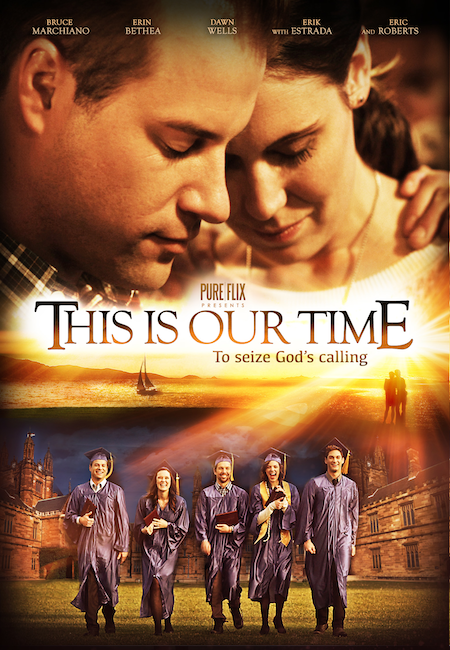
I had a  comfortable conversation with Erin Bethea last week. She is one of the ensemble actors starring in This is Our Time!, which releases on DVD Tuesday, April 16, 2013.

erin betheaHere is a small portion of our conversation:

CJ: You’ve had experience working with new directors, experienced directors, and now a female director. What was it like working with Lisa Arnold?

ERIN: What is great about working with Lisa is that she wrote the script and is a talented writer. She really knew the story well.

CJ: Did that background help Lisa cast the roles?

ERIN: She is amazing at casting. She knew what she wanted and got it…a perfect cast. They picked people that were the characters. When I met them, they were just what I expected and we built strong friendships, just like our characters.

CJ: What was it like working under Lisa?

ERIN: She has a quiet grace on set. Not too dynamic…she’s gentle and gracious. She is subtle, but pushes you in a way you don’t realize. I would happily do anything with her again.

This is Our Time PosterCJ: There are a lot of Christian films about good people becoming better people, which make finding a unique role difficult. What was a unique aspect of your character Alé that you hadn’t played before?

ERIN: I do play a lot of the same roles in faith-based films, but Alé is the first sold out believer, instead of the person that is not yet quite there. She was warm and friendly. I wished I were more like that girl. She has a warmth…she’s sweet.

CJ: The story was about the character of Ethan finding what gift God had given him and choosing to live it out loud. It seemed like your character was Ethan’s archetype or role-model that encouraged him to step up his life to God’s calling. What was it like to play such a powerful role-model with humility?

ERIN: It was a bit of a challenge. I wanted to keep Alé likeable. Because she’s everyone’s favorite, you don’t want to play her in a way where she becomes annoying. We all know amazing people who don’t realize how amazing they are, and she didn’t’ realize the gift she brought to others. She was just being who she was, so her seemingly perfection didn’t come across contrived.

CJ: In the film, Alé inspires everyone in the story. In what way did she inspire you personally?

ERIN: We shot in India in an actual leper colony for three days. For three days I really lived out her ministry. You can’t walk away from something like that without being impacted, challenged, and being other’s minded.

CJ: Do you find that the audience wants you to be that person in real life?

ERIN: There is an expectation that is placed on you as an actor. Fans are taken aback when they find out that you are not like the person they fell in love with on the screen.

CJ: As a Christian actress, are you limited to always playing the good guy? Wouldn’t it be refreshing and expand your acting chops if you played a bad guy?

ERIN: I would so love to play a bad guy. Please, someone put me in a film as a bad guy. I just want to play a villain…a rotten person. A friend of mine has a theory that nice girls can play bad people really well by playing the exact opposite of who they are.

CJ: Christian movie fans seem to put a lot of expectations on Christian films. Do you have any thoughts on the matter?

ERIN: I think that Christian films in general have a different set of expectations. People will accept certain things in a secular film that they won’t accept in a Christian film.

CJ: But what about films like Les Miz, which in my mind is one of the greatest stories of redemption ever told.

ERIN: I loved Les Miz. It was a great story of redemption. But if it were made as a Christian film, there would be an uproar over there being a prostitute in the film, and rightfully so. We are called to something higher.

CJ: We do have a higher standard to live by. But, how much greater is the value of redemption when the person’s devastating choices are revealed in the storyline?

ERIN: Storytelling…when Christians see that the arch of the story has redemptive qualities…if they see it embrace people…they get behind it like they did with The Blindside.

CJ: You seem genuinely thankful for the acting roles you’ve received. You must have fun playing the various characters.

ERIN: Making a movie is pretty much the most fun thing on this planet. You make friends on set that will be your friends for years.

CJ: Erin, thank you so much for your time today and chatting about your experiences.

ERIN: Thank you, CJ. It was a pleasure meeting you.

Copyright © 2013 by CJ Powers
Disclosure of Material Connection: I received one or more of the products or services mentioned above for free in hopes that I would mention it on my blog. Regardless, I only recommend products or services I use personally and believe will be good for my readers. I am disclosing this in accordance with the Federal Trade Commission’s 16 CFR, Part 255: “Guides Concerning the Use of Endorsements and Testimonials in Advertising.”