Over Cranking Beauty Shots

Hop On The ChestHave you ever wondered why the female lead always looks stunning during an intimate heartfelt moment in a Hollywood film, but not in an independent film? It has a lot to do with the type of director at the film’s helm – artistic or techie.

There are several clear distinctions between the talents of a director with a techie background and one with an artistic background. The techie guy typically has a history of using technology to glitz up his film with cool imagery, while the artistic guy focuses on story, emotions, and rhythm.

When its time for close-ups, the techie director uses the same lighting and lens set up as he used for the medium shot or the over the shoulder shot. The artistic director hates to see the camera team just tighten the shot and instead suggests a significantly heightened set up to explore the feelings of the moment.

One of my favorite techniques is over cranking the film. Or, for those with a video only background, shooting more frames per second. The technique is ideal for those heartfelt moments when the director needs a beauty shot or a graceful close up of the female lead.

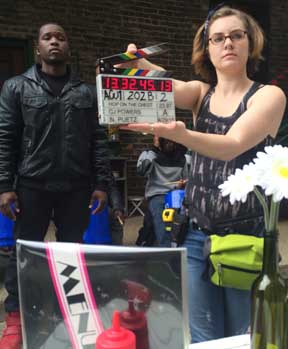
I tend to ask my DP (Director of Photography) for a more muted lighting set up to help enhance the over cranking shot. The softer lighting bends gently around the woman’s face and diffuses any harsh shadows that would otherwise be present. A soft filter might also be added to the camera to makes sure that there are no sharp edges.

If the camera is shooting at 24 fps (frames per second), I have the DP bump it up to 32 fps. This increases the clarity of the shot, while taking off the rough edges. By clarity, I’m not referring to sharpness of image, but rather the avoidance of extra blur inherent in capturing motion.

More importantly, by adjusting the speed by about 30% the image is captured with more detail within the actor or camera’s motion. This translates to an image with a great fluid movement during playback. Directors all have their own set of percentages for capturing a beauty shot, but I’ve found mine to be emotionally effective for all audiences.

In post-production, the 32 fps are then played back at 24 fps to generate a far more graceful shot of the female lead than was present on set. That ideal graceful cinematic shot can only be achieved with special diffused lighting, slightly soft focus lens and adjusted speed of film with readjusted playback.

The techie director tends to avoid the elaborate set up for the beauty shot by just slowing down the image in post. However, he can never get close to capturing that same dreamy and graceful effect that comes from the in camera artistry created on set by the camera team.

This one difference between a techie director and an artistic director is magnified when considering all the other techniques artists master that techies rarely learn.

The cumulative sum of these parts or production elements is what creates the uniquely different look between a Hollywood produced picture versus an independent picture. This focus on detail requires time and a budget for talented people in order to capture the beauty shot that everyone remembers from the film, but can’t explain why.

Copyright © 2015 by CJ Powers

97 Films Recommended by The Church of Satan

Good vs. EvilI’ve written about Christian films in recent days due to the surge in religious films. Some of the films are great redemptive stories for the general market, while others are preachy and intended for the like minded. In both cases, the genre has been difficult to define by production companies and distributors.

Another type of film is also getting attention and it too is hard to capture within a defined genre. Some refer to the films as satanic, while others suggest it is atheistic. In reality, it’s a genre that is more based in “I-theism.” In other words, pictures about a main character that is his own “god” – A person that establishes his own subjective hierarchy with himself as the most valued.

The films might also reflect the strong satanic beliefs followed like:

  • All forms of emotions from love to hate are healthy.
  • Ritual is for self-psychotherapy to purge any sense of conscience or emotion that hinders intelligently moderated pursuit of pleasures.
  • The prime dictate in lifestyle indulgence, over compulsion.
  • Animalistic tendencies and concern for the ecosystem.
  • All forms of sexuality between consenting adults.
  • Societal laws that regulate behavior so that a maximum of freedom might be obtained.
  • Justice where the punishment fits the crime when working to maintain an equitable society.

BladerunnerWhile some of this content sounds fine, like justice fitting the crime, it’s the intent and overarching goal that is self-centered. The purpose of the philosophy is to help individuals take their place, as god in their own lives, which is what Satanism is all about. That’s right, for most followers, it’s not about worshiping the devil, but self.

The list of films is one that Magus Anton Szandor LaVey felt best guided a viewer toward Satanism. While most of the filmmakers didn’t know they were leading their audience down a religious path, some were purposeful in their intent.

There was no surprise reading some films from the list like Rosemary’s Baby, Bedazzled and Svengali. Each of those films had overt satanic elements. However, some films were more of a surprise including classics like Citizen Kane, Metroplois, and Fantasia. Even more shocking was the family friendly film Willy Wonka and the Chocolate Factory.

The List of Films is NOT to be FearedWhen it comes to films like All the King’s Men, Bladerunner, The Comic, Pennies From Heaven, The Private Files of J. Edgar Hoover, Scarface (the original), The Stepford Wives, and Westworld, I can understand how the elements appreciated by the cult can be gleaned from the films, but that doesn’t make the film itself a satanic film.

Depicting a characteristic or a human flaw doesn’t make a film satanic, for it’s how the element is demonstrated that determines how it is received. For instance, a film about a wretched sinner that is later redeemed doesn’t make a film satanic, yet it might get the title onto the list.

Intent and performance determines if the content is redeemable or not. A selfish character may make the list, but if the film depicts a realistic cause and effect of his life, followed by a redemptive outcome, the film does more for the soul than a story steeped in teachings that convince audiences to put themselves above others – Looking out for number one.

The bottom line is that the list of 97 films is not to be feared or avoided, as some would conclude, but can bring an awareness of perspective.

A film like Les Misérables depicted a character that may have made a more recent list. But the story’s realistically portrayed redemptive qualities were far more powerful, putting the character’s original life choices in perspective with love, humility and gracious generosity that overcomes all. There has never been a better movie depicting the redemptive qualities of grace and mercy. Yet, some avoided the film for fear that their character would be negatively affected.

Redemptive stories will always overcome self-centered stories. Call it good versus evil, or God versus Satan, if you will. But, most of the highest grossing films of all time are stories of redemption. And, most satanic films do poorly at the box office.

What’s your view? Can a filmmaker unknowingly make a Satanic film?

Copyright © 2914 by CJ Powers

The 8 Powerful Techniques that Influence Your Future

CapturedI was sucked in. I couldn’t break free from the moment. It was alarming to me. After all, I understood the techniques used by the media to manipulate those who didn’t take time for conscious consideration of their media intake. It actually snuck up on me last Saturday morning.

I lounged in bed reading numerous Internet articles on my iPad. The sun had already lit up my room, the birds were singing and I was comfy enough to stay put. I easily jumped from article to article, some humorous and others curiously addicting. After about an hour, I couldn’t help but notice that I continually was captured by one particular publication.

The ezine grabbed my attention from numerous locations. It didn’t matter if I started on Facebook, Flipbook or Instagram. Every time one of their articles was shared, I felt compelled to read it. I had been captured by my own curiosity and leveraged by the marketers who published the blog entries.

The answer to being influenced suddenly popped up in an article titled The Anatomy of a Perfect Blog Post. Author Kevin Lee wrote about the sciences used in capturing readers and generating shares. Social Media had matured to the point of using science to influence its readers.

The techniques were simple enough and had proven effective in my life until I gave careful consideration to what I was actually reading. It was only then that I regained control of the amount of impact the influential articles could make in my life. Here are the main categories I learned about.

How to Write the Perfect Headline

The science of testing and retesting a reader’s response to headlines shows that people scan the first three words and the last three words. This suggests that a six-word headline gets perfect readership. Since this is close to impossible to achieve with many blog entries, marketers tested other aspects of headline readership and came up with the ultimate headline formula.

Number + Adjective + Keyword + Rationale + Promise = The Ultimate Headline

Start Your Post with Storytelling

StoriesBlogs that start with a story obtain about 300% more readership than a post without a story. Blogs sharing a story in the beginning of the article keep their readers 520% longer than those without a story. This makes sense to me, as by nature our society loves to hear or read a good story.

Reduce Characters Per Line by Using Images

The fewer number of characters used on a page shortens the eye movement and increases the reader’s comprehension. In other words, its better to use a picture that takes up half the column and reduces the number of words running across the page than it is to use a full column width.

Use Lots of Subheadings

The use of subheadings allows the blog article to be easily scanned. This scan ability gives the reader a quick understanding about what elements of your thoughts shared might be important to them. It also lays out your ideas in an easy way to understand much like a book or speech outline – Adding to the readers comprehension and consideration of your ideas.

Write the Perfect Length of Content

Blog posts of 1,500 words receive more shares than shorter articles. My guess is that it’s long enough to provide substantial content that’s worth sharing. This also puts the time of readership around seven minutes, which is just under the 8-12 minute window we can handle watching on TV – That’s why commercials interrupt your show every 8-12 minutes.

Add Tweetables When Possible

By making your post quotable, people will Tweet your comments. This is now done by placing a “Tweet This” or “Share This” link alongside the text. The old fashion way is to manually code a Tweet link.

Time Your Post for the Weekend

5 Steps to Take an Idea to ScriptSaturdays and Sundays get far more readership of blogs than any other day. This is due mostly to the lack of blogs published on weekends. Less competition means more readership, not to mention that weekends provide more time for people lounging in bed with their iPads.

A Call to Action

Topping off the list of techniques is a call to action. Suggesting that people do something about what they read inspires them to embrace what you’ve shared, especially if it is actionable, relatable, urgent, visual, solution-based, entertaining and definitive.

So, there you have it. The 8 techniques that caught me off guard. The only way I found to counter its effect, was to give the articles I read my conscious consideration, which put me back into the drivers seat and slowed my compulsory reading.

I hope you’ve found this information interesting and that you add these tools into your readership tool belt so you know when someone is trying to influence you. It’s only then that you can purposely take time to consider if you’ll receive and embrace the message to improve your life or discard it to protect it.