During a lazy summer’s afternoon, Billy sits on the aluminum bleachers at his friend Jeff’s baseball game, his phone resting loosely in his hands.
Sometimes he watches the game. Other times, he disappears into his phone. Neither holds his attention for long.
The game on his phone used to excite him. Now it feels predictable. He knows every move. Every outcome. Win or lose, nothing really changes.
Jeff taps his shoe with the bat, clearing his cleats, and steps back into the batter’s box.
Billy looks up as he hears a man shout from the bench, “Three balls, one strike. You can do it, Jeffrey.”
He lowers his phone and scans the scoreboard.
The bases are loaded. Two outs. Last inning. Jeff’s team is down by two runs. To win, everyone on base has to make it home.
Billy leans forward.
He feels the pressure before Jeff does. In the next few seconds, Jeff will either win or lose the game for two dozen families holding their breath in the stands.
The pitcher wipes his hands on his pants. Jeff wipes the sweat from his brow.
The pitch comes.
Jeff swings. CRACK!
The ball soars toward right field and slams into the chain-link fence, sticking for just a moment before dropping. Runners sprint. The right fielder grabs the ball and throws it in.
The ball moves fast—second base, then third.
Jeff slides.
He’s late.
Billy cringes. For a split second, it feels like everything has gone wrong.
Then the crowd erupts.
Billy realizes the runners have already crossed home plate. All three of them. The game is over. Jeff’s team has won.
Players rush the field. Teammates lift Jeff onto their shoulders. They carry him toward home plate as cheers echo across the diamond.
Billy watches, stunned.
His video game has never put him here—never asked anything of him. No one depends on him. No one’s joy or disappointment rests on what he does next.
This does.
When his mom picks him up after the game, Billy slips his phone into his pocket instead of turning it back on.
“Mom,” he says, “can you sign me up for baseball?”
She smiles. “That’s a change. What made you decide?”
Billy looks back at the field.
“In a video game, nothing changes,” he says. “But out there… on a team, everyone matters.”
Were you taught, like I was as a child, that the Garden of Eden was a paradise?
If not, let me explain that it was a place where everyone had innate abilities that they used daily. Fun and laughter, along with exploration, were a part of everyday life. Then, during the cool of the day, when people naturally walk, talk, and are present with others, God walked with Adam.
The communication was in person and personal, fostering relational closeness. Man’s conversation with God fit the normal, gentle rhythm of the day. At that time, proximity drove the culture of community.
Anna’s Passion for Gardening
I met Anna and learned about her passion for gardening. Her dream was to take an empty lot in her community and revitalize it so those in her village could join in and build relationships. She wanted it to be her Garden of Eden.
She knew that the shifts in the economy had negatively impacted many in the community. Her instinct was to convince those living nearby to meet in the cool of the day and plant, water, and weed a new garden, where conversations would heal hearts and invigorate the community.
Everyone loved the concept and shared their thoughts, offering various ideas on how the community garden could function. Some people wanted flowers, others preferred vegetables, and a few envisioned a venue for special events with a small stage at one end of the lot.
Communicating the Point of Your Vision
With her ears filled with an abundance of ideas, Anna recognized she needed to clarify one key point: the garden would be a space for everyone. Anna thought through what she had said to elicit a diverse onslaught of ideas, realizing that her initial message hadn’t been properly received.
Her vision was not adequately communicated, and various people placed their ideas over hers. Anna knew she’d have to go back to each person she talked with and help them understand her vision. She took time to think through how to prepare and came up with three steps.
THE FIRST STEP WAS TO CLARIFY what she pictured and to understand the vision herself. This is often done by focusing on a specific topic, stripping away any unnecessary details, and honing in on the core message she wanted to communicate.
When you clarify your thoughts, you can deliver your points concisely and with confidence.
Anna reminded everyone of the vision at every meeting or gathering: the garden was to be a shared space that brought the community together—a space for planting, learning, and connecting.
THE SECOND STEP WAS TO SIMPLIFY her message so people of various ethnic backgrounds, levels of education, and mindsets could understand her message. Many of her neighbors were not familiar with gardening, and some spoke English as a second language. So she created a visual flier that used easy-to-understand language and symbols to convey her message: “Come grow with us, no experience necessary!”
It was straightforward and welcoming to all, including children, elderly neighbors, and non-native English speakers. She used words that people at the sixth-grade reading level could understand, ensuring that the idea would be grasped by everyone in the neighborhood, regardless of background or education.
THE THIRD STEP WAS TO AMPLIFY her message and get the word out to everyone beyond the flyers and meetings. She wanted people to feel the same passion she had for the community space.
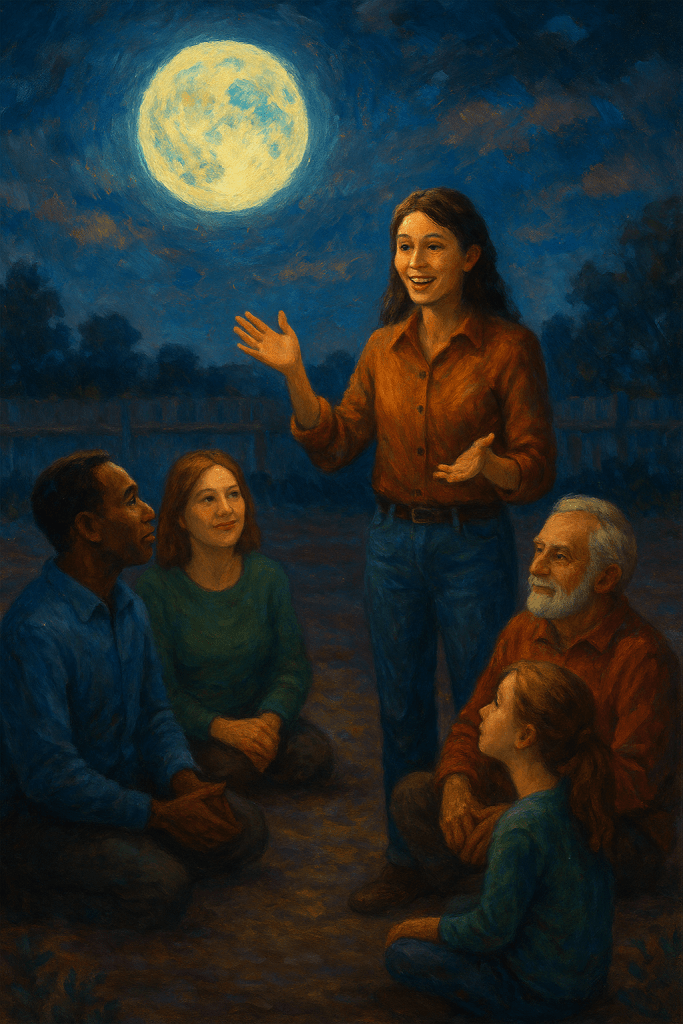
She gathered people on a Friday night under a full moon. She shared a memorable story about how the garden could bring the community together, improve the environment, and create lasting bonds.
She shared stories of other cities that had turned empty lots into thriving gardens. She even told a personal story about her grandmother’s garden, where Anna spent countless afternoons learning the value of planting seeds and watching them grow.
By weaving these stories into her presentation, Anna was able to amplify the idea, turning it from an abstract project into a vivid picture that everyone could see, feel, and embrace. Her words painted a picture of the garden as a gathering place—a place where people of all backgrounds could meet, learn, and grow together.
Engaging Your Audience
Anna ended the story by suggesting everyone take a few moments before heading home to greet someone they’ve never met. Then she did the same, working her way through the crowd and inspiring everyone she met.
Within three short weeks, the community garden was a huge success. What started as a vague idea became a clear, simple, and amplified vision that brought people together. By clarifying her message, simplifying it for the whole community, and amplifying it with a story that touched hearts, Anna made her dream a reality.
Word spread through the community, and the little lot garden became a popular place to meet for holidays, weekends, and relaxing with close friends. Is it time to create a special place in your community?
Bob Schmidgall was one of the most incredible speakers I’ve ever heard. I admired his ability to connect with people and studied him often. One of his greatest strengths was speaking in a way that reached blue-collar, white-collar, and gold-collar workers—all at once. Each listener walked away believing Bob was speaking directly to them.
If you haven’t heard those terms, they’re general categories of labor:
Blue Collar: Manual laborers and skilled tradespeople.
White Collar: Office and professional workers.
Gold Collar: Highly skilled and valued specialists, often in cutting-edge fields like AI.
When Bob made a key point, he often shared it three times. But he never sounded repetitive. Instead, each sentence was crafted for a different group. He wasn’t restating; he was expounding—layering meaning so each person heard it in a way they could relate to.
The result? Everyone left the room feeling as though his talk was written just for them. He was relatable, informative, humorous, and full of great stories. Out of the hundreds of speakers I’ve listened to, Bob remains in my top five.
At some point, I realized something important: no amount of study would turn me into Bob. But that wasn’t the point. Bob had his gift. What I needed to see was that all of us actually speak far more than he ever did. Over a lifetime, we will likely have the equivalent of a gigabyte of conversations—not just spoken words, but emails, texts, social DMs, and even old-fashioned snail mail.
Each exchange adds another “file” to our personal archive. Some are blurry images best deleted, but others are crisp, high-resolution moments worth revisiting.
And that leads to the real question: if you’re going to spend that much time talking, typing, and connecting—why not upgrade your conversations so they actually build trust, opportunity, and collaboration?
Here are five simple Conversation Upgrades I’ve found that can transform ordinary chatter into meaningful dialogue.
Upgrade 1: Curiosity Beats Cleverness
Instead of prepping stories to tell, prepare questions to ask. Dale Carnegie put it best: “You can make more friends in two months by becoming interested in other people than in two years by trying to get other people interested in you” (How to Win Friends and Influence People).
A practical way to stay curious? Think about their Family, Work, Recreation, and Dreams (the F-W-R-D framework). Ask about their kids’ hobbies, the wildest thing that happened at work this month, the new restaurant they tried, or the goal that lights them up. When you anticipate their story, you can’t help but lean in—and that anticipation is contagious.
Upgrade 2: Turn on Charisma Mode
Charisma isn’t some magic dust—it’s built from presence, warmth, and confidence. Olivia Fox Cabane (The Charisma Myth) shows how teachable this is.
Presence: Give someone the sense that there’s nowhere else you’d rather be.
Warmth: Try the “flooding smile”—pause, take them in, then let a genuine smile slowly spread. It feels personal, not pasted on.
Confidence: Strong posture and a few thoughtful pauses tell the room you’re comfortable in your own skin.
When those three align, people don’t just hear your words—they feel your attention.
Upgrade 3: Add a Twist of Surprise
Boring conversations fade. Playful ones stick. Instead of standard answers, toss in a curveball:
Instead of “I’m from Chicago,” say: “I’m from Chicago, where pizza is deep enough to need a lifeguard.”
Instead of “I’m a consultant,” say: “I’m a consultant who’s learned more from coffee spills in boardrooms than from MBA textbooks.”
It’s not about impressing—it’s about giving others something fun to react to, like setting up the first line of an improv scene.
Upgrade 4: Ask for Feelings, Not Just Facts
Charles Duhigg’s Supercommunicators highlights a Harvard study of speed dating conversations: the people who landed second dates asked emotion-driven questions, not fact-gathering ones.
Swap:
“Where are you from?” → “What do you love most about your hometown?”
“What do you do?” → “What makes your work exciting—or exhausting?”
“What did you do this weekend?” → “What was the highlight of your weekend?”
By aiming for Dreams, Elevated moments, and Passions (D-E-P), you’ll unlock stories that reveal what matters most. That’s the difference between polite small talk and real connection.
Upgrade 5: Let People Know They Landed
Everyone wants to feel heard. Psychiatrist Mark Goulston (Just Listen) says even small acknowledgments—nodding, “mm-hmms,” or paraphrasing—make a huge impact.
When someone shares, don’t just reply with “Wow, that’s crazy.” Echo a detail that mattered: “That’s hilarious—after all that effort, the IKEA shelf was upside down the whole time.”
It signals: I didn’t just hear you. I understood you. That’s the glue of collaboration.
Why These Upgrades Matter
Each “conversation upgrade” builds on the 3Cs framework that I’ve developed:
Communication: Clearer, warmer, and more engaging.
Connection: Deeper emotional resonance—because you’re asking what really matters.
Collaboration: When people feel seen and valued, they bring their best ideas to the table.
Conversations aren’t background noise—they’re the raw material of relationships. And when you upgrade them, you upgrade your influence, your opportunities, and your impact.
It’s Time to Upgrade
You’ve got a gig of conversations ahead. Most people will let theirs auto-save in the background. But you? You can choose to upgrade yours—turning them into meaningful files worth archiving.
Start small: one curious question, one genuine smile, one playful twist. Then watch how fast your communication, connection, and collaboration grow.




 CJ's Corner