When Social Glue Outweighs Truth

We live in a time when news travels at the speed of a click. A story breaks, opinions explode, and before the dust settles, millions of people have already picked a side. It would be encouraging if those positions were built on verified facts, but often they’re not. Instead, they’re shaped by something more powerful than truth itself: the social glue of belonging.

A Story That Stopped Me Cold

Recently, I read a breaking news report that angered me. The media shared details immediately—without taking time to verify the facts—because ratings and clicks mattered more than accuracy. The half-baked story took off, fueling activists who staked clear positions on the issue before anyone truly knew what had happened.

This morning, I bumped into someone who brought up the story. Since I had access to the actual facts from industry insiders, I began to explain what had really transpired. BLAM! Before I could finish, the person yelled at me. I tried to clarify, but I wasn’t allowed.

Why? Because their opinion wasn’t anchored in truth—it was cemented by their social circle. Their friends had already taken a stand. To question the narrative meant risking social rejection, and belonging outweighed accuracy.

The ripple effects were staggering. Activists were boycotting, social media arguments flared, and tempers ran hot—all based on false information. An industry insider confided that they had no idea how to slow the emotional rampage or get people back on the same page. Instead, they were forced into triage mode, just hoping to capture a shred of reality.

It got worse. One of the three companies involved had to build an entirely new publicity campaign that treated the falsehood as if it were true—because that’s where the public conversation had already landed. It sounds absurd, but there’s wisdom hidden there: sometimes the only way to lead people back to reality is to start where they are and slowly walk them across the bridge you build into truth.

Why Truth Often Loses

That experience hammered home a difficult reality: truth doesn’t always carry as much weight as community. People may claim they value facts, but when those facts threaten the acceptance of their social group, most will hold tighter to the group than to reality.

This is confirmation bias on steroids. We don’t just look for information that validates our perspective—we look for information that validates our tribe. And once we’ve socially reinforced a belief, even airtight evidence can feel like a threat.

Familiarity Feels Like Truth

Another reason false stories gain traction is repetition. The more often something is said—especially by trusted friends or favorite voices—the more “true” it feels. Familiarity breeds credibility, even if the information is wrong. That’s why fact-checks and corrections rarely travel as far or as fast as the initial story. Once a narrative is familiar and socially reinforced, it feels like common sense.

Why Facts Alone Don’t Change Minds

We’ve all tried it—dropping statistics or news articles into a heated debate, only to be dismissed or attacked. The problem isn’t always the strength of the evidence; it’s the lack of trust between the messenger and the audience. Facts are abstract. Relationships are personal. And when truth threatens to fracture relationships, it often loses.

This is why shouting louder doesn’t work. Correcting someone in front of their peers can backfire, because it doesn’t just challenge their opinion—it threatens their standing in the group.

The Path Back to Truth

So, what do we do when social glue outweighs truth? We start by recognizing that people are relational beings first and rational beings second. If we want truth to stick, it has to travel through trust.

Here are a few practical approaches:

  1. Lead With Respect. People listen when they feel respected, even in disagreement.
  2. Build Trust Before Sharing Facts. A trusted voice can carry hard truths where a stranger’s voice can’t.
  3. Find Shared Values. Frame truth in ways that connect with what the other person already values—safety, freedom, fairness, or community.
  4. Plant Seeds, Don’t Throw Stones. Change rarely happens in the heat of debate. It happens later, when a planted idea starts to grow.
  5. Start Where People Are. As frustrating as it sounds, sometimes the only way forward is to meet people inside their existing narrative and carefully build a bridge toward reality.

People Believe What Helps Them Belong

The story I experienced reminded me that truth, on its own, isn’t always enough. Social belonging can be stronger than facts, louder than reason, and more persuasive than evidence. People don’t just believe what they think is true—they believe what helps them belong.

If we want to see truth prevail, we can’t only correct lies. We must cultivate relationships, build trust, and patiently guide people across the bridge from where they are to what’s real. Because in the end, truth matters—but only if we can carry it together.

Copyright © 2025 by CJ Powers

Canoe Expedition Gone Wrong: The Secret to Forging Strong Personal and Professional Bonds

I was where adventure meets beauty. A group of guys headed into northern Wisconsin for a weekend canoe trip. The journey was meant to be relaxing—canoeing a chain of lakes surrounded by nature. A bald eagle flew overhead as this group of macho guys launched our canoes into the fresh waters.

A couple of guys stared at the soaring eagle. The majestic bird was a first for them. I had lost some of my awe, having shot hours of film documenting the lifestyle of a family or brood of eagles. My best footage included eagles soaring for a significant period without flapping their wings and diving into the lake for their morning catch.

Our gawkers finally chilled after a half mile into our canoeing expedition. The guys who weren’t fans of the great outdoors started asking how long until we stopped to make camp. These were grown men.

I estimated another eight hours if all went well, but as anyone who’s spent time outdoors knows, things don’t always go as planned. We soon struggled with low water levels, forcing us to portage the canoes several times. The drought that year had damaged the channels between the lakes.

We portaged in mud, across fallen tree branches visible for the first time in a decade, and a few old rusty appliances that owners didn’t want to pay a landfill charge to dispose of. The guys’ weekend out had become a grueling challenge with rising tension.

Conflict is often seen as something to avoid in personal and professional relationships. We instinctively shy away, thinking it might damage our bonds or cause lasting tension. But what if we reframe our view of conflict? What if we see it as a tool that can bring us closer together, build stronger connections, and foster resilience instead of avoiding it?

The hot sun quickly revealed who didn’t think to bring fresh water. One guy griped that he didn’t know he’d need any since we were canoeing in fresh water. But the low water levels meant muddy and undrinkable water.

As we faced and overcame these shared challenges, our group held together. We bonded in ways that might never have happened under easier circumstances.

The Power of Shared Challenges

When discussing connections, it’s easy to focus on the good times—the celebrations, the wins, the moments of joy. But it’s often the hard times that bring people closer. Shared adversity can be powerful, forging bonds far more substantial than those built during relaxed times.

Research in social psychology supports this idea. When people face challenges or conflict together, they often develop a sense of solidarity and trust. This is sometimes called the “misery loves company” effect.

Studies show that people who experience difficult situations together are more likely to feel connected to one another. They develop a bond strengthened by their mutual experience of overcoming obstacles.

My canoe trip was no different. The initial conflict felt inevitable as we encountered challenge after challenge—canoes hitting ground, shoes disappearing in the deep mud, and heavy gear sinking when rookies tried to climb out of the canoes incorrectly. Everyone had their idea of how to proceed, and disagreements flared as exhaustion set in.

Something fascinating happened as the sun set and the surrounding sounds shifted to night creatures. We realized that if we were going to make it through the trip, we had to stop seeing each other as obstacles and start seeing each other as teammates. This is where shared challenges turn into shared strength.

I took over cooking when several guys realized they had lost their food stashes while portaging a channel. The guys were exhausted, and I was the only one with a history of making great food for a group of guys in a short time—thanks to the summer scouting jamborees I participated in as a kid.

Transforming Conflict Through Communication and Collaboration

That evening, as we ate under the stars, communication became our most important tool. Instead of bickering or letting frustrations simmer beneath the surface, we aired our grievances and figured out how to work together. This was our needed turning point, a lesson that also empowers any relationship, personal or professional.

Effective communication is the foundation of any strong connection.

Whether navigating a challenging canoe trip or managing a complex project at work, the ability to communicate openly, listen to each other’s perspectives, and collaborate on solutions allows us to move forward productively. Once we started talking openly, we quickly realized everyone felt the same strain and pressure but expressed it differently.

We could finally address the real issues and move beyond the conflict by bringing everything out into the open. Our process aligns with research from Dr. Dean Tjosvold, a prominent conflict management expert who emphasizes the importance of open communication and cooperative conflict resolution.

According to Tjosvold, conflict isn’t necessarily damaging. How we handle it determines whether it strengthens or weakens our relationships. By focusing on collaborative problem-solving, we can transform disagreements into opportunities to deepen trust and build stronger connections.

Avoiding Toxic Positivity with Authenticity

With the sunrise came a shift in wilderness sounds. I took a deep breath of fresh air and contemplated our incredible discussion from our first night together. With everyone on the same page, this would be an exhilarating day until it wasn’t.

One of the guys became overwhelmingly positive. His mindset was hyperfocused and far from the truth compared to the more authentic men. His overzealous behavior was enough to force several fists to clench. I would’ve been one of them, but I firmly believe in showing new mercies every morning, so I released my expectations for the day and relaxed.

That’s not to say I didn’t wonder about his toxic positivity. This occurs when we try to cover up the negative aspects of a situation with forced optimism, thinking that if we stay positive, everything will be fine. But as my group learned on that trip, ignoring or dismissing our real challenges would have only worsened things.

Pretending that everything was okay would not have eased the physical strain or solved the practical problems of navigating the chain of lakes.

Toxic positivity can be especially damaging in professional settings, where there is often pressure to maintain a positive front at all costs. But when we gloss over difficulties, we miss the chance to engage in authentic problem-solving and personal growth. Real connection comes from acknowledging the full spectrum of our experiences—the good and the bad, the easy and the hard.

Humor and Reflection: Finding Meaning in the Struggle

Mr. Positivity finally exhausted himself and fell asleep in the canoe. The team pointed out that his yapper was shut, and we would have peace for the next few miles. We had additional good news: the water levels at our lower elevation were much deeper, so we no longer had to portage between lakes.

The sun hid behind a giant fluffy cloud, and a cool breeze cut across the lake. We were going to have a great ending to our trip. My canoe suddenly shifted sideways. Others were alerted to the water rippling around rocks like we had entered level 4 rapids.

Excitement reenergized the guys, and we shot forward into the light rapids with the enthusiasm of a race team. We jokingly talked sports trash as we maneuvered the small rapids, shooting down the short but steep channel to our destination lake. We ended the trip as if something remarkable had happened.

Weeks later, Mr. Positivity did a few speaking engagements, sharing how he took control of a canoe trip gone wrong and forced it into submission. He shared his moment of empowerment when he got us to safety for a glorious night under the stars, inspired us with his campfire stories, and motivated us to take class 4 rapids to finish off our trip of overcoming nature.

A handful of guys altered their memories to match the well-received positive story.

But four of us held to the unattractive truth. We faced heavy bouts of adversity in our “relaxing” canoe expedition. Some were self-inflicted by our ignorance, others inflicted by a drought, and still others inflicted by the stupidity of guys trying to be macho. We had endured physical, mental, and emotional exhaustion and found ourselves to be far more resilient than any one of us would’ve expected.

We found meaning in the struggle and even laughed at it. Later, I learned that laughing at our hardships is an essential part of turning conflict into connection. When we look back on challenges, we often find that the things that seemed overwhelming become the stories we tell with pride.

The hardships bind us together and make the good times even more meaningful.

Applying These Lessons to Your Connections

The lessons from this trip apply to personal and professional relationships. Conflict is inevitable in any setting, whether a team project, a business partnership, or a working relationship with colleagues. But if we approach it with the right mindset—seeing it as an opportunity for communication, connection, and collaboration—it can become one of the most powerful tools for building trust and strengthening bonds.

The best teams have faced challenges together and emerged stronger. The key is to engage in open communication, address the real issues, and avoid the trap of toxic positivity. By embracing the whole reality of the situation and working together to find solutions, we can create far more resilient and lasting connections.

At its core, conflict isn’t something to be feared. It’s a natural part of any relationship; when handled well, it can bring people closer. Shared challenges offer us the opportunity to strengthen our bonds, deepen our understanding of one another, and emerge stronger and more connected.

Copyright © 2024 by CJ Powers

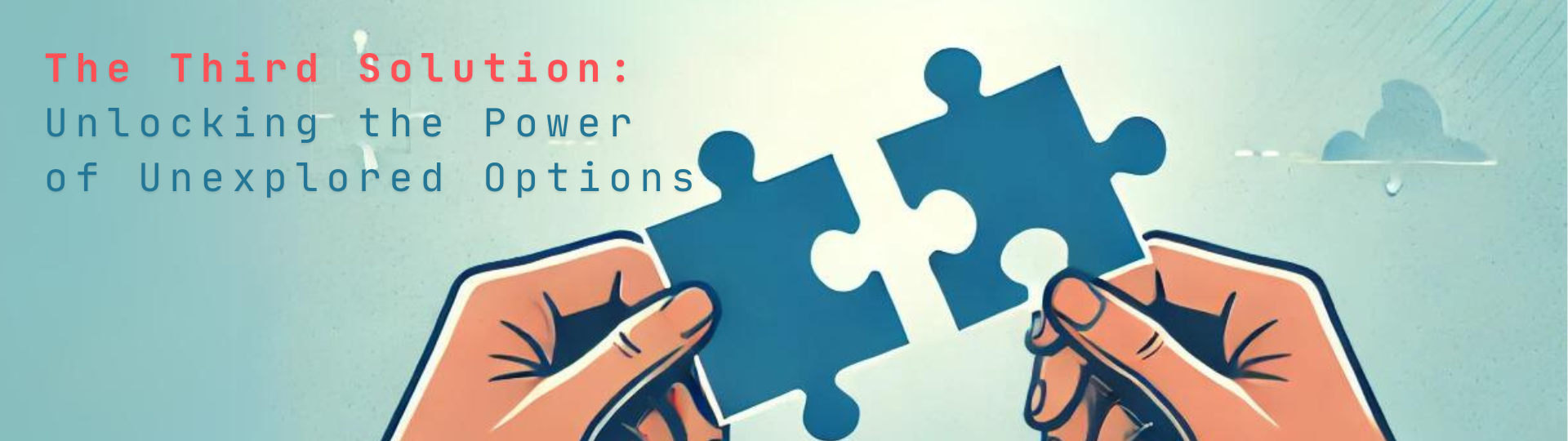
The Third Solution: Unlocking the Power of Unexplored Options

Have you ever run out of options, or so you thought, only to realize there were unexplored possibilities just beyond your perspective?

I remember a time during my marriage when we found ourselves in a stalemate over an important decision. We were both convinced that we were right, and it seemed like there was no way forward. It was in that moment of frustration that we discovered something important—each of us held just one small piece of the puzzle, a one-percent perspective that could lead us to a solution. It wasn’t much, but it was a start.

We made a commitment to each other that whenever we were at an impasse, we would set aside our need to be right and instead work together to find a third solution—or maybe even more. We decided to search out as many unexplored options as we could in a short period of time, allowing new insights to emerge that would help us move forward.

This simple decision became a powerful tool that transformed the way we approached disagreements.

What we learned along the way was that there were three essential steps to finding unbiased answers: communication, connection, and collaboration.

Communication: The Foundation of Understanding

The first step was communication. But it wasn’t just about talking—it was about truly listening to each other. We had to move beyond merely exchanging words and instead focus on understanding the deeper reasons behind each other’s perspectives. This kind of communication required patience, empathy, and a willingness to be vulnerable.

I remember one particular disagreement where I was convinced that my solution was the only viable option. It wasn’t until I paused and really listened to my partner that I began to understand the “why” behind their point of view. They weren’t just disagreeing for the sake of it; they had real concerns and motivations that I hadn’t fully appreciated. By listening without judgment, I was able to see things from their perspective, and suddenly, new possibilities emerged.

Communication became the cornerstone of our solution-seeking process. It created a space where we could share ideas openly, without fear of dismissal or criticism. By building a foundation of trust, we were able to move past our initial positions and explore options that we never would have considered on our own.

Connection: Bonding Through the Exploration Process

The next step was connection. As we communicated more effectively, we found ourselves growing closer. The process of exploring different perspectives wasn’t just about finding a solution—it was also about understanding each other on a deeper level. We began to see each other’s values, motivations, and desires more clearly, and this understanding brought us closer together.

I remember how, during one particularly difficult decision, we spent hours talking through different possibilities. It wasn’t easy, and there were moments when we both wanted to give up. But as we kept pushing forward, something unexpected happened—we began to feel more connected. The act of working together to find a solution became a bonding experience.

It wasn’t just about resolving the disagreement; it was about building a stronger relationship in the process.

This kind of connection can happen in any relationship, whether it’s with a partner, a friend, or a colleague. When you approach challenges with openness and a willingness to connect, you invite others into a meaningful partnership. The journey of finding unexplored options becomes an opportunity to foster trust, empathy, and genuine camaraderie.

Collaboration: Focusing on Each Other’s Needs

The final step was collaboration. True collaboration required us to set aside our personal biases and focus on each other’s needs. This was often the hardest part because it meant letting go of our own agendas and prioritizing the well-being of the other person. But when we did this—when we genuinely focused on giving each other the gift of seeing their needs met in the final decision—something amazing happened.

By prioritizing each other’s needs, we created a more balanced and empathetic approach to problem-solving. It wasn’t about winning or losing; it was about finding a solution that worked for both of us. This selfless focus prevented our biases from resurfacing and allowed us to work towards a mutually satisfying outcome.

I remember one discussion that gave us a spin. The more we focused on each other’s ideas, the more we realized our personal ideas were off the mark. We learned that when we collaborated with the intention of meeting each other’s needs, we unlocked creative solutions that neither of us could have come up with on our own.

One of the most powerful lessons we learned was that the best answers often didn’t look anything like our initial ideas. Our first choices were limited by our narrow perspectives, but by working together, we were able to discover unexplored options that were far better than anything we had considered before. It was a reminder that we could achieve far more together than we could alone.

Simple Steps—Hard Execution—Rewarding Solution

I don’t want to give the impression that this process was easy—it wasn’t. Both of us had to purpose in our hearts that we truly wanted the best for each other, even when it was difficult. There were times when we said we were willing to explore new possibilities, but deep down, we were still holding onto our own agendas. It was only when we were honest with ourselves and each other that we were able to move forward.

But when we did the work—when we communicated openly, connected deeply, and collaborated selflessly—we always ended up far happier with the results than we ever would have been with our original solutions.

The journey of exploring communication, connection, and collaboration is one that requires dedication and a genuine willingness to grow together. It’s about opening up to new ideas, valuing the needs of others, and working side by side to create solutions that elevate everyone involved.

When we approach challenges with this mindset, we not only find better answers—we build stronger relationships and discover the true power of partnership.

Copyright © 2024 by CJ Powers