

The Rise of Generation Z or iGen

iGEN.pngWhere has time gone? Generation Z is now the largest population group in the United States and has the greatest amount of disposable income. They are quickly becoming the new movers and shakers, while many are still focused on figuring out the Millennials.

This new generation is made up of an interesting mix of ideals since some of their parents are Gen Xers and others are Millennials. The first portion of the group (mid 90’s) grew up during the Great Recession with 9/11 driven security issues being a major factor in society. They are also the first group of individuals to be raised in a ubiquitous Internet society with 40% admitting to their smartphone addiction.

This unique positioning of the Internet in their lives has given rise to some calling the generation: iGen. They are also known as Post-Millennial, Homeland Generation, Plurals, The Founders, etc. The names come from published white papers in the advertising and marketing industry. It typically takes several years of observation for the group name to solidify, and since Gen Z started around 1996 and is still being birthed today, the final labels won’t lock in for some time.

Twitter and Instagram are their go to apps with Snapchat and Periscope following close behind. Gen Z does use Facebook, but only because they feel a commitment to community and that’s the place where most people hang out. With that said, it’s important to note that Gen Z enjoys following everyone’s shares, but rarely shares their own information. They prefer to keep things private.

In the U.S., 55% of Gen Z are non-Hispanic Caucasians, 24% are Hispanic, 14% African American, 4% are Asian, and 4% Multiracial or Other. As a group they are very diverse in their acceptance and prefer authenticity to polished imagery. They are opposed to “photoshopped” pictures, preferring real life imperfections.

The most important factor concerning Gen Z is their need for stability, something the millennial generation upset with its ever-changing community views on what’s right and wrong. In an attempt to stabilize their lives, Gen Z has become highly educated through Internet based self-education.

Gen Z is fiscally moderate to conservative. They fear huge college loans and many are jumping directly into the workforce to avoid debt. They seek stable jobs filled with purpose, where they can make a difference in society. They believe in continuing education, but not through the school system.

The workplace is becoming more complex because the things and processes that company’s finally figured out would work for Millennials does not work for Gen Z. Due to Gen X and Millennials parenting styles, leaving much of life for Gen Z to figure out on their own, Gen Z are quickly becoming more entrepreneurial. This trend leads to more start up boutiques that will function globally in order to survive. Gen Z’s Internet savvy will empower small global companies to pop up anywhere.

Bonds will develop between the boutique businesses to act like a large corporation on important projects. Gen Z’s drive for purpose and making a difference will give churches the opportunity to define purpose and help Gen Z’s to apply it in life. But if churches don’t fulfill the need, politicians will step up and gain political leverage by defining purpose.

The oldest of Gen Z turned 21 this year and is ready to make a difference in his or her workplace. They are also poised to impact our communities with a new perspective and purpose. The one thing we can count on is that the formal direction the generation will take will not be in keeping with the Millennials’ dreams or perspective.
© 2017 by CJ Powers

Creating a Polished Presentation

I was thinking about what it would take to create a polished presentation that would “WOW” the socks off of people. The work would require a new creative approach to take people on an emotional and educational ride that they’ve never been on before. The new method in and of itself would be refreshing.

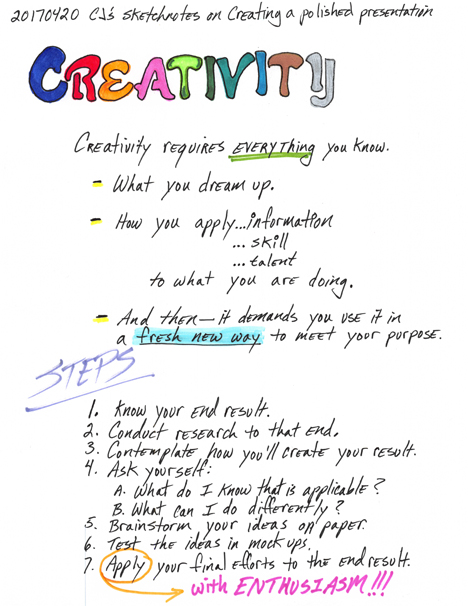
My mind jumped to a chapter from “The Imagineering Workout” by the Disney Imagineers. Susan Dain, an Imagineer Show Designer, shared some of her notes about how to produce the perfect finishing touches to make a magical product. I took sketchnotes as I reread her four paragraphs, but I used my perspective of creating a polished presentation as a filter.

Here are my sketchnotes followed by an example:


2017_04_20_sketchnote_v2

After reviewing my notes, instead of giving a polished presentation example, I’ve decided to share a creative example from my son and his family’s recent move. When I walked into my granddaughter’s new bedroom I was elated with the uniqueness of its layout. It made the room special, which in my mind requires an extraordinary design.

Using everything stored in my brain and heart, I started to dream up several ideas. More specifically, I wondered how the room could be designed to cause my granddaughter to smile from ear to ear like she does every time I visit her.

Creating a design that would make someone smile in that special way takes a tremendous amount of energy to apply all the information it would take, plus the use of skills and whatever talents can be tapped into for the project. And then, it’s time to figure out a fresh new way of combining everything into the purpose of making her smile every time she wakes up and every evening before closing her eyes at bedtime.

It would take brainstorming and mock ups galore. Until that moment when I’d realize that the best idea has been captured and figured out. Then, and only then, would it be time to approach her room with paint, thing-a-ma-bobs and do-hickeys.

But alas, I wouldn’t be able to do it, as her parents would want to help her design the room as a family activity.

It’s a good thing the creative process is fun and rewarding.

I can’t wait to see what she does with her room.

© 2017 by CJ Powers

Promoting without Purpose

CandyIt was a beautiful and warm day, perfect for long walks and meeting new people. I treaded carefully past the “No Solicitor” signs and came upon a business that flashed me back to my teen years. It was a detailing shop, which was all the rage back in my theater days, but are almost impossible to find today—well, at least quality shops.

The door was locked, so I moved to the next storefront to peddle my marketing pieces. But before I could open the door a little boy ran up to me and said, “We’re here. This is my shop.”

I must have had a perplexed look on my face because the six year old pointed to the door of the detailing shop.

“Your shop?” I questioned.

“It’s inside.”

The boy’s mother came up from behind him holding up a key. She wiped her hair away from her face to bring some semblance of order to her frazzled look. She worked hard to keep her family moving in the right direction.

“I’m sorry we’re late, we had to take care of some family matters,” she said.

The husband walked up with a baby bucket seat in one hand and reached his empty hand of welcome toward me.

“Please come in,” he said. “My son’s talking about his mini-business, just inside.”

“Okay,” I said as I followed everyone inside.

The front office looked more like a playroom than a waiting room for customers. The little boy grabbed nachos from his mother’s hand and sat down in front of the TV next to the curtain drawn display windows.

“You’ll have to excuse the mess,” the mom said. “This is a mom and pop shop and we don’t have anywhere else to take our kids.”

“No problem,” I said with a smile. “There’s nothing wrong with having a family business.”

The dad quickly interjected, ”It’s more like a nursery in here, but it gives our son more family time and we can keep an eye on the little one.”

“I used to have my son creating animations for my business back when he was in grade school,” I added. “Now he manages computer teams, speaks at conferences and makes the big bucks.”

“My son has become somewhat of an entrepreneur in his own right,” the father said. “This is his desk where he sells candy.”

The father pointed to a deep, black walnut desk with piles of boxed candy, cartoon business cards and handwritten receipts.

“He sells candy to help him understand the value of money,” said the proud dad. “He’s made $300 just this week and he’s going to give it all away to help others.”

“Wow, that sounds amazing,” I said. “Who is he helping?”

“We don’t know. He’s just selling right now.” The father paused, glanced out the door at a shop across the street. “Most of what he’s sold has been to a group of guys that work across the street. They come over here every day to buy his candy. They’re really great guys, and customers too.”

“They sound nice, to be able to help your son daily,” I said. “But, how exactly is your son learning the value of money?”

“Well, he’s giving it all away.”

“When I attempted to teach my kids the value of money, I had them take 10% out for charity, 10% out for savings, 5% out for vacation spending money, and so on,” I said. “I wanted them to learn how to manage money and learn of its value in the process.”

“No, he’s going to give it all away,” the father insisted.

“I’m sure there will be a lesson in the adventure for him.”

I turned to the little boy and asked, “Who do you plan on helping with the money you’ve raised?”

The little boy kept his eyes focused on the TV and shrugged his shoulders.

“Pay attention to the man,” demanded the father.

The little boy turned to me and said, “I don’t know.”

The mother chimed in, “He said he’d like to help the kids at a children’s hospital.”

“That would certainly be admirable,” I said.

“He wanted to give all the kids teddy bears, but then changed his mind,” said the father.

“I’m sure that whatever he does, it will be a blessing to the recipient.”

“Get over here,” said the father as he pointed his son to the desk.

The little boy ran around me and stood at his desk. He moved his hand across the candy like Vanna White revealing the Wheel of Fortune game board.

“It’s too bad I’m not a candy eater,” I said. “But it all looks good and the kids you help will certainly appreciate…”

Before I finished my sentence the boy ran back to the TV and flopped into his chair.

I’ve been know to purchase from kid’s sales stands and tables over the years. Sometimes I accepted the product and other times I pay for it and asked the seller to gift it to their next customer or someone in need. But, this candy table was different.

There was no purpose or intent behind the little boy’s candy sales that made it worth my support. Nor was I persuaded to think he was learning from the activity. And, aside from the generous men that worked across the street, I wasn’t convinced the kid even knew how to ask for the sale without his dad’s prompting.

I love to reach into my pocket and help young people who work hard for a cause, but when the moment is void of purpose, it feels pretentious and phony. I don’t like to support people that don’t have their heart in the matter. Show me a passionate person filled with specific intent and I’ll try to support them beyond what I should.

I walked out of the office wondering if I was the first person to withhold support from the father’s educational moment. After all, the cause appeared noble and the kid was cute. But when I turned back and saw the kid’s eyes still glued to the TV, I walked out of the building knowing that my money was going to be held for the next heartfelt project that’ll make a difference in the lives of real people.

© 2017 by CJ Powers