
How to Assign Value to Disparate Projects for Equal Consideration
Have you ever wanted to know which project to start next? Did you get frustrated comparing unrelated activities in an attempt to determine which provided the greatest value? The solution is as simple as a child’s game.
No, I’m not talking about a Six Sigma Pugh Concept Matrix to determine which potential alternative solution can more quickly and easily be engineered into a viable product for just-in-time manufacturing.
I’m talking about a simple game that boutique tech businesses use to prioritize projects by overall value.
It’s called a weighted decision matrix and its fun to use.
Picture a simple table with the name of the projects listed down the far left column. Across the top of each column is the criteria that you’ll use to measure a projects overall value. Where each project and column intersects are the letters H, M, and L. The far right column holds the total of the criteria scores for each project.

STEP ONE:
Name each project in the first column. Name the criteria being considered at the top of each column.
The H M and L represent the importance level of the criteria for the project—giving it a high, medium or low level of importance for each particular criterion. Circle the level of importance that each project holds based on the given criteria.

STEP TWO:
Give a value to each H, M and L. With less complex decisions I use the following values: H=4, M=2, and L=1. If the decision is more complex I use: H=9, M=3, and L=1. Then total the score by adding the values from each cell. The decision is obvious—I need to write a blog on Decision Matrix (see below table).
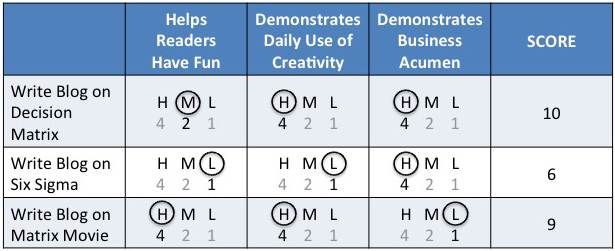
But many times life is not so simple because some criteria are more important than others, which requires some form of weighting.
STEP THREE:
When criteria are not equal, a numeric value must be attached that will work as a multiplier. I use a 5-point scale to make sure each criteria receives its due credit or strength in the formula. However, when sorting through a large number of projects, I switch to a 10-point scale in order to pick up on the value of subtle nuances for each criterion.
In the below table I’ve given each criteria a numerical value. In the first cell the M was circled and is valued as a 2. I then multiply it with the weighted criterion value of 4 and get a new total cell value of 8. Each cell is added together for a total score of 40.

The weighting has clarified what’s more important and shifted the score to a tie. In this case I would’ve been better off using the larger spread of values: H=9, M=3, and L=1 as in the below table. However, the scoring is so close that the decision of what blog to write had an original score of 10, shifted to a tie, followed by coming in second place (see below table).

Here’s where the game gets tricky. You have to be totally honest with yourself whenever assigning values to what’s important. Deciding between H, M, L is pretty easy, but the choice is more difficult with a 5-point criteria value—even more tricky with a 10-point value.
In the table below I changed the weighted amount for the third criterion from 3 to 4. Why? Well, since most of my readers run families, small businesses and departments, I thought the category should hold a higher level of importance.

Now look at what happened to the scores. The numbers made the decision very clear, but only because I was being truthful about the third column’s actual value of importance.
WARNING: As in all games that use numbers, a person can cheat to make things read anyway they want, which defeats the purpose of playing.
STEP 1A:
It’s important to use only the criteria that are truly important to a project. Extra criteria that’s not seriously weighted only complicates your decision making process.
If you’re an artist, consider some of these criteria:
• Passion Zone
• Stretch Comfort Levels
• Gain Knowledge
• Generate Money
• Advance Career
• Network Expansion
• Develop Skills
• Touch Lives
• Build Relationships
• Fun & Games
The above factors can all impact a decision for an artist deciding whether or not he or she is interested in signing on to a film project. Sometimes it’s worth doing if it expands your network or you can learn something significant from the experience. Other times making money is the number one weighted factor.
In business, other criteria might be considered like:
• Meets Objectives
• Forwards Career
• Meets Boss’ Bonus Requirements
• Generates Commission
• Creates Double Digit Growth
The above list can go on and on, but the idea is sound. Figuring out what criteria is important for the projects being considered helps change the decision from an aggravating dilemma to a child’s game that’s easy to solve with a quick hand written table or spreadsheet.
Members of different departments that make up a special team can also play this game. Each can add a few criteria to the table to make sure their area of expertise is well considered by the decision maker.
The biggest decision I faced was sorting through 11 projects with 32 criteria. Thankfully it was on an automated spreadsheet and the answers were quick and sound.
Let me know what other games or tools you use to decide which project should be next.

 The movie opens with no credits and what appears to be a boring scene, until you realize it was one of the few lulls in an intense battle that catapults you back to the reality of World War II. The film alternates between three stories told from the perspective of land, air and sea. Each story focuses on only one hero in the making based on the significant self-sacrificing choices made.
 My friend emotionally clicked with the air story and I related to the sea story. But both of us took much needed time after the film to discuss what we saw, as the film’s complexities were similar to Tinker Tailor Soldier Spy. Our discussion allowed us to better comprehend what we missed and the other had caught.
 I felt my muscles tighten and worried about the onset of a heart attack, even though I had no family history. The emotional drama within my body felt like a tsunami was collapsing all around me and I was unable to surface for a breath of air. The worst pressure came while I waited for the subcontractor to finish the arduous process of laminating the art to meet ultra high museum archival standards.
 CJ's Corner