
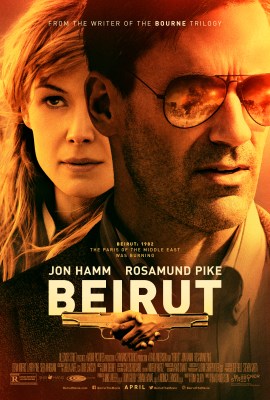
 “Thinking films” are far and few between, mostly because a small percentage of people take in a movie to be mentally challenged. However, those who kept their mind active during Dunkirk were well rewarded. And, with a bit less effort, many enjoyed Gary Oldman’s brilliant Oscar winning performance in The Darkest Hour.
The next installment of thinking films has arrived for this weekend in the movie Beirut. It’s a fascinating historical picture about several different countries and factions leveraging people and circumstances. They all share common goals of leaning the outcome of the war in their favor, not for justice or humanitarian ideals, but for selfish reasons that include revenge and the control of power.
The simple event is so entangled in the quagmire of jargon and hard-to-follow gibberish that the story seems far more complex than it is. If you’re able to follow the key plot points, you’ll realize that there wasn’t much of a story worth telling. On the other hand, if you were not able to sort through the bad accents and the dingy sets that all looked alike, the picture would seem far more complex.
The compelling situations that brought shock and awe to the American public during the Reagan years were not well captured in the film. The political intrigue was also left out, with the exception of a couple of interesting scenes suggesting how allies might have taken advantage of each other for their own gain.
But the interesting chess-like battle for information between the Palestinians, Israelis, and Americans was not handled well. Nor did the film reference or make use of additional political intrigue surrounding the multinational troops from France and Italy.
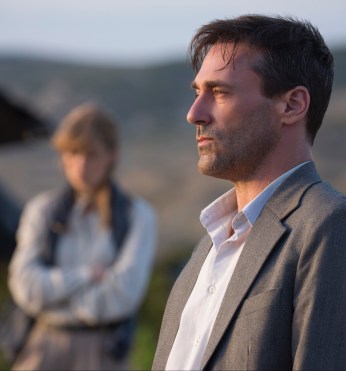 The story focuses on a former U.S. diplomat (Jon Hamm of Mad Men and Baby Driver) being sucked in by CIA operatives (Rosamund Pike of Gone Girl and Hostiles, and Dean Norris of Breaking Bad and Under the Dome) to return to Beirut and negotiate for the life of a friend he left behind.
The quasi-historical story was written by Tony Gilroy (The Bourne Identity, Michael Clayton). “At the time, Beirut was a hot topic because Tom Friedman’s book From Beirut to Jerusalem had just come out,” said Gilroy. “We wanted to put a negotiator in a historical setting where it could feel true to life without actually being a true story.”
Most of Gilroy’s fictional script was built around the 1984 kidnapping of CIA Station Chief William Buckley. “For me, that was very much the model for what would happen if a high-level CIA officer were kidnapped,” Gilroy said. “Buckley’s body actually turned up just as I was finishing the script, and there was a lot of reporting about that case that I drew on. It was all very garish and gothic and horrifying and dramatic.”
Unfortunately, Director Brad Anderson (The Machinist, Transsiberian) didn’t understand the realities of the horrifying, dramatic historical events, and it shows. “I was very taken by the world of Tony’s story. I frankly didn’t know very much about Beirut, so for me it was more the character elements that drew me in,” Anderson said. “I was fascinated with Mason (Jon Hamm) as this tortured soul who’s trying to redeem himself by saving his friend.”
 Not all veteran indie film writer-directors are able to express reality-based stories in a way that helps the audience experience or relive the historical moments. Anderson failed miserably at visualizing Gilroy’s fictional account, boring the veteran sitting one row in front of me. He actually pulled out his cell phone and engaged in 5-10 minutes of texting.
As for being spellbound by the characters that Anderson suggested drove the film, I found Hamm’s character to be flat and one dimensional. While Pike gave a great performance, her character was also limited, mostly by too little screen time.
For those who love political intrigue and deep thinking films, this one is a pass in my book. Even with thin character development, Hamm and Pike fans will not be disappointed in their performances, but they’ll have to keep in mind that the script and director tied their hands.
Copyright © 2018 by CJ powers

 Later in life I’d hear Hannah Brencher share about how our voice, as a writer or filmmaker, is birthed in our experiences and emotions. Brencher said, “Live and then write it down.” It’s such a simple activity that develops our voice, yet it’s all too often overlooked.
  CJ's Corner