
Directing at Age Four

Fear and trembling shot through my veins as my mother and I walked into the dentist office. At age four, it was the scariest place that I had ever been. I could never get used to visiting a location that created pain in the name of health. But, all I had to do was sit patiently in the waiting room until my mom’s teeth were evaluated.

While I wasn’t the type of person to sit still, a book about TV production fascinated me. I had no idea what was written in the book, but I could tell from the pictures that they used three cameras, a director and talent. The on-camera personalities sat on a small stage or platform under cool looking lights. The cameras were numbered so the director could pick which one went live during the production.
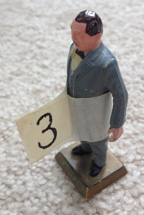
President_StatueWhen I got home, I ran up to my room and got some of the Jewel-Osco president collectables. They were miniatures of each president standing in a regal pose. I put a piece of masking tape around the belly of three that looked like cameramen and numbered them. Then I took a few other presidents and put them on a little platform made from a book and positioned Andrew Jackson to direct. I played for hours setting up various shots.

My imagination ran wild, as I pretended to make a feature film. While I don’t remember the exact story, I do recall that the cop story was intense, as the detective cornered two suspects.

“Mr. Bellagio, where were you during the night of October 31st?” asked the detective.

“I was with the dame from the all night pub.”

The detective slowly circled him, as camera 3 pushed in on a close-up.

“So, you say you’re innocent, but I can prove that I’ve caught you red handed.”

Trixie quickly turned toward the detective and confessed, “I was with Mr. Bellagio all night, even when we visited that dame. He couldn’t have stolen the cash.”

Camera 2 dollied in to a tight shot of Trixie, revealing her increased pulse. She was hiding something.

“There is only one way for me to prove you’re guilty.” Camera 1 set on a two shot. “Will you submit to a simple test?”

“Maybe,” quipped Mr. Bellagio.

“First wash up,” the detective instructed, tossing him a dry towel. Camera 3 turned to follow Mr. Bellagio’s every move.

Mr. Bellagio stepped over to the wet bar and washed his hands. When he pulled them out of the water they glowed bright blue.

“Hey! What’s this sadistic magic you’ve performed on me?”

The detective clasped handcuffs on Mr. Bellagio as he explained. “The stolen money was laced with a dye that once wet, turns a florescent blue. So, I’ve caught you red handed… Thanks to blue ink.” Camera 2 swung wide.

The detective walked over to Trixie and held up a second pair of handcuffs. “It’s now time to cuff your accomplice.” Camera 1 pushed in for a tight shot of Trixie’s face. She swallowed hard.

“Oh no, Mr. Detective, sir. I remember now that I was with Mr. Bellagio on a different night.” Camera 3 zoomed in on the detective.

The detective smiled at her. “I’ll see you at the pub for a drink later.”

Trixie smiled and ran off.

A shout from the first floor told me it was time to put away my film team and head down stairs for supper. My dad was home for dinner and I couldn’t wait to tell him about the adventure I filmed. It was an awesome movie for a four-year-old’s imagination.


Copyright © 2013 by CJ Powers

Jennifer Lawrence’s Honest Style of Acting

I met Jennifer Lawrence at the Beverly Hills Hotel in 2007 at an award gala. She was there to promote her new TV series The Bill Engvall Show. At the time Jennifer was very innocent and enthusiastic. She was all excited about having landed the series, but didn’t know anything about it, except for who would play her siblings and that the show starred Bill Engvall.

Jennifer_LawrenceFlash forward to last month’s Oscar® ceremony and I saw a very different woman. Two Oscar® nominations and a win later, her approach to life was less innocent. After receiving her statue, Lawrence downed a quick shot and then was ushered into the pressroom for questions. She was very straightforward in her response to the press and had no reservations sharing what went through her mind when she stumbled up the steps on the way to receive her award. She simply stated, “A bad word that I can’t say. It starts with ‘F.’”

Some people who followed her career were startled by a loss of innocence. This loss is not limited to child actors who are forced to mature all too quickly, but can be seen in many who look at life honestly. The world of film is made up of such fakery that many within the industry loose track of reality. However, there is a positive aspect that comes from this sobering awareness of what is real, and that is the ability to create honesty in one’s performance.

Lawrence’s performance in Silver Lining Playbook was raw, real and inspired by a tough life surrounded by people living in denial. These types of people are easy to study from within the distorted world of the film industry. Since many churches attract hurting people, it too is a good place of observation for developing a character.

The ideal character, especially one that is worthy of winning an Oscar®, is one that can be portrayed honestly. Even the top acting schools in LA have shifted to teaching honest performance techniques. Developing this type of acting chops can only come from deep within the actor’s gut and experiences. In other words, people who have always had a golden life are not capable of giving an Oscar® winning performance.

This is not to suggest that we appreciate damaged people over healthy ones within the arena of performance, but depth of character or heart are essential to award winning performances. Even comedians draw humor from their personal pain.

There are three steps an actor can take to move her acting toward an honest award winning performance:

1. FIND A THREE DIMENSIONAL CHARACTER. The average Hollywood actor reviews, or has her team review, a couple dozen scripts every week in hopes of finding one character worth playing. All too often an actor will grab a script to keep busy or to work with someone in particular, resulting in a character that keeps her away from an award winning performance. The key is to find a character with depth, some form of paradox, and a drive that leads to a good story – All within the same script. Take out any one of these three factors and the character will be less than award winning regardless of the actor’s ability.

2. ACCEPT YOUR PERSONAL FLAW. To play a character with some sense of honesty the actor must draw from their personal flaws or troubles. The closer the character’s actions are to the actor’s flawed experience, the more honestly the actor can play the role. This requires vulnerability and a strong director to protect the actor’s performance.

3. SECRETLY USE A VULNERABLE MOMENT. The best way to use an actor’s vulnerable moment from life is by attaching it to the character, as if she had an identical secret moment. The more embarrassing or vulnerable the moment, the more easily the actor will be able to draw from her emotions for the performance. This energy is discerned by the camera and takes very little movement on the actor’s part to deliver. She can hold still, while exuding an amazing intensity of performance.

Drama becomes melodramatic when the actor isn’t able to connect her vulnerabilities to her performance. However, when the connection is made, the performance is honest, believable, and draws the audience into the character. This bond plays a major role during award season and Lawrence was able to make the connection, resulting in statues from The Academy Awards, Screen Actors Guild and The Golden Globes.

Copyright © 2013 by CJ Powers

VeggieTales: The Little House that Stood – Review

The latest installment in the VeggieTales series includes two fun stories The Little House that Stood and The Good Egg of Gooseville, separated by a new Silly Song: Happy Tooth Day. The program is about 45 minutes long and is ideal for young children and older VeggieTales fans.

Little_House_that_Stood

The first story is about three little pigs that stroll into town looking for building contractors. One contractor has a plan and the other two are clueless. Similar to the Three Little Pigs nursery rhyme, there are three different houses built. Larry builds with hay, Mr. Lunt with bricks, and Bob follows plans from the Master Builder’s Handbook.

The story explores biblical references to building a house on the rock instead of sand. Bob starts building his house with a firm foundation according the Master Builder’s Handbook. The other two just throw their buildings together in a very precarious manner. While adults will know the outcome several minutes in advance, the humorous gags and animation will keep younger kids engaged.

The DVD has chapter stops so the two programs can be viewed one at a time, or the viewer can jump back to the Silly Song as often as they would like. There is also a free study guide available for small groups or families to share with their children. It is simple to use and includes several Bible verses for review and discussion. Coloring sheets are also available for free downloading.

Over all, the entertainment value is high and the Biblical principles ideal for families. In addition, the creative approach and artistic style makes the programs enjoyable for all ages. The DVD releases Tuesday, March 5, 2013 to numerous outlets with bargain prices at WalMart and Christianbook.com.

Disclosure of Material Connection: I received one or more of the products or services mentioned above for free in hopes that I would mention it on my blog. Regardless, I only recommend products or services I use personally and believe will be good for my readers. I am disclosing this in accordance with the Federal Trade Commission’s 16 CFR, Part 255: “Guides Concerning the Use of Endorsements and Testimonials in Advertising.”