 At the end of last week I was asked two questions about working on creative teams:
1. What has been your experience with creative teams?
2. What has been the dynamic of those that have worked and those that didn’t?
A smile came to my face as I remembered all of the great story elements created in the collaboration process. Then I also remembered the terrible failures that killed projects before they took off. The differences were clear, so I decided to share my views in this blog.
PRACTICES THAT DESTROY
1. Creatives wanting to be heard without first understanding others.
When I was wet behind the ears, I directed a documentary for WGN about the 1st Infantry Division that included soldier interviews from World War I and II, Korean War, Vietnam, The Gulf War and Desert Storm. The footage captured was priceless and included Captain Joseph T. Dawson sharing how God revealed a path (Historically named Dawson’s Ridge) for him to move his men off of Omaha Beach, take out the bunker and spare hundreds of soldiers that were being massacred.
Dawson’s humility, patriotism and love of God and country was clear. But, one of the producers that hired me was an advocate of separating anything about God from facts about our country – Never mind that our country was founded on religious freedom. The producer refused to hear any opposing views or test the heartfelt interview with an audience. This resulted in a dull segment that watered down the miracle to happenstance. The decision took the life out of the phenomenal testimony.
2. Creatives fighting for something the team already killed.
I was on the development team for Myst Entertainment where the goal was to create a feature film from an author’s book idea. One of the key elements from the original story not only demonstrated the author’s expertise, but it also revealed his strengths as a historian. While this key element was critical to the book, it was not visual and would flop on screen. The team agreed to replace the element with something more physical.
Nothing could zap the energy out of the room more than a passionate author fighting to maintain the integrity of his story when it simply wouldn’t work in the medium. What made the moment more difficult was that we all respected his literary brilliance, but had to stand firm on our visual knowledge.
3. Creatives not staying on Vision.
I was brought on to direct and co-produce a family adventure film titled Legend of the Lightstone. The writer created a brilliant story that was family friendly and held the attention of all ages. When I shared the script with Industrial Light and Magic in order to discuss the visual effects, the ILM creative team got so excited that they storyboarded the climax to sell us on being a part of the film.
In the meantime, the writer rented a BMW convertible and cruised several of the studios in California. His pitch was spot on and he had several luncheons with top executives all wanting the story. However, each studio wanted minor changes that transformed his excellence into a weak script. ILM dropped out of the project and so did I.
4. Creatives playing politics.
I’ve been a part of several webisode development teams, but none have survived long enough to produce a high quality pilot. A particular show fell apart because one of the five member creative team played politics to conform the story to his social agenda instead of supporting the emerging story.
Creating story is an organic process that when forced produces a poor outcome. Whenever a person plays politics to get others to side with his decisions, the story takes on an agenda and loses its realism. The end result is never universally marketable and greatly reduces the potential audience.
PRACTICES THAT ENHANCE
1. Creatives understanding and working with the original vision.
I remember working on A Fighting Chance with my 1st Assistant Director just coming off The Bird Cage and my DP just coming off the K9 Cop series. Both men were not only masters of their craft, but they listened attentively to my vision and gave me exactly what I was looking for. It was an amazing experience to see the film match what was in my mind – A rare occurrence.
What was even more powerful was how they helped conform the set, cast and visuals to match the emotional pattern I was hoping to achieve. Their efforts made it possible for me to win several awards for best directing. The collaboration was impressive, as they would make suggestions based solely on my vision – No added agendas.
2. Creatives heeding the Visionary’s final say.
The visionary differs between visual media. In theater it’s the playwright. In television it’s the producer. And, in film it’s the director. In each case the visionary gets the first and last say, while hopefully reaping the creative input of his team in between. When a standstill is hit, the final say goes to the visionary and everyone works to that end.
Tired & True was a labor of love. It was the first story that I was a part of that was designed for Millennials. As the director, I got the final rewrite of the script and could draw from my personal experiences with the younger generation. The head writer voiced his concern for a couple of my changes, but willingly accepted my final decision. I always appreciate the writer who can present a counter argument for consideration, while not kicking a dead horse. In my mind it’s the only way to make sure the film is at its best.
3. Creatives mastering their craft.
Everyone on the team needs to be an expert at something or it becomes too easy to become a yes man. Just as muscles get bigger and better when exerted against weights, the creative team pushes themselves to excellence through the respectful mashing of ideas. But for this to work, each person needs to be respected as an expert.
I shot a television commercial with a sales guru. He knew little about visuals and motion, but was an expert on what causes someone to say yes at the point of purchase. His expertise coupled with mine caused the final commercial to outsell all previous versions. Had we not respected each other’s expertise, the commercial would have been just another spot.
4. Creatives putting story first and their ideas second.
All creatives want to see the show overtly reflect their creativity or is at least birthed from their idea. However, the organic process typically merges ideas into something new and special that can’t be segmented without a critical eye. It’s like seeing your wife and yourself in your kid, but wanting the ‘you’ part of them to shine more.
I asked the Tried & True development team to come up with a unique set piece that would demonstrate the protagonist’s passion to out do his father, while getting closer to his love interest. The head writer came up with an adventurous scene that had a moose smash a car into the forest guard rails, putting the two leads in jeopardy with a rescue helicopter overhead. We kept the moose, the forest and the helicopter, but changed the cinematic scene into a hunt at a Renaissance fundraiser for the law school – One of the most memorable scenes in the movie.
Overall, collaboration is a great tool when done with people who are more into story than themselves. They need to understand their role in the process and yield to the final decision maker for the story to be at its best. Any attempt to spare one’s own ideas results in the story failing. And, when the story doesn’t include all involved, then it too seems to flop.
I should also mention that this must take place within a reasonable amount of time. Whenever the process goes too long, all suffer for a lack of continuity or a weak vision. A professional approach with everyone staying on task and verbalizing their ideas is the best way to achieve a universal story that works across many people groups.
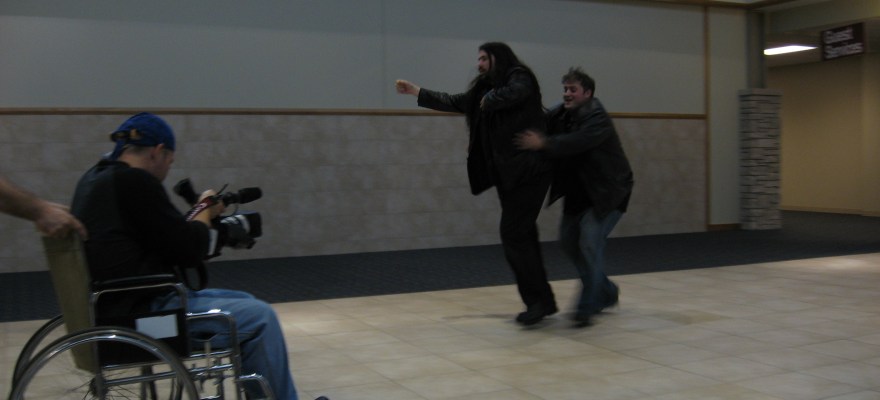
 The actors did a great job and we were ahead of schedule. It was time to move inside our location when the DP asked if his team could shoot a dolly running shot. The coverage wasn’t needed, but I always liked exploring other shots after we fulfill the preplanned list, so I gave him the approval and moved the rest of the cast and crew inside.


 CJ's Corner