
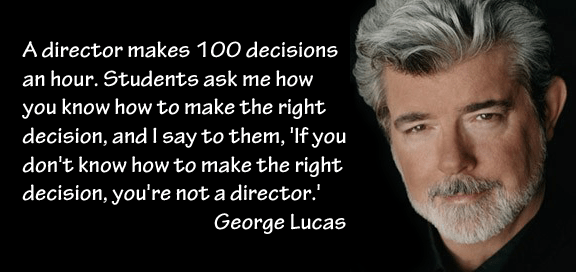
Rookie Director Misses the Obvious

George_Lucas

I had fun last Friday cutting together a two-minute promo piece for a new director I’m mentoring. He had three days of shooting that went into his opening sequence, but came up short of the specific shots needed to tell his story in his way. Whether certain key shots were out of focus or the actor gave him the opposite of what he requested, there wasn’t enough of the right footage to conform the sequence to the screenplay.

The fun I had in that hour came from my experimentation. I cut together the existing footage in the only way possible to create story – A significantly different story than what he intended. He was mildly shocked to see his shots cut into a variation of what he planned and immediately noticed how the changes rendered his act three obsolete.

The observation of the new sequence immediately caused missing shots to pop into his mind and ideas of how to get the actors to perform in keeping with the story, rather than facilitating their adlib. He also realized that because he was missing key shots, it would require a half-day of pick up shots and an additional half-day of capturing coverage shots.

The rookie director missed what pros would consider obvious. Whenever I put together a shoot for a given scene, I note the critical elements that must be captured and the possible coverage shots needed for the film to be cut together properly. Rookies typically miss transitions, set-ups, coverage, and even reaction shots.

A prepared director knows in advance what everyone on set will be doing to achieve his vision, while rookies have a general sense of what they want and might not know how to request or obtain it. The average rookie director comes to the set 10% prepared for the shoot.

The director who owns his vision typically has four large three ring notebooks of prep material for act 1, 2A, 2B, and 3. The rookie typically has a pocket of notes scratched out on a few pieces of paper. That’s not to say that pros won’t keep a lot of the info in heir heads, they do, but experts won’t risk missing anything that they’ve planned – They’ll have their materials on hand to double check everything before moving to the next set-up.

My suggestion for the rookie was, “Think coverage.” He had a great concept and a good story that relied on the audience buying into a character change happening within 5-8 minutes, which requires the audience to suspend disbelief. If he’s able to convince the audience to believe in his created world in the first two minutes, his story will have a chance at pulling off his fast character change – something that features take two hours to achieve.

By thinking coverage, or all the possible shots of the protagonist’s surroundings and relationships, he could capture enough expressible footage to forward the story and compress the time frame in a realistic manner. This would be a huge challenge for the most expressive directors and will be a great learning experience for the newbie. You’ve gotta admire him swinging for the wall on his first picture.

Coverage shots help keeps the story moving. It allows for time compression and gives the director plenty to work with when he has to drop an out of focus shot or poorly acted one. Coverage can also introduce more artistic license into a film, giving the audience a more believable world to experience.

Coverage, coverage, coverage! So, directors must know what they want, pull it together in three segments known as the beginning, middle and end, and shoot it with lots of coverage. Then, the rookie will look more like a pro even if he still only has three wrinkled pieces of paper in his back pocket.

Copyright © 2015 by CJ Powers

The Snow Perspective

The Wonders of Fresh Fallen SnowThis weekend will be the first Chicago snow and some shudder at the thought. Not because 6-8 inches makes life difficult in the windy city, it doesn’t, the problem is that the crazies decide they can drive like normal. They forget to alter their perspective to match the circumstances.

I’ll never forget my winter travels in San Antonio, Texas in 2006. I was the only one zipping down the highway to the office. I wondered if I had missed the rapture or if aliens had vaporized the city before my arrival. But neither were the case. The city shut down due to the “snow storm,” which by Chicago standards was a light dusting.

The contrast in perspective amazed me. Snow carries different value for skiers than the elderly. Some people choose to see the snow as a deterrent. They hunker down for a long cold winter and hardly move – Dropping their blood flow, which makes them feel even colder. But that isn’t enough tradition for them, as they must warn their family about the severity of winter that demands respect and great care.

I see snow in a positive light. Thanksgiving is always more special when snow is on the ground. It sets the perfect atmosphere for outdoor fun and indoor coziness. Most years I kick off Thanksgiving Day with a flag football game. Depending on travels, I pop in for a church service with a message on gratitude. The afternoon is filled with lots of food, family and fun. And, most evenings after all has settled, I make a trip to the movie theater to close out a great day.

Perspective is a choice that we make daily.

This morning I saw my granddaughter come around the corner to the dinning room where I ate breakfast. We instantly shared a warm smile. It was a new fresh day and the cranky sleep deprived child (due to her recent activity of waking up between 5-6 a.m.) who threw a fit the night before was consumed by a great night’s rest and a new hope for today. I too awoke with new graces facing me this morning and shared my first smile, which was returned with joy.

She and I chose to start the day with a fresh happy perspective and looked forward to each item on our agenda. She headed off to spend time with friends and I sat down to share a blog post with you – A great start to a wonderful day of possibilities.

A text message interrupted my thoughts…

“The place God calls you to is the place where your deep gladness and the world’s deep hunger meet.” Frederick Buechner

I don’t know anything about Mr. Buechner, but I can tell you he has a positive perspective based on a philosophy I hold dear. I’m convinced our passion drives us to action, which blesses those who need a touch – The exact kind of touch that comes from the essence of us being who we are. When we stop pretending to be something we’re not, we unleash a miracle. For a time, life is as it was designed to be before man messed it up.

Every snowflake is different than any that came before it. When the first snowflake touches my outstretched tongue tonight, I will adjust my perspective to make sure I am who I’m supposed to be and bless others by being me. I hope you do the same and reflect on this unique miracle come Thanksgiving Day.

Copyright © 2015 by CJ Powers

Filmmaking is an Artistic Lifestyle

Set on Sound StageBeing artistic means numerous things, but most consistently it reveals a single truth about the artist — He sees life differently than most. All artists, especially filmmakers, see life from a unique perspective based on daily observations of the human condition. This continuous attack on his senses drives him to express what he sees in hope of awakening the public to a life of greater insights and happier living. He is driven to peel back the irony and reveal the redemptive kingdom at hand.

Crucial to this passion is the filmmaker’s lifestyle that is filled with art on a daily basis. He is not able to function unless he addresses certain aspects of his art every day. In fact, he is forced by his own passion to find a way of incorporating film into his lifestyle, as no artist is able to set his art to the side on any given day. His very being is wired for artistic expression, but more earnestly he is compelled to observe what must be brought to society’s attention.

The artist is to be pitied and exalted. Pitied because he can never turn off his drive to observe the human condition and exalted because he must share his passionate findings with those around him. He is trapped and blessed to see the reality of society and struggles to express the human condition in a way that all people will take note and assertively address the issues portrayed within their own life — Raising the human condition toward enlightenment in the realms of the physical, mental, emotional and spiritual aspects of humankind.

But how does this happen?

Filmmakers have an eye for the Aristotelian tenet that all good stories have a beginning, middle and end. The beginning is the backstory or set up and is easily presented along with new characters and their situation. The ending is simply the fulfillment of the set up. It’s the middle that determines the artistry of the filmmaker and his ability to “sell” the audience on his view of the human condition and the answers he’s observed.

In other words, the entire film is an argument that brings an awareness to the audience and persuades them to consider the answers the filmmaker found. If embraced, the audience will rise from the depths of the human condition to something more profound and alive. They will move from a sorrowful state of sin, loss, or loneliness to a redemptive level of love, hope and faith.

The artist lays out the middle of the story in beats. Not in a rule oriented way, but in a way that the audience understands the distinct steps or premise of the argument and how they’re connected to each other. The filmmaker then carefully walks the audience through the argument in a logical process, giving the pros and the cons, in order to squash mental and emotional objections, while inspiring the consideration of the redemptive answer.

Filmmakers that don’t follow these century old standards, to enlighten their audience about the human condition and point them toward answers, are not true artists. Instead they are guys with a camera and cool ideas who have no understanding on how to open the eyes of the audience to new insights and point them to the right solution filled with hope and inspiration.

The Kendrick Brother’s “War Room” came up in conversation last night. My daughter-in-law heard from her friends that it was a really good movie. The artist in me cringed, as the story is a preaching tool to inspire people to pray, not a piece of art.

How can I tell its not art?

First, the middle of the film doesn’t walk the audience through the arguments associated with prayer. An artistic version of the film would have explored what happens when prayer fails. Further exploration might have touched on how to work through weeks of travailing prayer followed by it being unanswered. Another argument would’ve looked at our response to prayer regardless of it being fulfilled or not. This idea might then be extrapolated into whether or not someone is more or less spiritual based on the number or size of their answered prayers compared to others.

It takes a well crafted artistic screenplay to entwine these issues into a two hour argument that helps people to pray regardless of their circumstances or results.

Second, the Kendricks admit they aren’t making films for the general public. They are specifically addressing people who already know the arguments and just need encouragement to take action. In the vernacular, they’re preaching to the choir. This makes a lot of sense when you consider that Alex and Stephen are first and foremost pastors — Another “career” that is not a career, but a lifestyle.

Third, their stories focus on good people becoming better people, while artists focus on the messy human condition and salt in the redemptive silver lining available to all who seek it. I would be shocked if a Kendrick Brothers picture ever showed the darkness of sin in its true form. They would certainly allude to it, but their focus would be on the light to make sure they never cause someone to stumble.

A true artist, on the other hand, has observed that everyone has already fallen short of the the glory of God and no one can become more of a sinner than they already are. Your life is either stained or not. The amount of stain makes no difference on a person’s position in life concerning their redemptive value. Someone either pays a price to redeem them or they do not. The amount of stain doesn’t matters.

The artist therefore reflects reality in their film hoping that the person watching will see the truth of their situation and consider the argument unfolding in the middle of the story. This acknowledgement of ones own corruption or messy human condition is the first step in a person being open to seeking some form of redemption and the new life that it brings. Without the truthful display of the human condition, no audience will ever have a reason to buy into a redemptive solution they don’t perceive is needed.

These profound differences between preachers who make a film and artists are polarizing. It’s no wonder that Hollywood can’t stand what the Kendrick Brothers produce. And, it becomes clear why those who follow the Kendricks have a hard time watching great redemptive films that reveal the truth about the human condition like Les Miserables, Captain America: The Winter Soldier, and The Man in the Iron Mask.

When the dust settles on the differences, the artist is still compelled to open the audience’s eyes to the human condition and passionately argue their need for a redemptive solution. He has no choice. The artist is wired that way. He must share what he’s observed and point the culture toward a redemptive solution at all cost. The artist must be who he is — That weird person with a unique perspective that can change cultures across the globe with one compelling well crafted story.

Copyright © 2015 by CJ Powers