
Make a Short vs. Find an Angel

Is the key a short film that goes viral? Or, and angel who can fund a money making project?

Over the past five years I’ve chatted with 2,000 plus beginning filmmakers who are confident that if they create the right short film, it will open up doors of incredible opportunity. I’ve recently talked with scholars who also think the right short film would launch a career. A few friends have also suggested that a stirring short film might re-launch me back into the industry.

The truth of the matter is that out of the 4,000 plus filmmakers that followed my writings in various ezines, and the 16,000 writers who read my screenwriting column, none of them had a short film launch their career. In fact, out of the 100,000 plus filmmakers attempting to make their mark over the past five years, only two got a shot in Hollywood based on their short film. The one’s first project crashed and burned and brought demise to his career. The other’s career was launched with budgets he had no idea how to manage.

In the meantime, several dozen filmmakers launched new programs into the peripheral market and have found enough success to live off of it. They have started to build an audience and make enough money to make additional projects, while living off of its revenue. In my mind, these are the people who have found success.

Unfortunately, few people are able to enter the market at this lower level without some angel providing a break for them. Each one that I’ve talked with found someone to believe in them enough to front anywhere from $25-$125,000. These filmmakers also relied heavily on the team approach and pulled together the people needed to make the film.

This is the exact opposite of the going trend. Numerous people are suggesting that filmmaking is becoming an individual based process where one extremely talented person runs the whole show, especially in the area of short films. But the proof still resides with those who team together and create a mini or macro studio to make productions outside of the Hollywood system.

The last time I was at a film convention, I bumped into hundreds of arrogant filmmakers who all had extreme talent in one area and mediocre talent in other areas. I suggested that some of them get together to merge their talents and blow everyone away in the following year with an exceptional film that utilizes everyone’s expertise. They all looked at me like I was nuts, as they were each other’s competitors and would never stoop to such a ghastly thought.

I heard from a few friends that the last convention saw weaker films than the previous year. The quality of production and story had dropped. Few of the “competitors” were able to out do their previous attempts. This resulted in several of the filmmakers changing their life direction – All because they wouldn’t lower themselves to partner with other experts.

Those sharing the mentality that an individual filmmaker must make it on their own, see the drop off as a weeding out process that sifts out the real filmmakers. The odd thing is that most of those who gave up had more talent than those who stuck it out. Its sad to realize that the mediocre are now driving parts of the industry that used to be a collaborative art form for master craftsmen.

So, what are your thoughts? Should filmmakers keep on making shorts in hopes of being discovered or should they create a project that can make them enough money to live off of their art form?

Copyright © 2011 By CJ Powers

The Angle of Story

In talking with numerous filmmakers, preachers and teachers, I’ve found that all of them have some form of a story to share. They are filled with ideas that will help guide individuals down a recommended path in life and consider things and issues they may have never taken time to address had it not been for their story. But I find one thing perplexing about these master storytellers that most have in common, they typically tell the first version of the story they come up with.

Every valuable story has a right to be shared, but not every perspective on that story will yield the greatest benefit for the viewer or reader. Exploring multiple angles on the same story might open the eyes of its author to key subtleties or nuances that will leverage an emotion or touch a chord in the audiences’ life, empowering them to change.

Playing around with various perspectives or angles on a story takes significant work and shifts the author’s perspective from enjoying their own cool story to making sure the audience in directly benefiting from having heard or seen it. It’s all about taking the audience on a trip to consider an “argument” that stirs their souls and engages their minds.

Unfortunately, our society is geared toward massive amounts of information, compared to one or two high quality products. Authors are forced to make choices that generate a living, over creating a story that changes the way an entire generation thinks. Today, sheer quantity dominates quality. That’s not to say there aren’t a few new thoughts out there, but few are releasing products of any consequence.

I’ve been working on and off with a feature film script titled “Steele Blue.” It started out as an action film because I was in the mood to write some cool action sequences. There was little story involved, as it was an action romp. Then a friend asked me some questions about the characters and as I explained who they were, my friend was fascinated and wanted to know more. I changed the script to bring out those characteristics that were intriguing.

This led to another rewrite, as some of the scenes weren’t conducive to drawing out the key points of the characters. It forced me to shift from an action film to the genre of adventure. Once there, the characters came to life and others were intrigued by, not only the characters, but by certain curious items I alluded to in their relationships.

Another set of rewrites was engaged to explore the relationships that perked the interest. In doing so, I found that the story would be better served as a drama. After choosing to focus more on the heart of one character and exploring what her decisions would be in unique circumstances, I shifted the drama to include some comedy, adventure and a few thrills.

The story is still the same, but its told from such a significantly different angle of interest that I can’t wait to see the audiences’ reaction. To wet your whistle a bit, the story is about a maverick detective who hits the streets to protect her teenage son from the drug lord she’s falling in love with. The key question the action plot raises is whether or not she’ll get her man as a cop or a lover.

Had I not explored the various angles on how to tell the story, I would never have come up with the inner conflict that the main character faces. Its an intriguing question about the choices we make. Will it be a choice of doing what feels right or the more difficult choice of doing what is right? That is the question every one of us face in our society today. And, my choice is to tell this new version of the story and see what types of future choices the audience makes.

By taking a look at the same story from different characters or perspectives, opens the writer up to numerous creative opportunities to create a story that has never been done before. It also allows the writer to explore life issues that can only be handled indirectly without offense. This allows the audience to stretch their thinking and find new ways to grow who they are. All of these pros make for a great story and outcome.

Copyright © 2011 By CJ Powers
Photo © janaka Dharmasena – Fotolia.com

Set Pieces are the Latest Movie Tool

Gaffers, Best Boys and Set Pieces are terms unique to the film industry. Over the decades we learned that a Gaffer is the Chief Lighting Director or the Head Electrician, and a Best Boy is an assistant to either the Chief Electrician or the Key Grip (Head of the Grip department). But “Set Pieces,” we thought were a piece of stage scenery.

Set pieces are scenes that are designed to have an obvious imposing effect on the audience. They are the scenes in a film that are ideal for trailers. They are also the scenes that stand out and say this film is unique and special. When done correctly, they are the scenes that everyone remembers and creates a buzz about, driving more people to the movie.

Just about every movie is made up of Shakespeare’s three-act structure. Because films tended to die in the long second act, which is about half the length of a typical film, screenwriters split the second act into two segments: 2A and 2B. This was a natural decision as directors constantly wanted to do something special at the midpoint in the film.

Getting an entire industry to split the second act and use four segments within every film wasn’t difficult since the industry was used to films being delivered in eight 20-minute reels. These 20-minute reels had long ago driven stories to flow in sequences due to the projectionists having to physically change reels.

While the three-act structure is now written in four segments, each including two sequences, the responsibility is on the screenwriter to make sure the format doesn’t make the story boring. Thus, set pieces entered the picture.

Movies require a minimum of three set pieces to capture the audience. Some use four due to the split second act, while others try to have one set piece in every sequence. Today, there doesn’t seem to be any preset requirement due to the ever-changing variety of set pieces, level of creativity, and amount of budget.

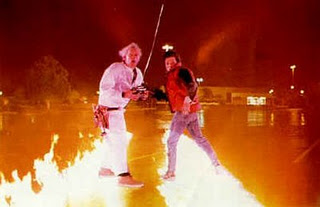
A strong set piece lasts the test of time. Many will remember the light saber battle between Darth and Obi-wan Kenobi. Another iconic set piece was the scene where Indiana Jones runs away from the giant boulder. I’ll never forget the DeLorean racing across the wet mall parking lot and seeing it vanish into a pair of fire trails in Back to the Future.

Set pieces distinguish a film and drive the buzz that skyrockets a title to success. Unfortunately, few screenwriters create such scenes, as it takes a significant amount of time to develop and a vast amount of creativity. For these various reasons, spec scriptwriters rarely write iconic set pieces. However, when they do, numerous contracts follow – Something every screenwriter should consider.

Copyright © 2011 By CJ Powers