
Creatives Are Driven To Live

OklahomaBill Hybels, a legendary spiritual leader, once talked about a “holy discontentment” and how it drives the spiritual to continually look for ways to help others. Choreographer Martha Graham spoke of an artist’s “divine dissatisfaction” that drives all creative work.

Prose writer Rachel Carson also spoke of this unrest that leads to creative activity, “No writer can stand still. He continues to create or he perishes. Each task completed carries its own obligation to go on to something new.”

Dancer and choreographer Agnes De Mille, known for her original choreography in Oklahoma!, a musical that generated numerous awards including a record setting 2,212 performances, found herself struggling with her “fairly good work” when critics touted it as a “flamboyant success.”

De Mille received clarity concerning this disconnect in her life when she bumped into Graham and shared her sense of dissatisfaction. De Mille started the conversation with a confession that she had a burning desire to be excellent, but had no faith to achieve it.

Graham: “There is vitality, a life force, an energy, a quickening that is translated through you into action, and because there is only one you in all of time, this expression is unique. And if you block it, it will never exist through any other medium and it will be lost. The world will not have it. It is not your business to determine how good it is, nor how valuable, nor how it compares with other expressions. It is your business to keep it yours clearly and directly, to keep the channel open. You do not even have to believe in yourself or your work. You have to keep yourself open and aware to the urges that motivate you. Keep the channel open. As for you, Agnes, you have so far used about one-third of your talent.”

De Mille: “But, when I see my work, I take for granted what other people value in it. I see only its ineptitude, inorganic flaws, and crudities. I am not pleased or satisfied.”

Graham: “No artist is pleased.”

De Mille: “But then there is no satisfaction?”

Graham: “No satisfaction whatever at any time, there is only queer divine dissatisfaction, a blessed unrest that keeps us marching and makes us more alive than the others.”

Graham and Hybels had hit on something fascinating. Both saw the activity rising from creative discontentment as divinely inspired for the good of others. While artists long for satisfaction with their work, the blessed only receive a drive to move on to another work.

Julia Cameron, known as a artist, poet, playwright, novelist, filmmaker, composer, journalist and teacher, learned through her studies of the human condition that, “Art is a spiritual transaction. Artists are visionaries. We routinely practice a form of faith, seeing clearly and moving toward a creative goal that shimmers in the distance—often visible to us, but invisible to those around us.”

When I meditate on what I’ve observed, whether information from life or scripture, and many times the combination of both, I receive a divine awareness that helps me to understand a perspective that most have never considered. The excitement contained within the moment drives me to share it with others. But they don’t get it.

The only way for people to understand what I’ve seen is to create art that can demonstrate it or move a person to consider something outside of their reality. It therefore compels me to create art, always hoping it reaches the people it was intended to reach.

This continual drive that most of my friends label as passion, breathes life into me daily. It forces me to try and try again so everyone gets the gift of understanding that I received, but my attempts always fall short. The cycle begins again and again. While I can’t complain because of the life that stirs within me, I am always dissatisfied in my feeble ability to communicate such an important understanding.

And there lies the truth of an artist’s dilemma. Filled with life overflowing, always driven, but never arriving with any form of satisfaction. I’ll call this curse a blessing for it is who I am.

© 2017 by CJ Powers


SaveSave

Creative Child’s Game Simplifies Value Decisions

How to Assign Value to Disparate Projects for Equal Consideration

Have you ever wanted to know which project to start next? Did you get frustrated comparing unrelated activities in an attempt to determine which provided the greatest value? The solution is as simple as a child’s game.

No, I’m not talking about a Six Sigma Pugh Concept Matrix to determine which potential alternative solution can more quickly and easily be engineered into a viable product for just-in-time manufacturing.

I’m talking about a simple game that boutique tech businesses use to prioritize projects by overall value.

It’s called a weighted decision matrix and its fun to use.

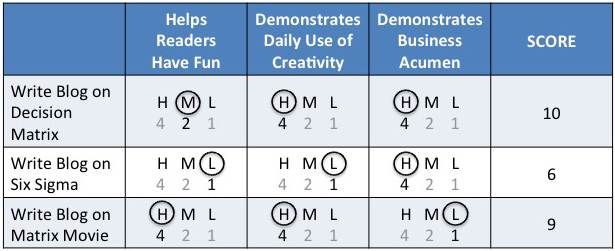
Picture a simple table with the name of the projects listed down the far left column. Across the top of each column is the criteria that you’ll use to measure a projects overall value. Where each project and column intersects are the letters H, M, and L. The far right column holds the total of the criteria scores for each project.

Slide1

STEP ONE:

Name each project in the first column. Name the criteria being considered at the top of each column.

The H M and L represent the importance level of the criteria for the project—giving it a high, medium or low level of importance for each particular criterion. Circle the level of importance that each project holds based on the given criteria.

Slide2


STEP TWO:

Give a value to each H, M and L. With less complex decisions I use the following values: H=4, M=2, and L=1. If the decision is more complex I use: H=9, M=3, and L=1. Then total the score by adding the values from each cell. The decision is obvious—I need to write a blog on Decision Matrix (see below table).

Slide3


But many times life is not so simple because some criteria are more important than others, which requires some form of weighting.

STEP THREE:

When criteria are not equal, a numeric value must be attached that will work as a multiplier. I use a 5-point scale to make sure each criteria receives its due credit or strength in the formula. However, when sorting through a large number of projects, I switch to a 10-point scale in order to pick up on the value of subtle nuances for each criterion.

In the below table I’ve given each criteria a numerical value. In the first cell the M was circled and is valued as a 2. I then multiply it with the weighted criterion value of 4 and get a new total cell value of 8. Each cell is added together for a total score of 40.

Slide4

The weighting has clarified what’s more important and shifted the score to a tie. In this case I would’ve been better off using the larger spread of values: H=9, M=3, and L=1 as in the below table. However, the scoring is so close that the decision of what blog to write had an original score of 10, shifted to a tie, followed by coming in second place (see below table).

Slide5

Here’s where the game gets tricky. You have to be totally honest with yourself whenever assigning values to what’s important. Deciding between H, M, L is pretty easy, but the choice is more difficult with a 5-point criteria value—even more tricky with a 10-point value.

In the table below I changed the weighted amount for the third criterion from 3 to 4. Why? Well, since most of my readers run families, small businesses and departments, I thought the category should hold a higher level of importance.

Slide6

Now look at what happened to the scores. The numbers made the decision very clear, but only because I was being truthful about the third column’s actual value of importance.

WARNING: As in all games that use numbers, a person can cheat to make things read anyway they want, which defeats the purpose of playing.

STEP 1A:

It’s important to use only the criteria that are truly important to a project. Extra criteria that’s not seriously weighted only complicates your decision making process.

If you’re an artist, consider some of these criteria:

• Passion Zone
• Stretch Comfort Levels
• Gain Knowledge
• Generate Money
• Advance Career
• Network Expansion
• Develop Skills
• Touch Lives
• Build Relationships
• Fun & Games

The above factors can all impact a decision for an artist deciding whether or not he or she is interested in signing on to a film project. Sometimes it’s worth doing if it expands your network or you can learn something significant from the experience. Other times making money is the number one weighted factor.

In business, other criteria might be considered like:

• Meets Objectives
• Forwards Career
• Meets Boss’ Bonus Requirements
• Generates Commission
• Creates Double Digit Growth

The above list can go on and on, but the idea is sound. Figuring out what criteria is important for the projects being considered helps change the decision from an aggravating dilemma to a child’s game that’s easy to solve with a quick hand written table or spreadsheet.

Members of different departments that make up a special team can also play this game. Each can add a few criteria to the table to make sure their area of expertise is well considered by the decision maker.

The biggest decision I faced was sorting through 11 projects with 32 criteria. Thankfully it was on an automated spreadsheet and the answers were quick and sound.

Let me know what other games or tools you use to decide which project should be next.

© 2017 by CJ Powers

Crisis Energy to Feed Stamina

Turning the Adrenaline Rush of a Disaster into Energy for the Solution

Years ago my company created art for a museum that had a specific deadline. Everything needed to be mounted and in place for the grand opening of the new display. The press was coming out in full force and the curator just hung up the phone after pushing me for a specific delivery time. He made it clear that I had 42 minutes left to deliver the final artwork.

Museum_PhotoI felt my muscles tighten and worried about the onset of a heart attack, even though I had no family history. The emotional drama within my body felt like a tsunami was collapsing all around me and I was unable to surface for a breath of air. The worst pressure came while I waited for the subcontractor to finish the arduous process of laminating the art to meet ultra high museum archival standards.

Everything around me started to waver and the room sounds dropped to a deafening quiet—I was passing out. I asked the person next to me if she would mind me lying down on the floor. She looked concerned and nodded a willing “yes.” I dropped to the floor, turned onto my back and wondered how I got in such a spot.

Staring up at the lights was a weird phenomenon, especially when I realized that there were four things that I could do to change my response to the circumstances.

Accept the Worst – Everyone who feels they are falling into an abyss of the unknown needs a solid baseline from which to start their recovery. By accepting the worst-case scenario that my imagination could realistically paint, I was able to stop the sense of pending doom. I no longer felt like I was in a free fall and could work on my choice of thoughts.

Change the Perspective – Turning the corner from a negative perspective to a positive one forces my feelings to follow. A small sense of glee rises when a person stops thinking about their cup of lemonade being half gone and decides to savor a second half-cup more of delight. The positive person can even pick up on how the second half of the drink tastes a tad sweeter due to the sugar settling over time.

Release the Rigid – Facts typically raise its ugly head the moment a person tries to see an opportunity in its best light. After all, we’re taught from an early age to think logically about the situation when a swift deadline appears to be statistically out of reach. The choice to turn the ridged facts into a moment of flexibility brings relief and experimentation—the very thing that fuels creativity and solutions.

Think Creatively – Taking advantage of the freedom found in flexibility energizes the creative soul to see the circumstances as an opportunity to be a hero. Once pulled off, the client will trust their vendor no matter how unrealistic the schedule. And, they’ll even be willing to pay higher dollars for “miracles” knowing the job will get done right and on time.

Strength surged through my bones as I stood up and brushed the dirt from my slacks. I suddenly had the stamina to complete the task and I was ready to be a hero. I had the opportunity to prove my team’s skills and commitment levels. Oddly enough, I also felt comfortable in the middle of the calamity.

Within seconds the subcontractor handed me the pieces of art and apologized for the delay. I thanked him and smiled when he handed me the invoice that read “No Charge.” He thanked me for the opportunity and asked that I consider his firm for future work.

I pulled into the customer’s loading dock and was met by specialists who care for archival quality art. They were ecstatic that the quality exceeded their requirements and worked diligently to install the new display.

The client pulled me to the side and apologized for the pressure he had placed on our team. He learned ten minutes prior that his boss gave an earlier deadline to avoid being embarrassed in front of the media.

I left with a large check that included a bonus. More importantly, I left more capable of managing my emotions based on choice, rather than arbitrary circumstances. And, I had learned how to turn crisis energy into the stamina necessary to complete a project in the midst of turmoil.

© 2017 by CJ Powers


SaveSave