
Breaking the Deterrents of Creativity

StripAll too often I hear someone say that they’re not creative, but I know it’s far from the truth when I see the cool ideas they generate. What they might mean is that they are too muddled down in their own habits to see life from a new perspective. Or, they are so regimented in their schooling, which was originally designed to train students for factory work, that they find it hard to break free of their rhythm in the name of progress.

The greatest deterrent to creativity is the discipline and habits that individuals form to fit into a logical society. However, our culture is now changing and requires creativity to survive, so its time to change gears and learn how to create and innovate. Here are three steps that a person can take to increase their creativity.

1. Break Habits. People talk about how ideas pop into their head while showering or doing anything mundane like eating breakfast. Those things do tend to happen when we first get up, but soon dissipate with the rigors of a work filled day. To counter the effects of habits we need to purposely change our life patterns.

By parking in a new space, sitting in a different place during a meeting, or walking a new way back to your office can fill your senses with new observations. The fresh experience will generate unfelt reactions, altered thinking, and a form of circumstantial genius that allows you to take in data that you’ve never considered before—all of which will fuel your creativity.

The above cartoon demonstrates the breaking of a habit. The ant that said, “A,” broke the habit of repetition. The ant that joined in, albeit skeptically, by saying, “B,” supported the change. Unfortunately, the next ant was confused because he didn’t focus on the unexpected.

2. Focus on the Unexpected. Boredom sets in when we find ourselves trapped in a reoccurring scenario day after day. When we focus on the unique or unexpected circumstance, we open our minds to consider new perspectives and ideas.

The person that focuses on the newfangled experience reenergizes their faculties of observation and creativity. This also opens the door to developing new patterns that can lead to success, especially when focused on the possibilities that come from the change.

Had the 7th ant focused on the change and said, “A,” the 8th ant would have most likely said, “B”—affecting permanent change. Unfortunately the focus on the change was missing, which encouraged the 8th ant to go back to the same boring, yet comfortable pattern as usual. Creativity lost its opportunity because the last ant wasn’t willing to live in the moment.

3. Live in the Moment. The person that drives to work at the exact same time and takes the same route rarely lives in the moment. The person who lives in the moment creates fresh opportunities and experiences a heightened sense of reality that feeds his or her creative soul. The new stimulus can help us capture information in a new and exciting manner.

The freshness from living in the moment is invigorating for positive people and fear ridden for those who see the cup as almost empty. Perspective plays a major role in the fear factor, which can paralyze those who seldom see the world through the eyes of hope.

The 5th ant above was living in the moment and made an exciting change. The 6th ant was also living in the moment, but was so uncomfortable with change that he questioned the new direction by dragging his proverbial feet. The 7th ant was perplexed and didn’t want to return to the old boring life, nor did he want to support the unknown. His ability to live in the moment wasn’t based on wonder, but instead based on fear.

These three steps allow our mind to meander and draw information from various memories in a new fresh way. Being purposeful in breaking old habits like the ones that no longer serve our vision, can open us up to an unforgettable adventure. By focusing on this change and paying attention to how it unfolds empowers us to turn the unexpected into a vision-boosting rocket. And, living in the moment helps us to steer change into a positive result.

While these three steps drive creativity, it’s our participation that determines success or fear formed failure. Embrace a positive mindset and start breaking habits today.
© 2017 by CJ Powers

Creativity—No More Corporate Box

Failures within the Fortune 1,000 world have become critical over the past ten years. To learn how to protect corporations from bad decisions, IBM polled 1,500 CEOs to learn the #1 leadership competency required to survive the future. The answer was “Creativity.”

Two years ago a dozen corporate futurists also stated that creativity was moved to the number one slot of the top ten skills list needed for advancement. Business analysts stated that the only growth companies were those that thrived in creative environments with innovators on staff.

The flurry of activity surrounding creativity in the corporate sector suggested that HR departments needed to set up creative training sessions, adjust hiring scripts and find ways to compensate those who created beneficial solutions. But hundreds of HR departments did nothing.

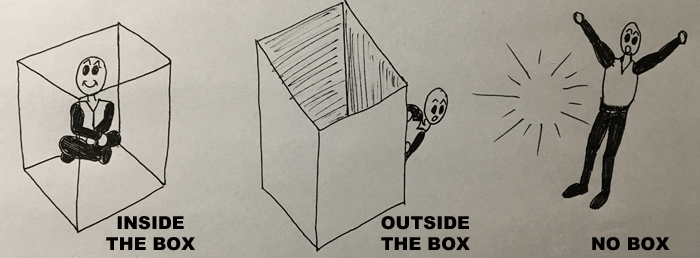
Over the years HR has become a science, while creativity remains an art form. It’s hard to scientifically measure the value of a creative to determine which one should be hired. It’s also difficult for a director, who was taught that people are supposed to work in the figurative box that the company made, to design a program that trains logical people to play in a box-less environment.

BOXsm

Corporations needed to build the box lifestyle for employees during the days of industry in America. By the time the personal computer was invented, corporations needed people who thought outside of the box. For our future, corporations need to hire people who don’t work, but play, not in or out of a box, but in a box-less environment.

And they don’t get it.

Who doesn’t get it?

Well, let’s start with SEARS or any other relator that is headed toward bankruptcy. The list is getting longer every year. Just think about SEARS having survived for 124 years both inside the box and outside of it, but now that a box no longer exists, the company has no clue how to survive. Some are guessing its doors will close during its 125-year anniversary.

I was once taught that business is always moving. If its not moving forward with growth, then it’s moving backwards with decline. A business is incapable of standing still. I was also taught that innovation (creativity) was the only thing that could grow a company exponentially. Creativity is movement.

The companies throughout history that disrupted their business market with new innovative solutions always captured 40-90% of the market and forced all other competitors to share the leftovers.

The fact that progress is impossible without change stumps numerous leaders. But a creative knows that change is inevitable and chooses to create the change rather than worrying about what may or may not take place by the hand of others.

Creatives are the leaders of our cultural future.

© 2017 by CJ Powers

The Misunderstood Creative (pt. 2)

part2(Click Here To Read Part One)

The creative is misunderstood no matter how hard they try to temporarily fit into society. Some think its because they live 5-10 years ahead of everyone else. Others think it’s their unique wiring that gets them in trouble with the logical ones in life. Regardless of the arguments, its better to learn how to understand the creative rather than pointing out their differences as being weird.

Here are some insights that would help the cause of understanding.

6. They Feel Deeply. It’s not possible to create something of great meaning without first experience the depths of the idea to an even greater depth than would be expected. The creative feels everything more deeply than others so they can feel and understand the emotional tug that must be placed within their art.

Many creative people have well intact memories of their deepest experiences that can be drawn from. Those writing about despair are capable of reliving their darkest moments in order to get the flavor of the experience onto paper. The same is true for the highest of highs. The mere thought of a joyful moment will cause a smile to bust open on the writer’s face.

When the average person watches the writer relive a terrifying moment from their life, it’s all too easy for them to consider dropping the subject. But, the writer embraces the moment to capture the right emotions for his creative work. The unpleasant experience is justified in the final emotionally driven story.

7. Give Long Explanations. When you ask a creative a question, he gives a long-ish story in response. The average person would prefer a short concise answer, but for the artist, the point isn’t the answer, but the journey of the experience. The creative will answer in story form so the person asking the question gets a feeling for everything that led up to the answer.

When I was a kid my family ate dinner together almost every night. My mom would always start off the conversation with any information we’d need for later. Once we had been briefed, my mom would ask dad a question about work. In his artistic storytelling fashion, we’d then experience the life of a cop as he told numerous stories of the day’s events. He was never capable of answering her question in a few sentences. Instead, we all went on a journey as junior cops exploring his day through story.

8. They are Their Work. Artistry is a very personal work that every creative does from his or her heart. They are not capable of separating their art from who they are. The voice of the critic makes life a struggle since each critique is a commentary of their self-worth—validated or condemned. When all goes well, the artist shines all the more, but when things turn south the artist must fight for their emotional survival.

I’ll never forget the premiere of “The Ragman.” It was one of my earlier films made on a micro budget. I had to set up the food tables, collect tickets and then put my tux on in the men’s restroom. A critic caught me dressing and wrote his column on my hole-in-the-wall production company instead of the movie. The film flopped in the U.S. and broke even overseas. I was humiliated—a feeling that resided in me for years. As a result, I can now write tear-jerking stories.

9. Off-the-Hook Intuitive. Creatives intuitively know how to flow within their art form, while the average person can’t even understand the how and whys of artistry. Science has tried to create robot art numerous times, but continues to fail at capturing the essence of the imagery. This is due largely to the intuitive nature of tweaking art based on the artistic imperfections of the human condition—something that must be experienced and can’t be faked by algorithms.

I remember teaching a photography class on composition. The lesson was on the golden section versus the rule of thirds. I ran a quick competition with the students. They would shoot their best work using the rule of thirds and I was to shoot my work using the golden section. We showed the great pictures to numerous students outside of class and the golden section pictures won every time. Okay, I probably should’ve mentioned to the students that I was a national award-winning photographer in both Kodak and Polaroid competitions that year, but I wanted them to emotionally buy into the golden section, not just learn its measurements.

10. Love to Play. Life is about movement, action and adventure. Creatives are always learning and exploring anything that raises their curiosity. Research to an artist is a game that’s fun to play and filled with lots of observations. They toss out the stodgy idea of a methodical program and instead plunge into a more interesting way of capturing the essence of what they’ve set out to learn.

I can’t help but notice that during family birthdays a couple people always find ways of acting goofy. The childlike behaviors invigorate the group with life and joy. The artists in the family seem to get younger every year and some of the more logical folks find themselves sitting in chairs and conversing about the goofy ones rolling around on the floor with the little ones. I’ll admit that at birthday parties I’ve flown trips to the moon, gone on deep sea diving excursions and have piloted an airplane in and out of volcanoes just before they’ve erupted—all while sitting underneath the cake table with happy kids.

I hope these thoughts help you to better understand the creative soul. I also hope its stirred your own heart to bring your creative streak back to the forefront of your life with enthusiasm. Life for a creative is always full of play and that very choice leads to a young energetic life.

(Click Here To Read Part One)

© 2017 by CJ Powers