

Death of the Three-Act Structure – Maybe Not

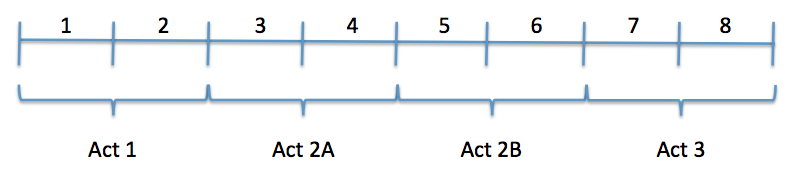
Story Sequence BreakdownFor decades filmmakers have pointed to William Shakespeare’s three-act structure for the development of motion pictures. Even noted screenwriter and teacher Syd Field was a solid proponent of the structure. But today, the Internet, television, and shortened attention spans of viewers are forcing filmmakers to shift to a new eight-sequence structure.

The new structure still holds true to the three-act form, but breaks it down into acts 1, 2A, 2B, and 3 – Each having two sequences. The story beats have stayed the same, but the structure was evenly divided to simplify productions, reduce costs and provide for future commercial breaks.

In all reality, the three-act structure will never disappear, as all stories have a beginning, middle and end. However, the middle is now split into two parts to avoid the loss of momentum in the action plotline. In the past, numerous films would die in the second act, which gave rise to the mid-point that turned the tables on the protagonist in order to regain the audience’s attention.

The further shrinkage of attention spans drove films to split each act further into what is referred to as mini-movies. Each 12-15 minute segment is given its own beginning, middle and end, while energizing the character arc and plot points to catapult the viewer into seeing the next sequence.

This format allows the audience to gain some satisfaction from minor issues being resolved in the story, while building a desire for them to watch until the entire film is resolved. In other words, the mini-resolutions reward the audience for continuing to watch for the climax of the overall story.

The new structure makes it all the more difficult for the director to generate an emotional flow with the audience and forces the use of more transitions to reset the viewers’ emotional state at the end of each sequence. This formula, if adhered to religiously, can create an unwanted pulse that alerts viewers to what’s coming next within the story. It can also pull the audience emotionally out of the story and make them feel like they’re watching a film rather than exploring an unfolding event.

The good news is that the new structure can help first time filmmakers understand a complex process in simpler terms. It may also lead to longer shorts that use a similar structure with the hope that a series of shorts can turn into a feature film after transitions are edited in.

A 10-minute short might be broken down in the following way:

ACT 1

:30 Teaser
:60 Backstory/Set-up
:30 Reluctant of Call to Action
:30 Turning Point 1

ACT 2A

:30 Intro Plot B
:60 Learn Needed Skills for Act 3
:30 All Goes Well
:30 Mid-Point

ACT 2B

:30 The Chase
:60 Mini Proxy Battle
:30 All is Lost
:30 Turning Point 2

ACT 3

:30 Regroup
:60 The Main Battle
:30 The Climax
:30 The Resolution

This type of structure works well for a story based short film rather than an image based film. It allows enough time for the director to develop the story and its main characters, causing audiences to desire a second and third viewing. It might also be combined with seven other shorts utilizing the same structure to make a feature film, although this has yet to be accomplished.

The pacing of shots and sequences has also increased due to short attention spans and the audiences’ ability to construct the missing elements in order to compete the story. This allows for further time compression and shorter scenes. In fact, the average scene length today is one page long compared to four pages in the early 70s.

Copyright © 2015 by CJ Powers

6 Ways to Make Your Film Ineffective

© Ilyes Laszlo - Fotolia.comEvery month young filmmakers who want to learn a golden nugget of information approach me. They ask for secrets of the trade that they can use to boost their filmmaking skills to the next level. But, most of the time they are not ready for a higher level of skill and need to focus instead on what not to do – those things that stop them from being successful.

I’ve decided to share a list of items that make their films ineffective. The six items are common among many young filmmakers and I hope that this list will bring new insights to bear.

1. Kill Your Dreams
It’s far easier to pull a cast and crew together and make a movie when filmmakers compromise their work. In doing so, they quickly build a team of eager friends, but soon find that compromises weaken their original concept. The short film becomes an image piece instead of a story – Something that excites others, but rarely gets a second viewing.

Having judged in many film festivals, I’ve learned that teams with selected cast and crew based on each individual’s skills made the awarded films. Compromise was limited to ideas that strengthened the story, rather than appeased people to ensure their involvement.

2. Focus on Yourself
First-time filmmakers always talk about a great idea and how he plans to make an award-winning film. The conversation is all about the filmmaker placing his mark on society, but the end result is typically a movie that doesn’t make sense to the audience because it’s void of a beginning, middle or end.

Maintaining an audience perspective allows directors to work and test the imagery of his story with those outside of his inner circle. This unbiased feedback forces more creativity and demands a visualization of the story that can be received by people who know nothing about the synopsis or the director’s original vision. To survive, the story is forced into having a beginning, middle and end.

3. Try to Keep Everyone Happy
When a filmmaker needs to please his great aunt who funded the short film, or his mother who wants to make sure his short film is respectable, or his friends demand the film is cool, the filmmaker loses his passion and creates such a watered-down story that nobody cares to watch it.

Creating a story with universal appeal that holds true to the director’s heart becomes a powerful tool of passion that captivates even the greatest skeptic. Since film is an emotional medium it is critical that the director’s passion shows up in the story. This can only happen if it is his story and not one dictated by a board of investors.

4. Make Mediocrity Your Standard
Producing the exact same kind of story over and over again brings blandness to the theater experience that is sure to reduce the audience. Never expanding the budget to include higher-quality elements within a show, or experimenting with how the story is expressed, will lead to a show that is unworthy of a second viewing.

Experimentation is at the forefront of bringing a unique story to an audience in a new and refreshing way. While audiences like something that feels familiar, they also demand something new that they’ve never seen before. Every story requires a set piece that drives the story out of mediocrity and into the spotlight.

5. Treat Every Film The Same
Filmmakers that think genre requires repetitiveness of story will likely kill second viewings and possibly future viewings. Only those living in denial will continue to put up with a director that produces the same ole thing with every release.

Audiences love to work for their entertainment. They like their thinking to be provoked, without any part of the story being handed to them on a silver platter. People want to be able to figure out what’s happening in the story just before its revealed, not during the opening act. Responding to this audience need requires a director who is willing to differentiate his titles from his previous work and his competitors.

6. Make It Obvious Who You Don’t Like
Films that preach to the proverbial choir and avoid relating to the general public will quickly deflate the film’s potential reach and life span. Making the film for such a tight niche that even like-minded people with a different vantage point can’t relate to will surely shorten the film’s release window.

Universal stories reach millions of people with a film’s specific message. The more open the film is in relating to various people or interest groups, the more powerful the message shared.

Film is a social media that is driven by emotional appeals. Any use of the medium in other capacities weakens the message and the film’s power to trigger change within its audience. By working around the above mistakes, a filmmaker can influence his ideal audience along with millions more.

Knowledge Vs. Wisdom in Screenwriting

© Pixelbliss - Fotolia.comThe audience is always amazed when a character displays wisdom, rather than just knowledge. In fact, when the main character just spews out knowledge, they become two dimensional and preachy – As seen in numerous faith-based films.

The key is to have the main character demonstrate, not preach the wisdom needed in life. This demonstration draws the audience into the story and inspires them to implement the character’s principles within their own life. To accomplish this ideal, the writer needs to understand the difference between knowledge and wisdom.

British broadcast journalist Miles Kington simply explained it when he said, “There is a difference between knowledge and wisdom. Knowledge is knowing that a tomato is a fruit, not a vegetable. Wisdom is knowing not to include it in a fruit salad.”

This topic was also discussed for decades using the perspective of book sense versus street sense. Everyone understands that learning about something and experiencing it first hand is very different. The thinking process alone and the conclusions drawn by those gaining knowledge or wisdom from a particular situation will generate significantly different outcomes depending upon his or her vantage point.

The same holds true for characters on the screen. This results in the audience buying into an argument from the character demonstrating gained wisdom versus discarding the information from a character who preaches the shared truth.

To demonstrate a character’s wisdom takes a substantial amount of time in crafting visual depictions on the screen that reveal the wisdom, while preaching characters can be written within minutes. Also, to demonstrate wisdom, it requires a director who can draw a performance out of an actor, rather than one who commands a specific performance.

Over the past few months I’ve consulted with a professional screenwriter in the Asia Pacific region for a major motion picture that will be first released in the east and then followed in the west. Since one of the media companies involved is a media ministry, the screenwriter chose to write several preaching scenes in act three.

While the knowledge expounded in the third act was accurate based on the media ministry’s beliefs, it killed the story. Thankfully, the decision-makers have agreed to a rewrite, which was a wonderful surprise – Yet, expected.

You see, the entire movie was about the main character gaining wisdom. In act one, she clearly lacks knowledge and by act two is manipulated into a poor lifestyle thanks to a dangling carrot of knowledge. But, the tables soon turn and she realizes the difference between wisdom and knowledge. By choice, she seeks wisdom and witnesses it’s impact on life, causing her to desire it all the more. But, instead of act three helping the audience to see the benefits of this newly acquired wisdom, she becomes a preacher that tells everyone knowledge.

Demonstrating wisdom causes the audience to desire a drink from the same cup that brought wisdom to bear in the first place. Knowledge is rarely accepted as a solution in any character’s life and most audiences discard it as not being proven or worth testing in his or her own life.

The key to inspiring an audience to greatness starts with a great character driven screenplay that demonstrates the wisdom gained, not the expounding of easily discarded knowledge. I find it ironic that faith-based screenwriters, who want to inspire their audience through the passing on of wisdom, choose to leave wisdom out of the stories and instead gives voice to the preaching of knowledge. Then again, it takes a significant commitment and some twenty revisions to write wisdom into screenplays and most faith-based screenwriters believe in going with one of his or her first three “God-inspired” drafts, for fear of losing the original message planted within his or her heart.

However, there is a difference between cultivating a planted message and killing it. The better the craftsman, the greater chance the message will rise to a place of understanding through demonstration to its audience. Therefore, faith-based screenwriters must learn to embrace rewrites, knowing that they will eventually get his or her writing up to the level that God actually intended. For without the demonstration, there is no reception of the message. And, even Jesus shared parables that demonstrated wisdom, rather than expounded knowledge.

Copyright © 2015 by CJ Powers