
4 Ways of Coping with Culture Shock

Here is a recent article I wrote for an India newspaper.
4 Ways of Coping with Culture ShockTravel was a large part of my career for several years. Business took me to 26 countries with many repeat trips. My lifestyle was in contrast to those I worked with overseas, but thanks to English being embraced by many cultures as a second language, I was able to function well among those that I served.

When I was a consultant for a global food company, I had a back office fulfilling my follow up work for the client. My skills were put to use in strategic endeavors and the back office team, which was located in India, handled the tactical work. We developed processes that simplified the cultural gaps and encouraged weekly conference calls to verify workloads.

It didn’t matter if I was in another country or I was working with teammates that lived outside of the United States, all situations required someone to bend their culture to meet the needs of the other. Seldom did both parties meet in the middle. The majority of the time the person in a weaker position or the person from a more passive culture adapted to the other’s philosophy.

Since that time I’ve had several associates move from India to America. They feel a little overwhelmed by the assertive people that now surround them and try to avoid those who are more aggressive. A couple of them even tried to become more bold to fit in with the strong Chicago culture, but they quickly back off when confronted.

Culture shock tends to show up when a person moves between cultures. Signs of this experience present itself in the form of sleepiness, depression, apathy, compulsive eating, negative stereotyping of nationals, and a lowered immune system.

Every traveler can overcome culture shock symptoms by focusing on four coping mechanisms.

  1. Acknowledge New Surroundings as Unique. Most new locations have a set of unique smells, sounds and sights. By acknowledging the differences as something remarkable or memorable, it can be embraced as positive. This new experience can then be viewed as an opportunity to grow and expand ones horizons beyond that of their peers or relatives.
  1. Listen and Learn about New Expressions of Feelings. The sharing of feelings differs between cultures and can appear strange or awkward until we understand the meaning behind the expressions. Being patient with others is key. By carefully asking questions to understand the sensitivities behind each expression, we can bring a new form of enlightenment to our understanding of what is really being shared behind the spoken words.
  1. Exercise and Eat Healthy. New environments tend to make us homesick for mom’s cooking, but few of us are able to take mom and her groceries on the road. Instead of wishing we could eat similar foods from our past, we can choose to see our new circumstances as an opportunity to expand our palate. Making sure we exercise daily will increase our circulation and provide us with a more discernable mindset, allowing us to become a connoisseur of fine international dining.
  1. Develop New Local Friendships. Confidence comes when we fit in to our surroundings. By developing friendships that are active within our new location, we can get involved in uplifting challenges. Activities with a new friend might include taking a class together or joining an intermural sports team. Simple short-term experiences like attending a concert, art festival or movie can create memorable moments that we cherish.

These four proactive steps empower a person to accept their new circumstances and take positive control of their life. The stability can calm our feelings and give us hope in a greater future than before we traveled.

I’ll never forget traveling to Shenzhen, China. The first night was filled with loneliness and the unknown. I was in a hotel that served familiar meals, but the moment I left the building for a walk, I found myself in a very different culture.

Walking to the right a few blocks took me into the rundown streets where the locals lived. Walking to the left from the hotel placed me in an area that was being set up for a great festival to celebrate traveling dignitaries. The contrast within a few blocks made me feel uneasy.

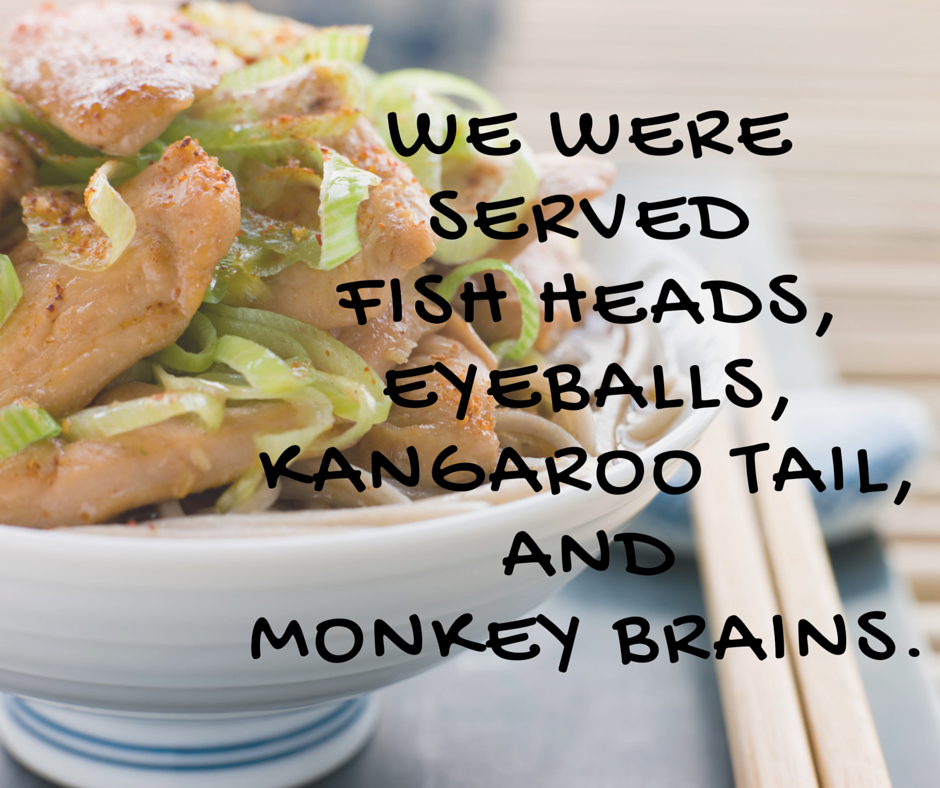
On another night, our team from America shared a dinner with our counterparts that were local to the area. The meal was not familiar and made me lose my appetite. We were served fish heads, eyeballs, kangaroo tail, and monkey brains. I couldn’t tell if I was being served delicacies or food mislabeled as a joke, but it made me feel uncomfortable.

After the meal I realized that I needed to embrace the experience as a positive one, so I started asking the nationals about their language. It was based on pictures and had changed three times over the centuries. The one man was curious, so he drew words and had me guess what they were.

He shared simple words like restroom, bus, man, woman and other things a person might see daily. I got 100% of the words correct from the original language, but I only got 50% of the new language right. He was amazed at how well I did and then poured out his frustration about how the new generation makes it difficult for the older generation to communicate.

In that moment we connected. A new friendship formed from our joint understanding and experience. By acknowledging my surroundings as unique, asking the man questions that allowed him to share his feelings, we developed a friendship that made me feel liked I belonged.

The rest of the trip was a blessing because my fears and loneliness had vanished. I had found a way to cope in my new circumstances that allowed me to function fully. I was now more a part of their culture than my uninterested co-workers.

These simple coping mechanisms allowed me to thrive in the new environment, while those who didn’t adjust suffered. On the last day of the trip it was hard leaving my new friends, but my peers couldn’t wait to get home.

I had risen above the culture shock and took great stories home to share with my friends and family. My associates on the other hand, took little more than a few souvenirs back and soon forgot about the great experiences we shared in China.

Inspiring Leaders Develop 3 Easter Eggs of Success

© apops - Fotolia.comMy son gave a great talk at a large conference of social web developers. While the talk didn’t come together until a few days before his presentation, it was extremely well received and life changing for the participants. Others also grew by watching his talk on the web weeks later.

When Chris explained how he put his talk together, I realized that he followed the Dale Carnegie method of preparation. Carnegie was a leader who felt it was important to be constantly learning and growing, so as to always be prepared for any opportunity to speak. Carnegie had a large reservoir of information he could draw from at any point in time to give a great talk.

Chris prepared by gathering known information from within his own reservoir, organized it and personalized it for his audience. While it only took a few days to “create” his talk, Chris had taken months in preparing the information – A task he takes for granted.

I wanted to learn how the talk went so I asked him a few questions. Chris immediately suggested that his talk was successful for three reasons. It just so happens that he listed the same three Easter eggs of success that inspiring leaders take time to develop.

1. DEVELOP TRUST

Inspiring leaders are authentic. They address their employees from a point of reality, even when casting a vision for the company’s future. This creates a level of hope within each employee, as they comprehend how things could work and understand their role in making it happen. To support this new hope, inspiring leaders invite participation from every employee.

The results are products and services that each employee thinks and feels is in place because of their part in the process, yet no one is able to separate out their portion from the whole. The item also becomes a symbol of trust that each employee placed in the inspiring leader to see the vision come to fruition.

2. DEVELOP PERFORMANCE

Building trust is simplified when the inspiring leader sells the benefit of the process to each employee. The newly agreed upon benefit also drives the employees to higher levels of performance. This is especially true when the atmosphere is one of curiosity and play, rather than pressure and deadlines.

The strong inspiring leader is able to navigate a course of action based on quick but calculated decisions, the established process being an adventure for the team to explore together, and a playful time of creative exercise. All of which raises the bar of outstanding performance among peers.

3. DEVELOP EMPLOYEES

Developing employees over time is the most practical of activities that inspiring leaders engage in. The reinforcing of the employee’s optimism is critical to the company’s long-term success. Related by perspective is the opportunity to turn all failures into educational experiences, especially when coupled with a focus on igniting the enthusiastic potential within each worker.

This emphasis on individuals encourages confidence of character and voice. Self-assurance becomes the very driver that turns standard employees into the gifted. Without the employees, the company has no future potential and will eventually be overtaken by the next big thing.

Inspiring leaders build trust by focusing on their resources. They also work to refine their abilities and seek to promote the best in others. When evaluating the gifts, skills and talents of their team, they work hard to draw out a higher level of performance than what the worker thought was innately possible.

Copyright © 2015 by CJ Powers

Box Office Mendoza Line

Mendoza Trading CardMany times critics and filmmakers argue about the quality of a film’s content or message against its story. Star power and a filmmaker’s ability to draw in an audience also factor into arguments about what makes a film successful. But, one factor stands the test of time and survives all arguments about the monetary success of a film: the box office Mendoza line.

Named after baseball’s Mario Mendoza, whose mediocre batting average defined the threshold for incompetent hitting, the box office marks the threshold when theaters drop titles from its screens for the next best opportunity to make money.

The moment a film drops below a per screen average of $2,000 per weekend, it’s no longer viable as a money making device. This amount has stood the test of time based on competitive new releases, negotiated house nuts and the duration of marketing budgets.

When a film crosses the Mendoza line distributors stop promoting the film in order to cut its potential losses and replace it with new selections. Films that fail to rise above the Mendoza line rarely survive past the second week in theaters, as numerous films fight for the few open screens during each release period.

This is partially due to distributors not wanting to lose a screen to a competitor and desiring to manage risk mitigation on the film’s current margins. Theaters also need to maintain a certain level of revenue stream in order to protect its house nut (its negotiated take on concessions).

While the exit strategy on films typically cause titles to have a long distribution tail, very little revenue is generated during this period. Most films only make 5-10% more unless it’s in a light distribution window that can generate an additional15%.

Analysts that estimate each film’s market potential and weekend predictions, use additional tools that determine expected thresholds of a film’s longevity. For instance, prior to making adjustments based on the impact of social media, all films will make 50% of its opening during its second weekend. The third weekend will make 50% of the second weekend’s box office and so on.

However, advertising and social media directly impact the percentage. The alterations can change the percentage from 50% to 35-55%. The addition or dropping of screens due to contract changes or regional performance success can also impact the percentage by a plus or minus 30-45%. While these sound like huge swings, an analyst who has tracked the market for two years can easily estimate within a plus or minus 5% of accuracy.

Analysts do take into account outliers and transitions within sub-genres, which paint clear pictures of market trends. This gives production and acquisition departments a leg up when determining future investments and expansion.

Production companies also benefit from understanding and tracking the Mendoza line. Any picture that never rises above it or falls too quickly below it either has too few super-fans or has a story that didn’t connect on a universal basis. In a fragmented market that’s filled with social media, a film only needs 1,000 super-fans (or influential fans) to succeed.

The combination of factors that keep a film above the Mendoza line for numerous weeks includes a great story, influential super-fans, star power and provocative social media. Writer/directors have also become a factor over the past ten years, but are still considered new to the promotional cycle.

Copyright © 2015 by CJ Powers