

Directors Pull in Summer Audiences

popcorn-movie-party-entertainmentDecades ago the major studios drew audiences to the silver screen with big extravagant pictures. A few decades later movie stars became the biggest drawing card to pack out film houses. But recently we’ve seen a shift to a new role that is drawing in millions to the box office—the director.

The audience is no longer willing to sit through a star driven movie just because their favorite actor plays a role in the film. Over the past few years, films that had Bruce Willis in its trailer or on the one sheet poster disappointed many. Why? Because the films weren’t really Bruce Willis type films. He was just in the movies for a paycheck.

This summer we saw a lot of film actors fail to deliver audiences to theaters like Scarlett Johansson’s Ghost in the Shell and Rough Night, Tom Cruise’s The Mummy, Charlie Hunnam’s King Arthur, and Johnny Depp’s Pirates of the Caribbean: Dead Men Tell No Tales.

But it was the directors that brought the solid draw as social media buzz surrounded the filmmakers, not the stars. The successful films used lesser-known actors in leading roles under the guidance of strongly directed vision. The box office successes included Jordan Peele’s Get Out, Edgar Wright’s Baby Driver, Christopher Nolan’s Dunkirk, Jon Watts’ Spider-Man: Homecoming, and Patty Jenkins’ Wonder Woman.

Tom Rothman, chairman of Sony Pictures Entertainment Motion Picture Group told Variety, “To be theatrical, you need to be distinctive now. That’s what Spider-Man and Baby Driver have in common. Even though they are as different as night and day, the audience can feel both are distinctive, and so theater-worthy.”

Director Alex Kendrick, of the faith-based Kendrick Brothers, has carved out a niche for himself that draws in enough audience to generate about $60MM every time he releases a film. While Sony has rarely understood how he does it, they have acknowledged his distinctive films. In fact, there have been many who have tried to follow in Alex and Stephen’s footsteps, but all have failed to replicate their distinctive style.

One of the reasons I study a lot of film is to make sure I create something that hasn’t been done before. A director’s style coupled with his writer, DP and Production Designer choice makes for a uniqueness that is seldom replicated. The heart and soul of his vision must come through in order to create a successful title that will storm the box office.

There will never be another Christopher Nolan or Alex Kendrick, no matter how often a budding filmmaker suggests he offers a similar style.

I’ll never forget listening to an interview with Phil Vischer, of Veggie Tales fame, before he became famous. In the interview he was likened to Walt Disney, which surprised me since I was familiar with both artists. The two were highly creative and did the voices for their primary animated characters, but their styles and audiences were very different.

The thing I remember most about the interview was how quickly Phil’s distinctive style was getting lost behind the Disney name. Don Bluth, known for The Secret of NIMH, had the same problem differentiating himself from Disney. It takes a strong director to carve out a niche for his own style that is memorable and draws an audience to the box office.

So who’s your favorite director?

© 2017 by CJ Powers

Facebook Hackers Attack

FacebookBy now you’ve noticed that my personal Facebook profile no longer exists. That means I’m no longer able to communicate back and forth with you in Facebook. Why?—Because my profile was hacked and then deactivated.

My blog and books generated about 6-40 new “friends” a week, but suddenly jumped to 100-300 and then to 500 daily until I hit the 5,000 friend cap. The growing number of new friends attracted the unscrupulous who sneaked in. One person even figured out my password and removed me from managing my page.

But now, if you’re reading this post in Facebook, you found my professional page and either liked it or I transferred you as an initial like. The number of likes will drop in the first few days as some will unlike the page. And, some who wanted to communicate with me will have to hang in there for a bit before I reopen communications with “friends.”

If you want to like my new hack free page on Facebook you can search for me in Facebook with the following: @cjpowersppi

Or, you can use the URL: http://facebook.com/cjpowersppi/

I’ll get back to my postings in the near future, after resting up from the 48-hour hacker battle I endured.


Creative Child’s Game Simplifies Value Decisions

How to Assign Value to Disparate Projects for Equal Consideration

Have you ever wanted to know which project to start next? Did you get frustrated comparing unrelated activities in an attempt to determine which provided the greatest value? The solution is as simple as a child’s game.

No, I’m not talking about a Six Sigma Pugh Concept Matrix to determine which potential alternative solution can more quickly and easily be engineered into a viable product for just-in-time manufacturing.

I’m talking about a simple game that boutique tech businesses use to prioritize projects by overall value.

It’s called a weighted decision matrix and its fun to use.

Picture a simple table with the name of the projects listed down the far left column. Across the top of each column is the criteria that you’ll use to measure a projects overall value. Where each project and column intersects are the letters H, M, and L. The far right column holds the total of the criteria scores for each project.

Slide1

STEP ONE:

Name each project in the first column. Name the criteria being considered at the top of each column.

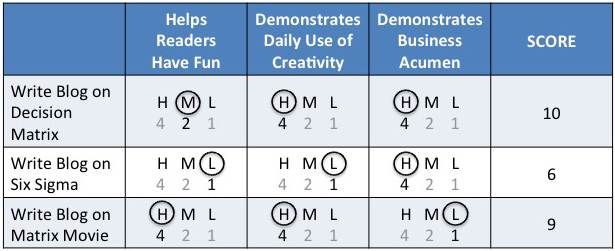
The H M and L represent the importance level of the criteria for the project—giving it a high, medium or low level of importance for each particular criterion. Circle the level of importance that each project holds based on the given criteria.

Slide2


STEP TWO:

Give a value to each H, M and L. With less complex decisions I use the following values: H=4, M=2, and L=1. If the decision is more complex I use: H=9, M=3, and L=1. Then total the score by adding the values from each cell. The decision is obvious—I need to write a blog on Decision Matrix (see below table).

Slide3


But many times life is not so simple because some criteria are more important than others, which requires some form of weighting.

STEP THREE:

When criteria are not equal, a numeric value must be attached that will work as a multiplier. I use a 5-point scale to make sure each criteria receives its due credit or strength in the formula. However, when sorting through a large number of projects, I switch to a 10-point scale in order to pick up on the value of subtle nuances for each criterion.

In the below table I’ve given each criteria a numerical value. In the first cell the M was circled and is valued as a 2. I then multiply it with the weighted criterion value of 4 and get a new total cell value of 8. Each cell is added together for a total score of 40.

Slide4

The weighting has clarified what’s more important and shifted the score to a tie. In this case I would’ve been better off using the larger spread of values: H=9, M=3, and L=1 as in the below table. However, the scoring is so close that the decision of what blog to write had an original score of 10, shifted to a tie, followed by coming in second place (see below table).

Slide5

Here’s where the game gets tricky. You have to be totally honest with yourself whenever assigning values to what’s important. Deciding between H, M, L is pretty easy, but the choice is more difficult with a 5-point criteria value—even more tricky with a 10-point value.

In the table below I changed the weighted amount for the third criterion from 3 to 4. Why? Well, since most of my readers run families, small businesses and departments, I thought the category should hold a higher level of importance.

Slide6

Now look at what happened to the scores. The numbers made the decision very clear, but only because I was being truthful about the third column’s actual value of importance.

WARNING: As in all games that use numbers, a person can cheat to make things read anyway they want, which defeats the purpose of playing.

STEP 1A:

It’s important to use only the criteria that are truly important to a project. Extra criteria that’s not seriously weighted only complicates your decision making process.

If you’re an artist, consider some of these criteria:

• Passion Zone
• Stretch Comfort Levels
• Gain Knowledge
• Generate Money
• Advance Career
• Network Expansion
• Develop Skills
• Touch Lives
• Build Relationships
• Fun & Games

The above factors can all impact a decision for an artist deciding whether or not he or she is interested in signing on to a film project. Sometimes it’s worth doing if it expands your network or you can learn something significant from the experience. Other times making money is the number one weighted factor.

In business, other criteria might be considered like:

• Meets Objectives
• Forwards Career
• Meets Boss’ Bonus Requirements
• Generates Commission
• Creates Double Digit Growth

The above list can go on and on, but the idea is sound. Figuring out what criteria is important for the projects being considered helps change the decision from an aggravating dilemma to a child’s game that’s easy to solve with a quick hand written table or spreadsheet.

Members of different departments that make up a special team can also play this game. Each can add a few criteria to the table to make sure their area of expertise is well considered by the decision maker.

The biggest decision I faced was sorting through 11 projects with 32 criteria. Thankfully it was on an automated spreadsheet and the answers were quick and sound.

Let me know what other games or tools you use to decide which project should be next.

© 2017 by CJ Powers