
Set Pieces are the Latest Movie Tool

Gaffers, Best Boys and Set Pieces are terms unique to the film industry. Over the decades we learned that a Gaffer is the Chief Lighting Director or the Head Electrician, and a Best Boy is an assistant to either the Chief Electrician or the Key Grip (Head of the Grip department). But “Set Pieces,” we thought were a piece of stage scenery.

Set pieces are scenes that are designed to have an obvious imposing effect on the audience. They are the scenes in a film that are ideal for trailers. They are also the scenes that stand out and say this film is unique and special. When done correctly, they are the scenes that everyone remembers and creates a buzz about, driving more people to the movie.

Just about every movie is made up of Shakespeare’s three-act structure. Because films tended to die in the long second act, which is about half the length of a typical film, screenwriters split the second act into two segments: 2A and 2B. This was a natural decision as directors constantly wanted to do something special at the midpoint in the film.

Getting an entire industry to split the second act and use four segments within every film wasn’t difficult since the industry was used to films being delivered in eight 20-minute reels. These 20-minute reels had long ago driven stories to flow in sequences due to the projectionists having to physically change reels.

While the three-act structure is now written in four segments, each including two sequences, the responsibility is on the screenwriter to make sure the format doesn’t make the story boring. Thus, set pieces entered the picture.

Movies require a minimum of three set pieces to capture the audience. Some use four due to the split second act, while others try to have one set piece in every sequence. Today, there doesn’t seem to be any preset requirement due to the ever-changing variety of set pieces, level of creativity, and amount of budget.

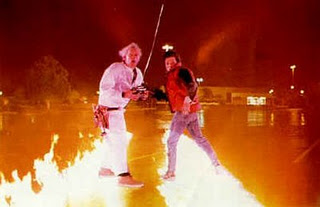
A strong set piece lasts the test of time. Many will remember the light saber battle between Darth and Obi-wan Kenobi. Another iconic set piece was the scene where Indiana Jones runs away from the giant boulder. I’ll never forget the DeLorean racing across the wet mall parking lot and seeing it vanish into a pair of fire trails in Back to the Future.

Set pieces distinguish a film and drive the buzz that skyrockets a title to success. Unfortunately, few screenwriters create such scenes, as it takes a significant amount of time to develop and a vast amount of creativity. For these various reasons, spec scriptwriters rarely write iconic set pieces. However, when they do, numerous contracts follow – Something every screenwriter should consider.


Copyright © 2011 By CJ Powers

Elements of a Great Pitch

I had an opportunity to successfully pitch a story concept to a producer a couple weeks ago. He was excited about the project based on how I shared the story and told me to contact my attorney to close our deal.

A few days later, I had a writer pitch me a story concept in hopes of getting me to collaborate on her screenplay, but her pitch left me without any desire to read her script. The project died before it could be launched, all because she didn’t understand the key elements in a pitch.

Pitching a story requires three key elements:

1. A unique idea or concept.
2. A marketable story.
3. Great story telling.

The unique idea is very difficult to accomplish in this day and age when studio marketers want something familiar, but different. They immediately reject the same ole thing and the totally new thing. They are looking for something familiar so they know how to market it, with enough of a twist to spur on interest from the potential audience.

The marketable story must be relevant and cutting edge. It needs to be something visual, yet touching. It must satisfy the niche markets, while being universal enough to reach the masses. In other words, it has to hit what the market manager might be thinking at the time, or you have to convince him that your story will set a new trend in motion.

If by some chance you master the first two abilities, the story is the last thing that will make or break your pitch. The great pitches always include the following:

Create a Connection
People want to work with great relationships that are built by people persons. The energy that comes from a positive collaborator is essential to your story’s success. The pitch session is the time and place to be the person that your friends like, not the cold businessperson you may need to be during negotiations.

Showing a sincere interest in the person you’re meeting with will go a long way, especially if you take the time to listen to what he has to say about your story. All too often the person is so much into telling their story that they don’t notice that making a simple tweak would land them a deal. In other words, get them to want to do business with you, but be real in the process. Phonies are easily spotted in Hollywood.

Charismatic Magnetism
Share your story as if you’re really into it. Help him to visualize the scenes as you express them. Tell the story dramatically when you’re at a dramatic point in your story, and make it humorous when you share the comedic bits. Be an entertainer and see if you don’t get applause and a contract.

Set-Up the Story
Tell the producer what makes your story great. Explain when and how you came up with the story, as the heart behind the story will add to its value. In fact, if you can share the genesis of your story, while showing how it’s grounded in reality, you will surely grab his attention. And, no matter what, make sure he understands why its relevant.

Introduce Your Characters
Share enough about your characters so the producer gets a feel for who they are. Let him become their buddies and learn how to care about them. Then, turn up the story with plenty of jeopardy so he needs to hear every bit of your story to be satisfied.

These key elements will make your pitch session a success. However, one simple caution always applies: Don’t get nervous. Now, of course you’ll get nervous, so make sure you take enough time to get to know everyone in the room and help them to get to know you before you dive into your story.

Being real and relaxed are still the two greatest tools you have on your side. Producers and studio executives deal with fake all day and long for those real down to earth conversations and stories. So, just be yourself and have fun telling the story you know all too well.

The Football Coach — A Story of Hand Holding

Here is an excerpt from a talk I gave years ago titled, The Businessman and His Teen Age Daughter.

The big season was about to start. Football fever was in the air. My associates started whispering around every corner about our boss’ latest fantasy football fetish. He was trying to recruit all the managers to join in the pool at fifty dollars a crack.

I turned his request down for a real football experience on an actual game field with a 75-lb. peewee football team. I was the new coach, up for the challenge, and proud of it. My objective was simple: Win five key games and take the team to the play-offs.

After verifying my strategies with my couch-potato football associates, I reviewed my materials for the first day of practice. My overall plan was to instill discipline from day one, followed by gradually reducing the pressure every time the team demonstrated positive skill development. My plan was fool proof and received the praise of all my macho friends.

As I finished loading the football gear into the trunk, my teenage daughter wanted to talk with me. I winced at her request to join me at practice. After all, having a girl at a man’s practice, well, a little boy’s practice wasn’t proper. Then came the guilt trip about spending enough time with her. She had me convinced I was spending more time with the football team than with her, and we hadn’t even had the first day of practice.

I gave her specific instructions as we drove to the field. She needed to clearly understand my expectations so I’d be free to coach. I wasn’t going to be on the field to baby-sit her. I was a coach and going to lead a winning team to victory.

Practice started well and the kids were obeying my every instruction. They wanted to win and were working very hard to earn the right to win. While the assistant coaches were working defensive drills, I needed to cross the field and talk with the league president. My daughter asked is she could join me and I agreed.

On our return, my daughter reached out her hand to take mine. This was a very awkward moment for me. I didn’t want my players to see their coach do something “sissy” on the football field. I also knew that if I pulled my hand away from her, I would be pulling a part of me out of her life and possibly loose the opportunity to get that part of our relationship back.

I swallowed hard, felt awkward and continued walking hand in hand. Suddenly a football got away from one of the boys and rolled nearby. It was my opportunity to let go of her hand and quickly “help” the boy by passing back the ball.

Then it hit me. My macho attitude was alienating my precious child from my life. I was allowing what I perceived as coolness to determine my future with her. I also realized that she soon would have the same choice to make about her potentially un-cool dad.

I grappled with the fact that this situation was only a symptom of a much deeper issue. I could sense that it was starring me dead in the face and I couldn’t see it. Nor did I have a clue of what I needed to do about it.

My lack of insight was depressing. Some how, after years of raising three kids, I felt like my skills we tiny like a mustard seed compared to my giant redwood tree sized business skills. It was clear I had a major weakness that needed to be overcome. Or, at least covered with one of my business strengths until I had time to develop the proper skills and knowledge that I lacked.

That’s when it dawned on me, I was responding intuitively to the situation based on my business prowess. I immediately ran a “what if” scenario through my mind. What if I approach my daughter and her need for a good relationship with me as a business deal – could it work? While I was uncomfortable about the concept, I realized it might be enough to steady our relationship until I could learn to be the dad she needed.

I quickly accessed the tools I’d need to pull it off. I decided my calendar, personal mission statement, cell phone, and computer would all come in handy. It was now time to plot the strategy.

Just as I planned out the football season, it was time to make plans for my new growing relationship with my daughter. The goal was clear: to feel comfortable being with my daughter in any circumstance. Putting the goal into objective measurable terms, so I’d know when I achieved it, was the next step.

In this case it was easy. My goal would be met when I could hold my daughters hand anytime or in any place that she wants to hold my hand. Once achieved, an obvious follow-up goal would include my initiating the hand holding with her. But, I’d start with an easy win to set myself up for a few successes in the beginning of this mission-critical venture.

I was going to be a great dad, even if I had to use my business skills to get there.

Copyright © 2011 By CJ Powers
Photo © Maridav