
A Gig of Conversations: Lessons from Bob Schmidgall

Bob Schmidgall was one of the most incredible speakers I’ve ever heard. I admired his ability to connect with people and studied him often. One of his greatest strengths was speaking in a way that reached blue-collar, white-collar, and gold-collar workers—all at once. Each listener walked away believing Bob was speaking directly to them.

If you haven’t heard those terms, they’re general categories of labor:

  • Blue Collar: Manual laborers and skilled tradespeople.
  • White Collar: Office and professional workers.
  • Gold Collar: Highly skilled and valued specialists, often in cutting-edge fields like AI.

When Bob made a key point, he often shared it three times. But he never sounded repetitive. Instead, each sentence was crafted for a different group. He wasn’t restating; he was expounding—layering meaning so each person heard it in a way they could relate to.

The result? Everyone left the room feeling as though his talk was written just for them. He was relatable, informative, humorous, and full of great stories. Out of the hundreds of speakers I’ve listened to, Bob remains in my top five.

At some point, I realized something important: no amount of study would turn me into Bob. But that wasn’t the point. Bob had his gift. What I needed to see was that all of us actually speak far more than he ever did. Over a lifetime, we will likely have the equivalent of a gigabyte of conversations—not just spoken words, but emails, texts, social DMs, and even old-fashioned snail mail.

Each exchange adds another “file” to our personal archive. Some are blurry images best deleted, but others are crisp, high-resolution moments worth revisiting.

And that leads to the real question: if you’re going to spend that much time talking, typing, and connecting—why not upgrade your conversations so they actually build trust, opportunity, and collaboration?

Here are five simple Conversation Upgrades I’ve found that can transform ordinary chatter into meaningful dialogue.

Upgrade 1: Curiosity Beats Cleverness

Instead of prepping stories to tell, prepare questions to ask. Dale Carnegie put it best: “You can make more friends in two months by becoming interested in other people than in two years by trying to get other people interested in you” (How to Win Friends and Influence People).

A practical way to stay curious? Think about their Family, Work, Recreation, and Dreams (the F-W-R-D framework). Ask about their kids’ hobbies, the wildest thing that happened at work this month, the new restaurant they tried, or the goal that lights them up. When you anticipate their story, you can’t help but lean in—and that anticipation is contagious.

Upgrade 2: Turn on Charisma Mode

Charisma isn’t some magic dust—it’s built from presence, warmth, and confidence. Olivia Fox Cabane (The Charisma Myth) shows how teachable this is.

  • Presence: Give someone the sense that there’s nowhere else you’d rather be.
  • Warmth: Try the “flooding smile”—pause, take them in, then let a genuine smile slowly spread. It feels personal, not pasted on.
  • Confidence: Strong posture and a few thoughtful pauses tell the room you’re comfortable in your own skin.

When those three align, people don’t just hear your words—they feel your attention.

Upgrade 3: Add a Twist of Surprise

Boring conversations fade. Playful ones stick. Instead of standard answers, toss in a curveball:

  • Instead of “I’m from Chicago,” say: “I’m from Chicago, where pizza is deep enough to need a lifeguard.”
  • Instead of “I’m a consultant,” say: “I’m a consultant who’s learned more from coffee spills in boardrooms than from MBA textbooks.”

It’s not about impressing—it’s about giving others something fun to react to, like setting up the first line of an improv scene.

Upgrade 4: Ask for Feelings, Not Just Facts

Charles Duhigg’s Supercommunicators highlights a Harvard study of speed dating conversations: the people who landed second dates asked emotion-driven questions, not fact-gathering ones.

Swap:

  • “Where are you from?” → “What do you love most about your hometown?”
  • “What do you do?” → “What makes your work exciting—or exhausting?”
  • “What did you do this weekend?” → “What was the highlight of your weekend?”

By aiming for Dreams, Elevated moments, and Passions (D-E-P), you’ll unlock stories that reveal what matters most. That’s the difference between polite small talk and real connection.

Upgrade 5: Let People Know They Landed

Everyone wants to feel heard. Psychiatrist Mark Goulston (Just Listen) says even small acknowledgments—nodding, “mm-hmms,” or paraphrasing—make a huge impact.

When someone shares, don’t just reply with “Wow, that’s crazy.” Echo a detail that mattered: “That’s hilarious—after all that effort, the IKEA shelf was upside down the whole time.”

It signals: I didn’t just hear you. I understood you. That’s the glue of collaboration.

Why These Upgrades Matter

Each “conversation upgrade” builds on the 3Cs framework that I’ve developed:

  • Communication: Clearer, warmer, and more engaging.
  • Connection: Deeper emotional resonance—because you’re asking what really matters.
  • Collaboration: When people feel seen and valued, they bring their best ideas to the table.

Conversations aren’t background noise—they’re the raw material of relationships. And when you upgrade them, you upgrade your influence, your opportunities, and your impact.

It’s Time to Upgrade

You’ve got a gig of conversations ahead. Most people will let theirs auto-save in the background. But you? You can choose to upgrade yours—turning them into meaningful files worth archiving.

Start small: one curious question, one genuine smile, one playful twist. Then watch how fast your communication, connection, and collaboration grow.

Copyright 2025 by CJ Powers
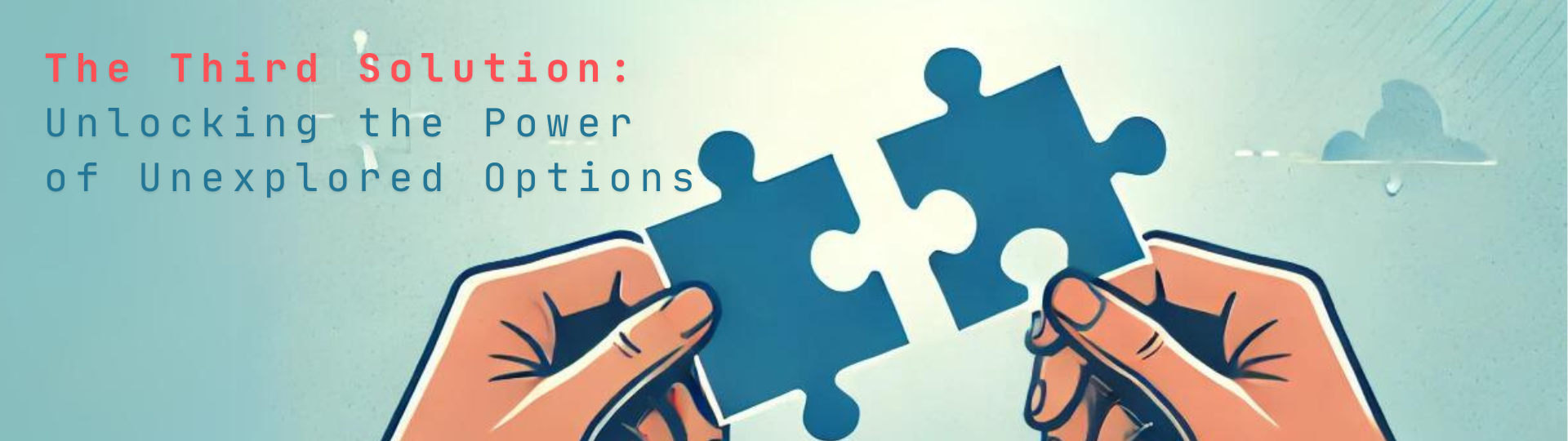
The Third Solution: Unlocking the Power of Unexplored Options

Have you ever run out of options, or so you thought, only to realize there were unexplored possibilities just beyond your perspective?

I remember a time during my marriage when we found ourselves in a stalemate over an important decision. We were both convinced that we were right, and it seemed like there was no way forward. It was in that moment of frustration that we discovered something important—each of us held just one small piece of the puzzle, a one-percent perspective that could lead us to a solution. It wasn’t much, but it was a start.

We made a commitment to each other that whenever we were at an impasse, we would set aside our need to be right and instead work together to find a third solution—or maybe even more. We decided to search out as many unexplored options as we could in a short period of time, allowing new insights to emerge that would help us move forward.

This simple decision became a powerful tool that transformed the way we approached disagreements.

What we learned along the way was that there were three essential steps to finding unbiased answers: communication, connection, and collaboration.

Communication: The Foundation of Understanding

The first step was communication. But it wasn’t just about talking—it was about truly listening to each other. We had to move beyond merely exchanging words and instead focus on understanding the deeper reasons behind each other’s perspectives. This kind of communication required patience, empathy, and a willingness to be vulnerable.

I remember one particular disagreement where I was convinced that my solution was the only viable option. It wasn’t until I paused and really listened to my partner that I began to understand the “why” behind their point of view. They weren’t just disagreeing for the sake of it; they had real concerns and motivations that I hadn’t fully appreciated. By listening without judgment, I was able to see things from their perspective, and suddenly, new possibilities emerged.

Communication became the cornerstone of our solution-seeking process. It created a space where we could share ideas openly, without fear of dismissal or criticism. By building a foundation of trust, we were able to move past our initial positions and explore options that we never would have considered on our own.

Connection: Bonding Through the Exploration Process

The next step was connection. As we communicated more effectively, we found ourselves growing closer. The process of exploring different perspectives wasn’t just about finding a solution—it was also about understanding each other on a deeper level. We began to see each other’s values, motivations, and desires more clearly, and this understanding brought us closer together.

I remember how, during one particularly difficult decision, we spent hours talking through different possibilities. It wasn’t easy, and there were moments when we both wanted to give up. But as we kept pushing forward, something unexpected happened—we began to feel more connected. The act of working together to find a solution became a bonding experience.

It wasn’t just about resolving the disagreement; it was about building a stronger relationship in the process.

This kind of connection can happen in any relationship, whether it’s with a partner, a friend, or a colleague. When you approach challenges with openness and a willingness to connect, you invite others into a meaningful partnership. The journey of finding unexplored options becomes an opportunity to foster trust, empathy, and genuine camaraderie.

Collaboration: Focusing on Each Other’s Needs

The final step was collaboration. True collaboration required us to set aside our personal biases and focus on each other’s needs. This was often the hardest part because it meant letting go of our own agendas and prioritizing the well-being of the other person. But when we did this—when we genuinely focused on giving each other the gift of seeing their needs met in the final decision—something amazing happened.

By prioritizing each other’s needs, we created a more balanced and empathetic approach to problem-solving. It wasn’t about winning or losing; it was about finding a solution that worked for both of us. This selfless focus prevented our biases from resurfacing and allowed us to work towards a mutually satisfying outcome.

I remember one discussion that gave us a spin. The more we focused on each other’s ideas, the more we realized our personal ideas were off the mark. We learned that when we collaborated with the intention of meeting each other’s needs, we unlocked creative solutions that neither of us could have come up with on our own.

One of the most powerful lessons we learned was that the best answers often didn’t look anything like our initial ideas. Our first choices were limited by our narrow perspectives, but by working together, we were able to discover unexplored options that were far better than anything we had considered before. It was a reminder that we could achieve far more together than we could alone.

Simple Steps—Hard Execution—Rewarding Solution

I don’t want to give the impression that this process was easy—it wasn’t. Both of us had to purpose in our hearts that we truly wanted the best for each other, even when it was difficult. There were times when we said we were willing to explore new possibilities, but deep down, we were still holding onto our own agendas. It was only when we were honest with ourselves and each other that we were able to move forward.

But when we did the work—when we communicated openly, connected deeply, and collaborated selflessly—we always ended up far happier with the results than we ever would have been with our original solutions.

The journey of exploring communication, connection, and collaboration is one that requires dedication and a genuine willingness to grow together. It’s about opening up to new ideas, valuing the needs of others, and working side by side to create solutions that elevate everyone involved.

When we approach challenges with this mindset, we not only find better answers—we build stronger relationships and discover the true power of partnership.

Copyright © 2024 by CJ Powers

The Power of Connection, Communication, and Collaboration

I was chatting with a man recently whose Dad was a good friend of one of my Dad’s friends. We suddenly had a connection. This connection engaged us in an effortless conversation where we were encouraged and had fun. Our laughter and shared stories got us thinking about exploring some form of future collaboration.

That perfect 20-minute moment lifted our spirits. I realized our ability to connect, communicate, and collaborate with those around us has never been more crucial. Whether you’re leading a team, navigating relationships, or building a personal brand, these three pillars form the foundation for success.

Connection: Empowers Communication

Connection is the first step in any meaningful relationship. It’s about finding common ground, understanding others, and fostering trust. A genuine connection breaks barriers, drops assumptions, and allows for open communication and deeper collaboration.

As Brené Brown put it: 

Connection is why we’re here; it is what gives purpose and meaning to our lives.”

Without connection, we’re left with shallow interactions, and we watch our opportunities to grow personally and professionally slip through our fingers. Worse yet, without continuous growth in this area, we disconnect from the community and become lonely while surrounded by many people with valuable experiences and life-rich stories.

Communication: Brings People Together

Once a connection is established, communication is the tool that keeps the relationship alive. Good communication involves active listening, expressing ideas clearly, and ensuring that both parties are on the same page. Without this clarity, misunderstandings arise, leading to frustration and missed opportunities.

George Bernard Shaw wisely said: 

“The single biggest problem in communication is the illusion that it has taken place.”

In a recent speaking engagement, I discussed my definition of inadequate communication. Simply put, bad communication is a disconnect in understanding while we believe we are understood.

Effective communication is the bridge between confusion and clarity. It ensures that everyone involved understands the expectations and outcomes. It’s a two-way street, not a one-way road.

Collaboration: The Power of Collective Effort

Collaboration is where connection and communication come together to create powerful results. It’s the understanding that two heads are better than one. When people pool their resources, skills, and ideas, they can achieve more than any individual could.

People have always been able to do more in groups than individually. Even Taylor Swift will tell you that stars are only as good as their fans drive them to be. Without her fans, Swift would be another sweet girl enjoying her music under a star-filled sky on a breezy summer night with a few friends.

However, collaborating with her fans has changed the music and movie industries.

Swift has frequently spoken about her fans’ vital role in her career, often crediting them for empowering her to make significant changes in the music industry. One notable example is her Eras Tour, which became a powerful demonstration of how music can unite people and create a shared experience.

Swift has used her platform to advocate for better artist rights, empowered by her fanbase. This collaboration between Swift and her fans played a vital role in her fight for artists to own their work, as seen in her decision to re-record her albums.

This mutual support has allowed her to challenge the status quo and shape the music industry. True success lies in working with others.

Why These Three Elements Matter

No matter what aspect of our life (work, home, or community life), connection, communication, and collaboration create a foundation for stronger relationships and better outcomes. By mastering these skills, we set ourselves up for success in every area of life.

So, the next time you find yourself navigating a challenge or an opportunity, ask yourself: 

— Am I truly connecting with those around me?

— Am I communicating clearly and openly?

— Am I fostering collaboration to achieve the best possible results?

Master these three elements, and you’ll be on your way to unlocking new levels of personal and professional growth.

Copyright © 2024 by CJ Powers